A practical guide to growing mushrooms in IndiaA joint educational initiative by MushroomWale & DMR Solan
MushroomFarming.in

A joint educational initiative by

MushroomWale.com
ICAR–Directorate of Mushroom Research, Solan logoICAR–DMRSolan

New reference section · Crop health

Understand the problem.
Protect the next crop.

A mushroom disease library for growers: recognise clues, compare lookalikes and work out what to check next.

Start with your crop or an observation. Every guide separates possible causes, immediate precautions, prevention and the evidence needed for confirmation.

48problem guides14crop groups48source records
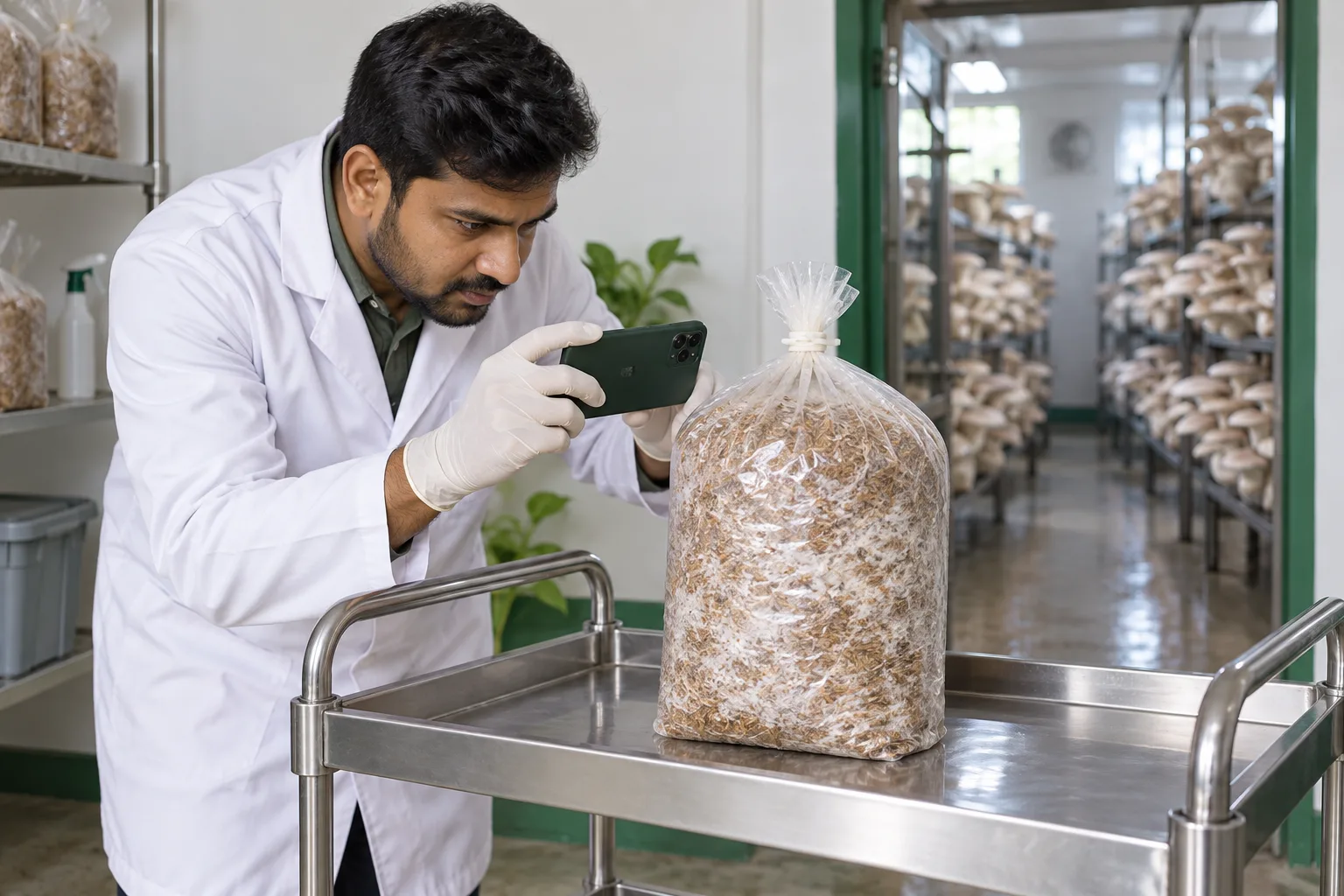
Illustrated grower photographing a closed mushroom substrate bag without opening it.
AI-generated teaching illustration · not a diagnostic photographObserve first. Photograph through the intact bag; do not open suspect material inside clean production.

Start with a picture

Where do you notice the change?

Choose the part of the growing system you want to understand. These are labelled teaching drawings, not a photo-diagnosis tool.

Start with the host

Which mushroom are you growing?

A problem reported in button mushrooms does not automatically apply to oyster, milky or a specialty crop. Each crop page explains what evidence is available and what is only a shared production risk.

The condition directory

What changed in the crop?

Try “green”, “brown”, “flies”, “wet”, “no pins”, “virus” or a scientific name. A crop filter includes both documented diseases and clearly labelled general differentials.

48 guides.

Bacterial diseases

Bacterial diseases

Brown blotch in oyster mushrooms

Blotching in oyster needs its own host context. Different strains reacted differently to a controlled bacterial challenge.

Detailed evidence here concerns tested P. ostreatus, P. pulmonarius and P. cf. floridanus strains. King oyster is a differential, not a claim that this trial tested it.

Signs, checks & response →

Bacterial diseases

Drippy gill

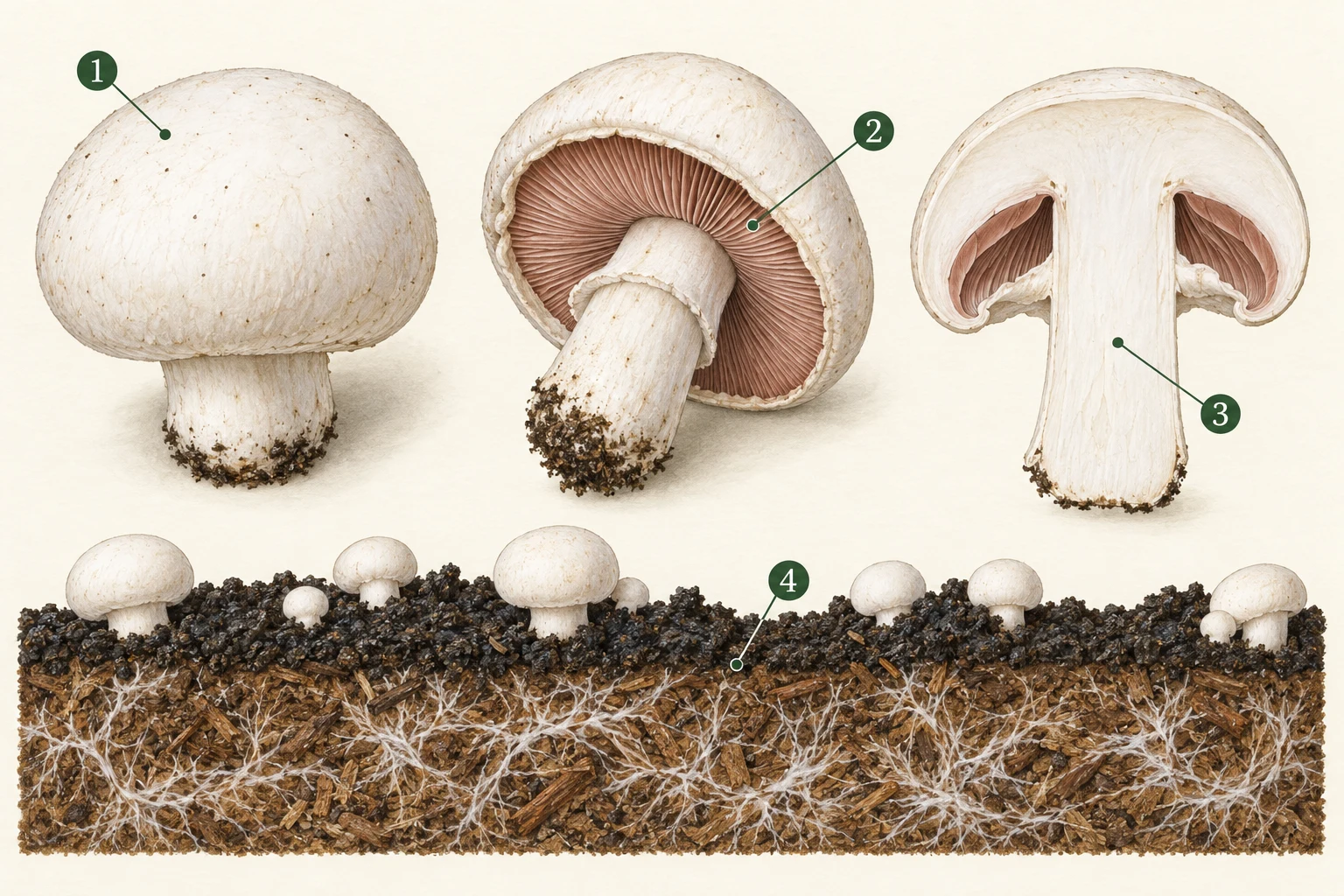
The gill surface matters: some disease is hidden beneath the cap. A cap-only photograph can miss the most useful evidence.

Agaricus bacterial gill disease.

Signs, checks & response →

Bacterial diseases

Internal stipe necrosis

A mushroom can look relatively normal outside while its stem is damaged internally. Internal quality checks can reveal a different problem from cap blotch.

Reported in cultivated Agaricus; stem browning has multiple possible causes.

Signs, checks & response →

Bacterial diseases

Bacterial soft rot and tissue collapse

Wet, collapsing tissue is a reason to separate produce and investigate timing. It can be a primary infection or secondary decay after injury.

Symptom differential. The cited Burkholderia evidence includes Agaricus bitorquis; it is not the cause of every soft rot on this crop list.

Signs, checks & response →

Competitor moulds

Competitor moulds

False truffle

A competitor recorded in Indian mushroom research. Unusual compact fungal bodies in compost deserve identification rather than a “mushroom” label.

Historical Agaricus problem; this is not an edible truffle crop.

Signs, checks & response →

Competitor moulds

Fast-spreading orange mould

Rapidly spreading orange growth is an operational contamination problem. A history of food use for selected Neurospora strains does not make an unknown colony safe.

Generic substrate-contamination differential; not a confirmed disease report for every crop listed.

Signs, checks & response →

Environmental disorders

Environmental disorders

Rosecomb, residues and chemical injury

Unexpected forms or lesions after cleaning, spraying or nearby fuel use need an exposure history as well as a disease differential.

Rosecomb is classically described in Agaricus; broader crop filters cover exposure investigation, not identical symptoms.

Signs, checks & response →

Food & worker safety

Fungal diseases

Fungal diseases

Dry bubble

An infection whose appearance changes with the age of the mushroom when it is attacked. A distorted pin and a spotted mature cap can belong to the same disease.

Principally cultivated Agaricus; do not transfer the diagnosis to every malformed mushroom.

Signs, checks & response →

Fungal diseases

Wet bubble

A disease of developing mushroom tissue, often producing swollen, disorganised masses rather than a normal cap and stem.

Agaricus disease; the two names occur in different publications.

Signs, checks & response →

Fungal diseases

Cobweb disease

Spreading surface growth can overrun casing and fruit bodies. The important clue is progression across the crop, not simply white colour.

Strong Agaricus evidence; additional cultivated hosts are documented in Korean studies. Susceptibility varies with isolate and host.

Signs, checks & response →

Fungal diseases

Green mould in button compost

A competitive or pathogenic fungus can occupy compost that should be colonised by the mushroom. Green spores may appear after an initially white phase.

Composted Agaricus substrate. Not every green colony is the aggressive epidemic organism.

Signs, checks & response →

Fungal diseases

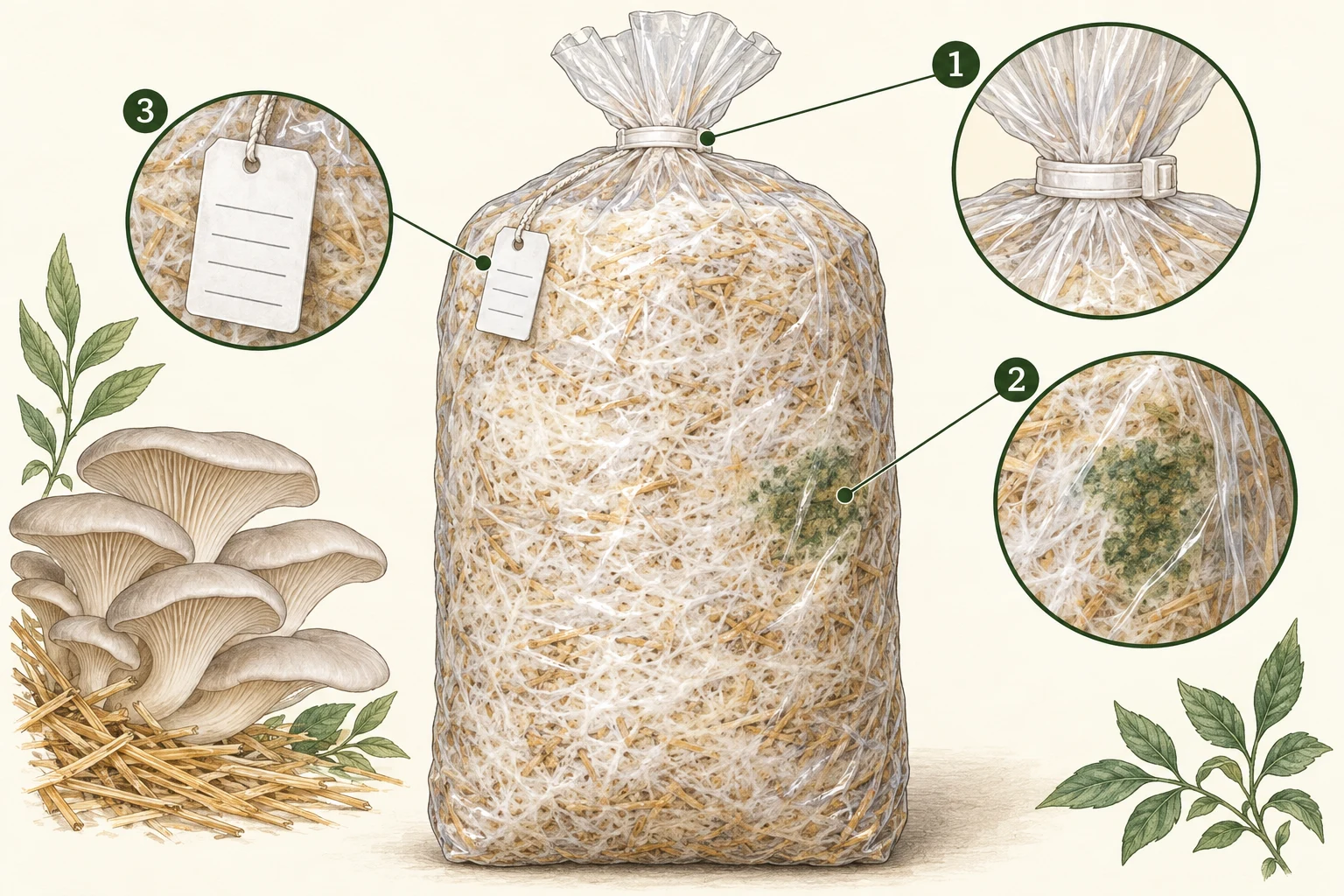
Green mould in oyster and other bags

A bag can contain competing mould before green colour is visible. Oyster-associated Trichoderma species differ from the main button-mushroom epidemic species.

Detailed pathogen evidence exists for Pleurotus; the other listed crops have published green-mould host reports, not a shared diagnosis.

Signs, checks & response →

Fungal diseases

Shiitake block green mould

Green mould may damage block colonisation and fruiting. It must not be confused with the normal development of a brown, mature shiitake block surface.

Lentinula edodes sawdust blocks; log production has a different contamination environment.

Signs, checks & response →

Fungal diseases

Wood-ear brown rot

A reported Trichoderma-associated rot needs to be separated from natural wood-ear pigmentation, drying and general spoilage.

Confirmed in a particular A. cornea production study; not every brown Auricularia is diseased.

Signs, checks & response →

Fungal diseases

Morel white mould and fungal rot

White growth and fruit-body collapse in morels can involve a primary pathogen plus secondary colonisers. A list of isolates is not a list of equally proven causes.

Cultivated Morchella, especially Chinese M. sextelata studies. Indian field prevalence is not established by these sources.

Signs, checks & response →


Pests & vectors

Pests & vectors

Cecid midges

Tiny larvae in wet crop material can be overlooked when a farmer only watches for flying adults.

Historical Indian pest group; local identification is essential.

Signs, checks & response →

Pests & vectors

Nematodes / eelworms

Crop decline in wet substrate may justify examination for nematodes, but the presence of nematodes alone does not establish the cause.

Nematode function depends on identity; not all are harmful to mushrooms.

Signs, checks & response →

Viruses & culture health

Viruses & culture health

Mushroom virus X and brown-cap syndrome

Virus detection is not automatically proof that the detected virus caused the symptoms. Mixed infections complicate interpretation.

Unexpected browning in a normally white strain and associated crop disorders; normal brown strains are not this disease.

Signs, checks & response →

Viruses & culture health

Oyster mushroom viruses

A mycovirus can alter crop performance in a susceptible strain, but contamination and growing conditions must also be investigated.

Experimental evidence in particular P. ostreatus and P. pulmonarius strains; not a universal explanation for poor oyster crops.

Signs, checks & response →

Viruses & culture health

Culture degeneration and non-fruiting strains

A clean-looking culture can lose desirable fruiting behaviour. Conversely, a failed crop does not prove that the strain has genetically degenerated.

Detailed research cited for Cordyceps militaris; other crop filters indicate a culture-quality investigation, not the same mechanism.

Signs, checks & response →

A safe first response

  1. Observe without disturbing

    Keep suspect bags closed. Photograph the room pattern and the affected unit.

  2. Limit movement

    Keep tools, people and exposed waste from carrying material into clean areas.

  3. Check the alternatives

    Compare crop stage, environment and batch history before naming a pathogen.

  4. Confirm and review

    Ask for appropriate testing. Record what changed and whether the problem recurs.