Describe the change
Small dark flies and pale larvae, often with conspicuous dark heads.
 MushroomFarming.in
A joint educational initiative by

 ICAR–DMRSolan
Pests & vectors
Adults are a monitoring clue. Larvae feeding in substrate, pins or mushrooms cause the direct crop damage.
Organism / cause: Sciarid flies; species identification may be needed
Where this evidence applies: Production-system risk across crops; most detailed guidance cited concerns commercial Agaricus.
Picture → observation → next check
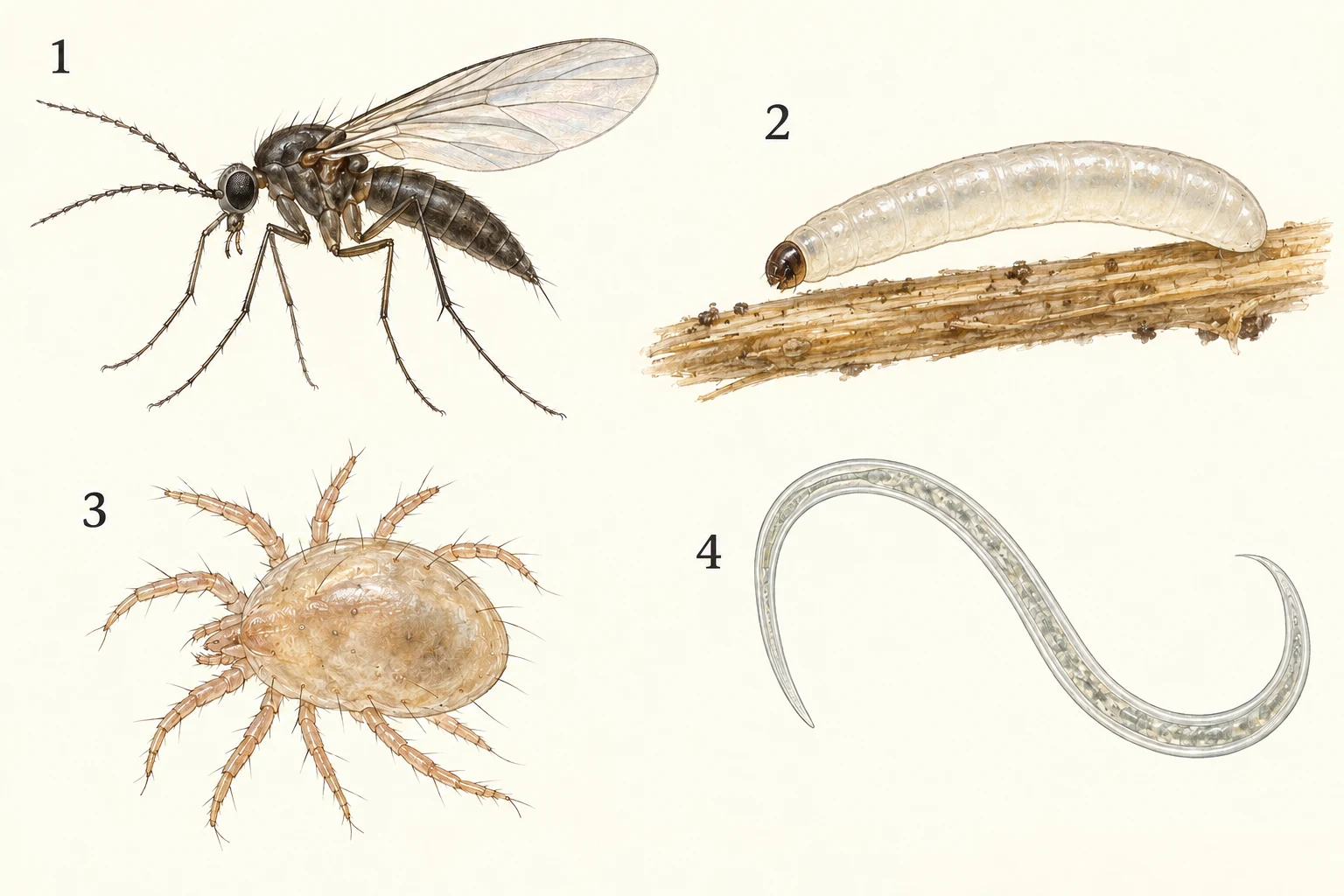
Record where it is seen and whether it walks, runs or flies. Adult identification and larval damage are separate observations.
A gnat-like legless larva is shown. Do not assume that every pale organism in substrate is the same pest.
Mites may feed on crop tissue, mould or other organisms. Presence alone is not proof of crop damage.
Nematode groups have different roles. Microscopic examination and specialist identification may be necessary.
Small dark flies and pale larvae, often with conspicuous dark heads.
Phorid flies, non-pest gnats and other larvae.
Label trap counts by location and date, not just “flies present”.
A visual match is only a starting point. Identification and crop inspection distinguish a pest population from incidental adults.
01 · Observe
No verified reusable diagnostic photograph is included for this entry. The illustration above explains observation context, not a confirmed disease specimen. Consult the original source figures where available.
02 · Compare
Adults can enter or move between rooms and carry material; breeding sites include suitable substrate and residues.
03 · Check
What confirmation needs: Identification and crop inspection distinguish a pest population from incidental adults.
Use the field record and sampling checklist →04 · Respond
These are investigation and containment steps, not a guaranteed cure. Do not eat, sell or distribute suspect material on the strength of a visual match. Do not culture unknown contaminants or experiment with pesticides in a growing room.
05 · Learn
After intervention, compare new affected units, crop condition and inspection results against the same recorded baseline. A lack of visible growth does not, by itself, verify decontamination or food safety.
Read the stage-by-stage prevention plan →Established pest biology; no universal trap threshold or pesticide recommendation is inferred.
Penn State Extension · Undated page
Used for: Larval feeding, adult transport and monitoring clues.
Limit: Life-cycle timing and pest species differ with conditions; no universal trap threshold is supplied.
Penn State Extension · Undated page
Used for: Separation of clean and older crops, tools and material routes.
Limit: Adapt the workflow to actual building, worker safety and ventilation needs.
Pests & vectors
Phorids must be distinguished from sciarids because monitoring and biological-control choices are not interchangeable.
Strong commercial Agaricus context; other crops require identification of the actual fly.
Signs, checks & response →Pests & vectors
Tiny larvae in wet crop material can be overlooked when a farmer only watches for flying adults.
Historical Indian pest group; local identification is essential.
Signs, checks & response →Pests & vectors
Identification can prevent the removal of useful organisms. Biological control still needs the correct pest, product, conditions and local legal status.
A decision guide, not an instruction to release an unapproved organism.
Signs, checks & response →