


A practical guide to growing mushrooms in IndiaA joint educational initiative by MushroomWale & DMR Solan
MushroomFarming.in

A joint educational initiative by

MushroomWale.com
ICAR–Directorate of Mushroom Research, Solan logoICAR–DMRSolan

MushroomFarming / guide

Government schemes, finance and application readiness

A versioned decision system for scheme fit, official evidence, DPR preparation, bank readiness and compliance.

4 full chapters + technical referenceSources & review ↓
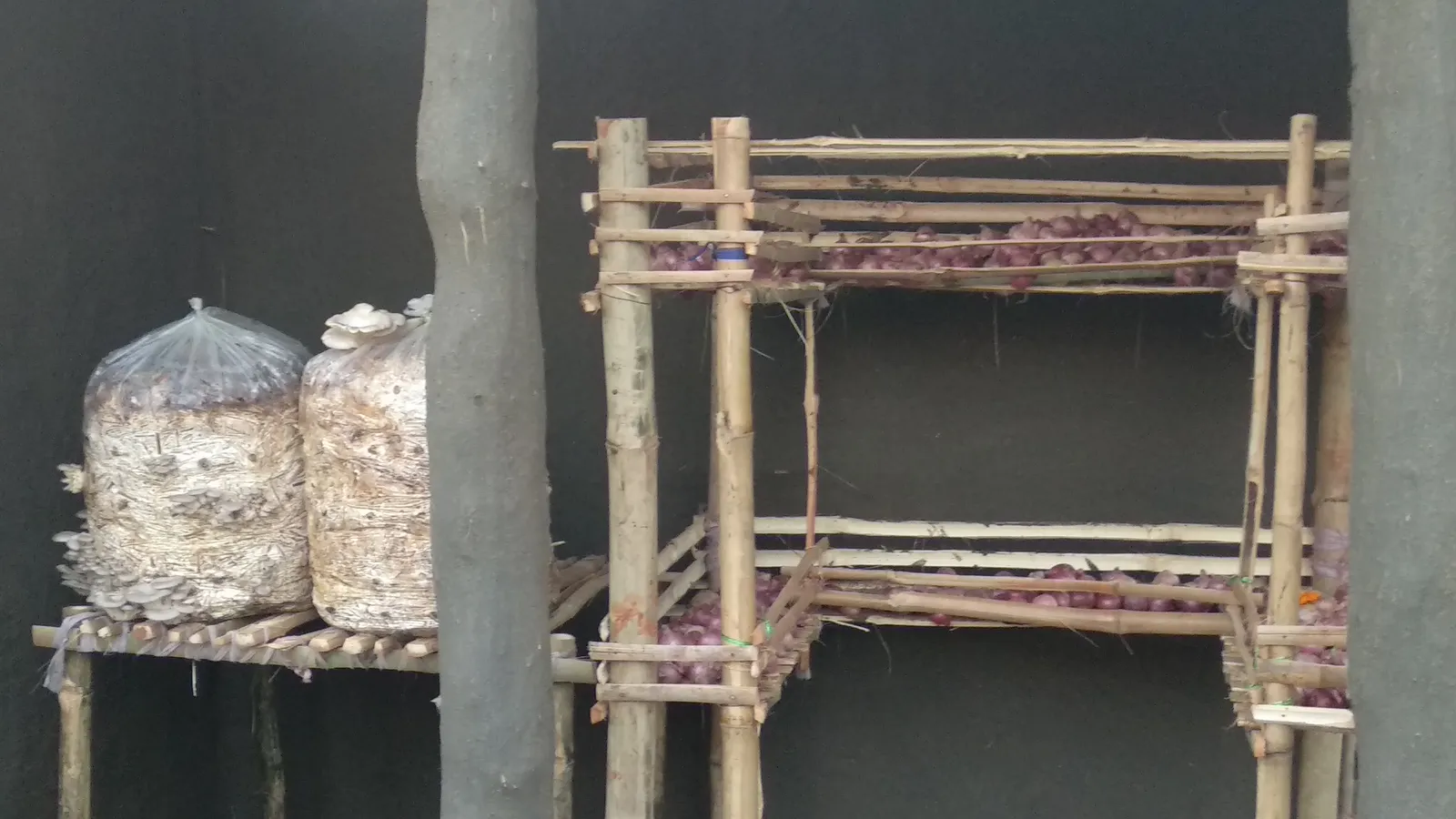
Spawned straw mushroom bags kept on a wooden shelf next to a bamboo onion-storage rack inside an adivasi (tribal) house, Odisha, India.
Real cultivation photograph. Read its source for location and context; it is not a universal operating specification.Soumendra Kumar Sahoo · CC BY-SA 4.0View full photograph ↗
On this pageChoose a section, or keep reading below
The full field guide

Prepare an evidence-backed project file for schemes and lenders

Separate scheme eligibility, application status, lender appraisal and your project's ability to operate.

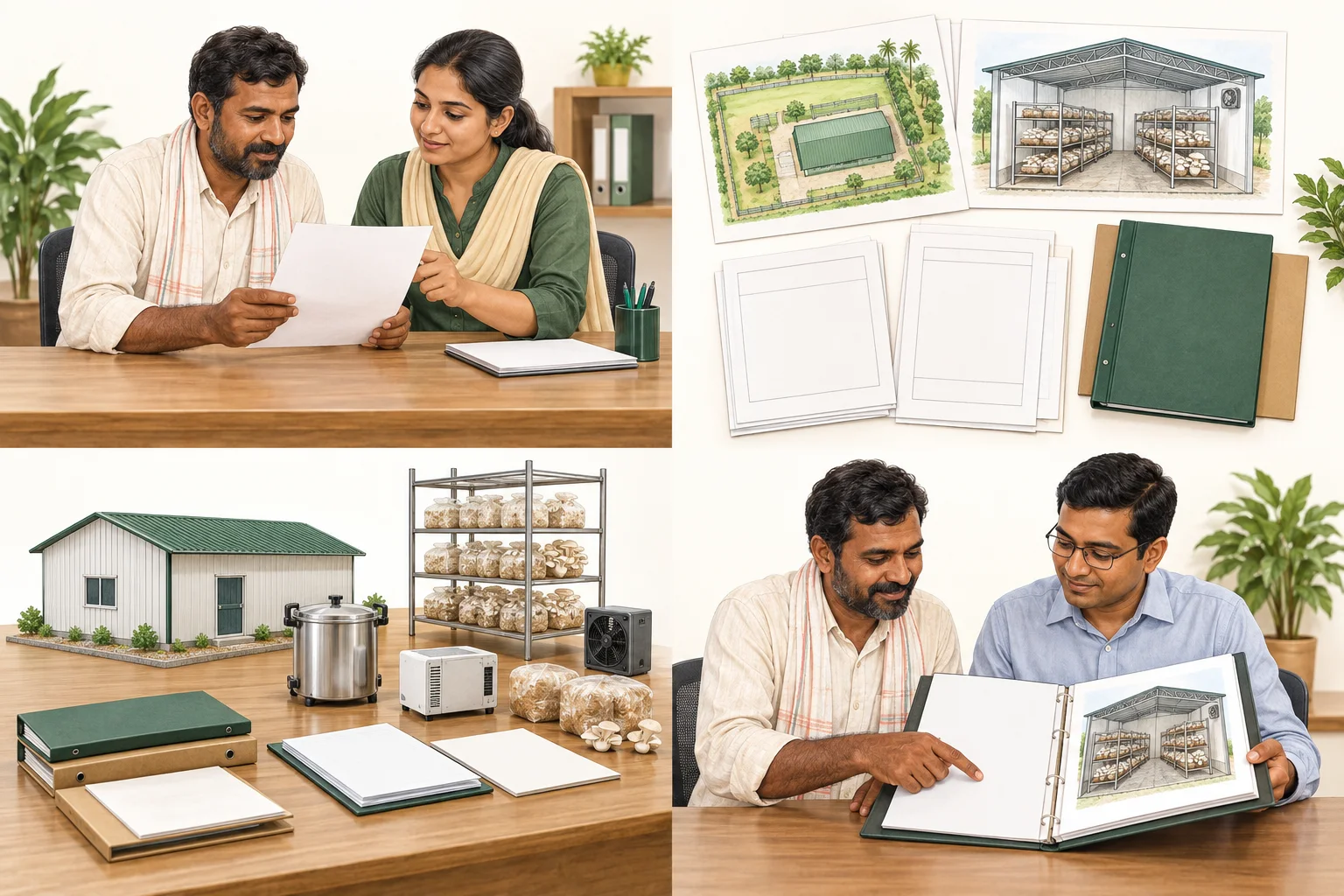
Choose a picture to understand that part of the process.

  1. 01Check the live rules
  2. 02Build the evidence file
  3. 03Separate funding columns
  4. 04Check consistency

AI-generated teaching illustrations · Not photographs of actual farms

Chapter 01

Verify the exact scheme and current application route

Write down the scheme name, issuing authority, financial year, project component and location. Read the current guideline together with amendments and application notices. A document remaining online does not establish that applications are open or that its rates still apply. Verify the live position with the implementing authority before committing expenditure that depends on assistance.

Create a question list covering applicant eligibility, land or lease requirements, eligible components, timing of application versus purchase, inspection stages, financing conditions and release mechanism. Keep the reply or official reference beside each answer. Do not replace a missing answer with a claim from a supplier's advertisement.

Four decisions that must remain separate
DecisionWho determines itWhat it does not prove
EligibilityThe implementing authority under current rulesAn application is open or assistance is guaranteed
Application acceptanceThe relevant application processApproval or payment
Loan sanctionThe lender after appraisalScheme assistance or biological performance
Commercial feasibilityProject evidence and qualified appraisalThat funding will be approved
Chapter 02

Build the technical file before polishing the report

Assemble land and site documents, the production boundary, material supply arrangements, layout, utilities, staffing and buyer evidence. Make quotations comparable by recording taxes, transport, installation, exclusions, warranty and validity. Match every major cost to a defined component and every production assumption to its source or clearly labelled estimate.

The NHB mushroom DPR model is a useful historical example of the breadth of a project file. It is not evidence of current eligibility or a substitute for the form required by today's authority or lender. Use the current required format and preserve the supporting evidence so that a reviewer can follow the figures back to their origin.

Chapter 03

Keep project cost, eligible cost and available cash distinct

The amount you must spend may differ from the cost recognised by a scheme. Prepare separate columns for total project expenditure, proposed eligible expenditure and the authority's eventual assessment. Do not present an assumed assistance percentage as a guaranteed deduction from the amount needed to start.

Build a cash plan using the lender's actual terms and the scheme's verified release conditions. Include delay scenarios and a case without assistance. Ask a qualified finance professional to review repayment ability and funding gaps. A positive annual surplus does not ensure that cash is available on each instalment date.

Chapter 04

Submit a consistent file and track each condition

Check that the applicant name, site, capacity, project components and financial totals agree across the application, drawings, quotations and report. Retain a dated copy of the submission and acknowledgement. Record queries and responses so that later revisions do not contradict earlier commitments.

After any approval, read its conditions before ordering or changing scope. Maintain invoices, payment evidence, implementation records and other documents required by the actual process. Changes in suppliers, capacity or components may need authority or lender review. Use written confirmation where a decision affects eligibility or financing.

Chapter sources & scope

These are educational explanations, not an independently reviewed operating protocol. Worked examples do not predict your yield or income.

Back to the chapter list ↑

Understand the topic

The key ideas, at a glance.

Begin with the applicant, activity, location and project stage. Scheme status and application intake are always kept separate.

Keep exploring

Every part of this topic.

Choose the stage, material or decision you need to understand next.

01

MIDH support for mushroom units

Current mushroom production, spawn, compost and small-unit cost norms with rate, geography and credit-linkage conditions.

02

Agriculture Infrastructure Fund and mushroom projects

Understand AIF interest subvention, applicant restrictions, community-asset fit, lender appraisal and timing.

03

What NABARD does for mushroom projects

Separate refinance, model-project and development roles from retail bank sanction and current subsidy claims.

04

PMFME for mushroom processing

Assess possible fit for eligible micro food processing without treating fresh cultivation as processing or assuming intake is open.

05

Food processing schemes for mushroom businesses

A boundary-led map of PMFME, PMKSY and processing compliance for fresh, dried, frozen and value-added routes.

06

State mushroom scheme directory

A source-governed state research index that publishes pages only where dated official source records are attached.

07

Banking and credit for mushroom projects

Prepare for lender appraisal with project viability, borrower contribution, security, cash flow, DSCR and document evidence.

08

Compare mushroom schemes without double counting

Compare assistance form, applicant fit, eligible activity, lifecycle, application status, timing and convergence restrictions.

09

Government scheme update register

See version changes, source-record check dates, stale thresholds and records waiting for human policy review.

10

Government scheme scam awareness

Avoid fake portals, paid Udyam registration, guaranteed-subsidy agents and requests for unsafe document sharing.

11

Official scheme and compliance contacts

Reach institutions through official portals and published channels without relying on copied officer lists or private agents.

12

Scheme verification and application calendar

A workflow calendar for annual guideline review, application-notice checks, DPR preparation and document expiry.

13

Does mushroom farming get 40% subsidy?

Why the MIDH percentage is component, geography, cost-basis, applicant, credit and application dependent.

14

Mushroom farm DPR system

Build an internally consistent, source-versioned project report across project identity, technology, capacity, cost, finance, market, cash flow, risk and compliance.

15

Mushroom business compliance pathway

Map cultivation, packing, processing and nutraceutical activity through national, state, local and project-specific checks.

Go deeper

Technical reference, records and tools.

Detailed crop-stage information, parameters, diagrams and specialist tools are kept together below. This material retains its source conditions and review limits.

Open the complete technical reference

government hub

Government schemes, finance and application readiness

Begin with the applicant, activity, location and project stage. Scheme status and application intake are always kept separate.

Editorial record: publishedPrimary sources: 4 linkedLatest attached source check: 2026-08-23

Find a scheme

Start from applicant and activity fit.

Open path

Calculate assistance

Use a source-linked component and eligible basis.

Open path

Build a DPR

Create a local-first appraisal draft.

Open path

Check bank readiness

Test evidence, cash and debt service.

Open path

Decision matrix

Compare the mechanism, not just the headline.

RecordPrimary mechanismMushroom fitPolicyApplications
MIDHconditional credit linkageDirect fit for production, spawn, compost and low-cost mushroom units, subject to component, applicant, geography, conditional credit linkage, release procedure and implementing-agency checks.activeunknown
AIFinterest subventionMushroom farming appears in the community farming asset list for specified group applicants. Post-harvest and eligible infrastructure can have a different applicant fit.activeunknown
PMFMEcredit linked capital subsidyPotential fit for eligible micro food processing activities such as value-added mushroom products. Ordinary fresh mushroom cultivation alone is not treated as processing.under-reviewunknown
NABARDmodel project onlyUseful for DPR structure, area-development context and bankability questions. It is not evidence of a current NABARD mushroom subsidy.under-reviewnot-applicable
AIF.FINANCE + PMFME.INDIVIDUALofficial procedure found
  • The same cost item cannot be financed twice
  • Each scheme and lender must approve its own component
  • Timing and documentation must follow the official convergence procedure
MIDH.MUSHROOM + AIF.FINANCEpossible subject to approval
  • No double benefit on the same eligible expenditure
  • Applicant and activity eligibility differ
  • Implementing authority and lender confirmation are required before modeling both

Primary sources

Open the attached authority records.

current2026-08-23

MIDH Operational Guidelines 2025, guidelines dated 31 December 2025

The guideline establishes cost norms and assistance patterns. It does not prove that applications are open in a particular state or that a project will be approved.

Authority
Department of Agriculture and Farmers Welfare
Reference
Guideline page 17 and Annexure V page 49
Checksum
sha256:1e9ffa6b727d11deb0a258c4b627fe31430ab7f8d1aeee459cd0d481f07911db
Open official source
current2026-08-23

Agriculture Infrastructure Fund Revised Scheme Guidelines, September 2024

Mushroom farming is listed as a community farming asset for specified group applicants. Loan sanction, rate, security and eligibility remain lender and scheme decisions.

Authority
Ministry of Agriculture and Farmers Welfare
Reference
Guideline pages 5 to 12
Checksum
sha256:6ceb00939f44524789817d7334533921414f1de21590c009e2a0a58f9d4a2af9
Open official source
current2026-08-23

PMFME modification for individual and group components

This component concerns micro food processing, not ordinary cultivation. The portal does not by itself establish a currently open state application window.

Authority
Ministry of Food Processing Industries
Reference
Office Memorandum, paragraph 1
Checksum
sha256:7145c0e400c6aefef245a34b78d51e72fe11e570067753c53568496dba33bbd9
Open official source
current2026-08-23

Priority Sector Lending Targets and Classification Directions, 2025

Priority-sector classification is not an instruction to approve a particular borrower or project.

Authority
Reserve Bank of India
Reference
Official page
Checksum
url-snapshot:RBI-PSL-2025-08-23
Open official source

Read the evidence

Sources & review.

Editorial update: 2026-08-23. Independent technical review is not recorded for this entry.

  1. MIDH Operational Guidelines 2025, guidelines dated 31 December 2025

    National Horticulture Board, Ministry of Agriculture and Farmers Welfare · 2025

  2. Agriculture Infrastructure Fund Revised Scheme Guidelines, September 2024

    Department of Agriculture and Farmers Welfare · 2024

  3. PMFME modification for individual and group components

    Ministry of Food Processing Industries · 2022

  4. Priority Sector Lending Targets and Classification Directions, 2025

    Reserve Bank of India · 2025

Reading a source is not the same as applying its instructions to every farm. Confirm species, strain, crop stage, system, region and publication date. Old chemical recommendations are not current-use instructions.

See something that needs correcting? Tell us →