


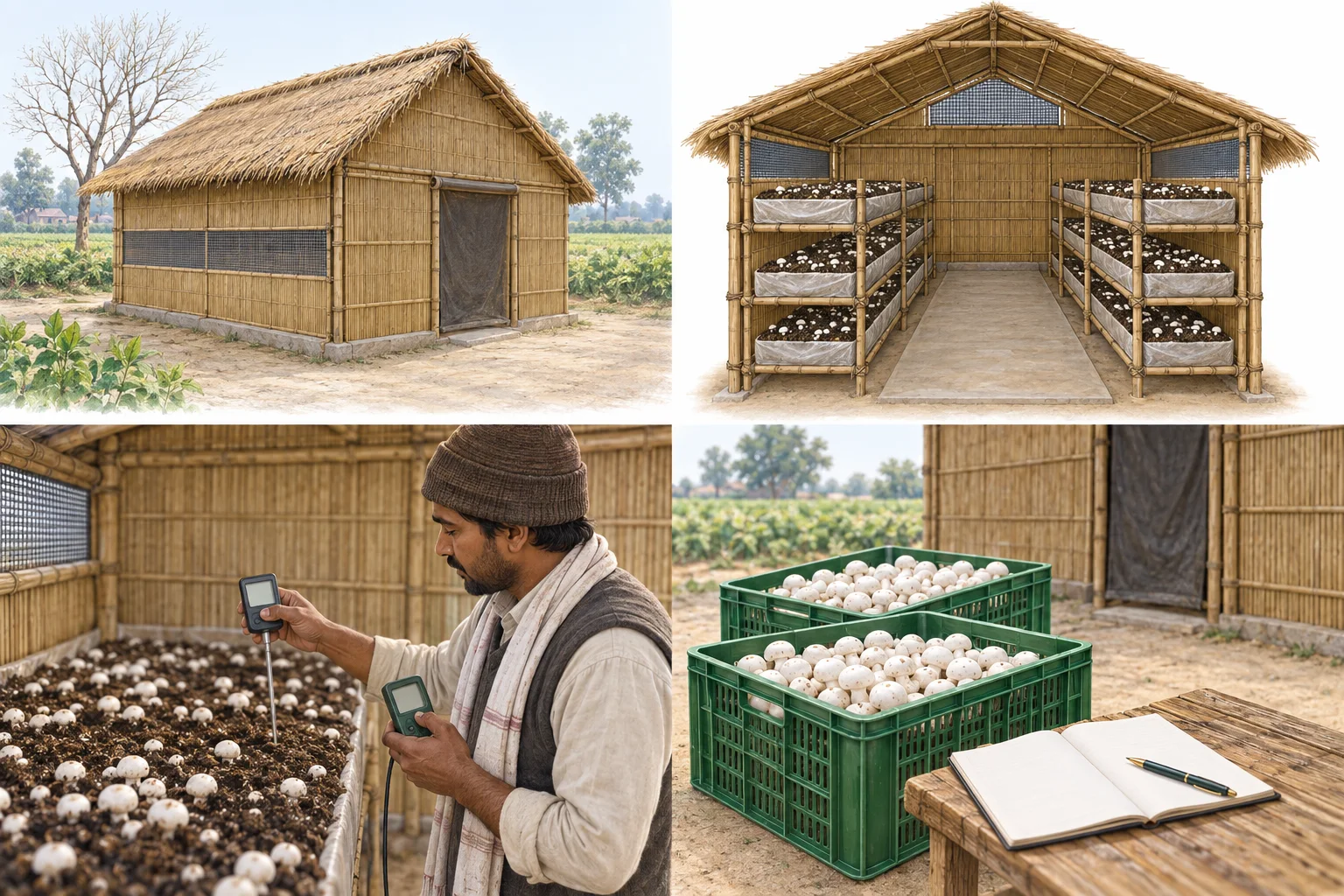
Winter field guide · North-west plains & suitable cool regions
Grow Button Mushroom in winter, only when the hut can hold the crop.
A field-oriented operating manual for mud, bamboo or thatch huts using favourable outdoor weather, from the 14-day site audit and written procurement specification to crop-stage release, harvest dispatch, stop-loss and pilot economics.
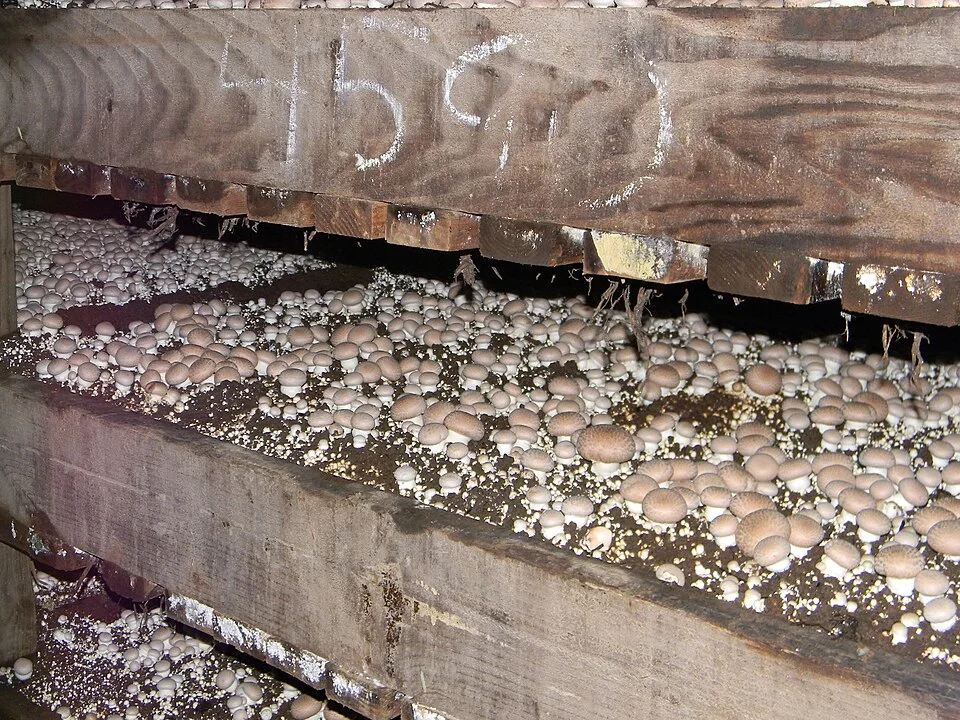 Real contextual photo
Real cultivation photograph showing Button Mushrooms across tiered beds. The rack, spacing and crop density are context, not a construction drawing or yield standard.
Photo: I. G. Safonov (IGSafonov). CC BY-SA 3.0. Source and licence- System
- Low-input, seasonal
- Natural window
- Site-specific; verify with local measurements
- Best first move
- One measured pilot
- Not included
- Income or yield promise
Non-negotiable
The core boundary
The hut slows temperature swings and supports ventilation. It does not create winter, remove compost heat or guarantee the fruiting environment. If local weather cannot hold the crop-stage conditions, pause the crop or use engineered control.
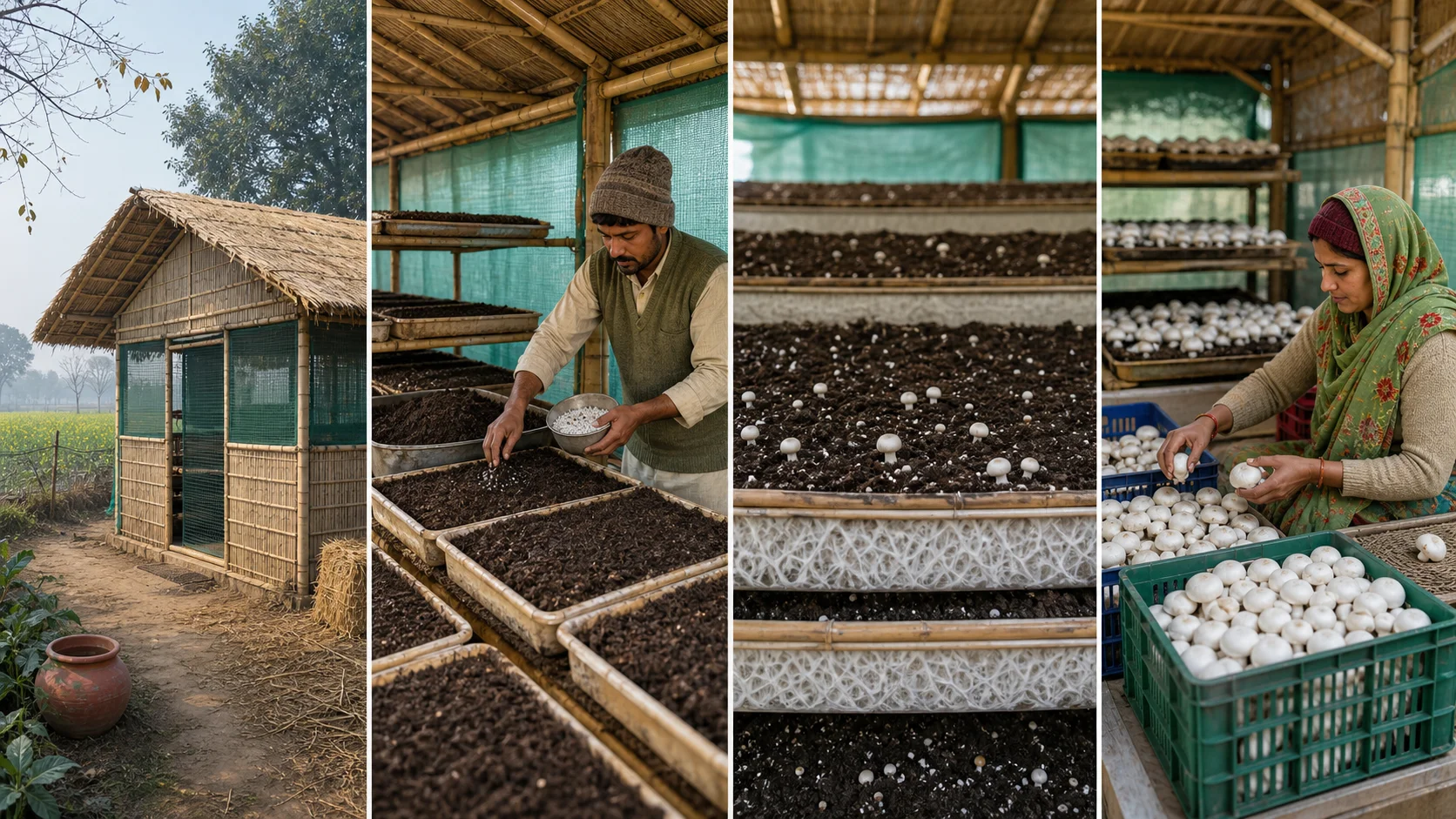
See the whole journey
Understand the seasonal crop in four pictures.
Each panel is a decision handoff. Keep this visual map in mind before reading the operating detail.
Decision 01 · before you spend
Pass three gates before ordering compost.
Weather gate
Use your own daily minimum/maximum records, not a calendar label. Confirm that the cool window is long enough for spawn run, casing, fruiting and harvest.
Process gate
Secure selective, conditioned, ammonia-free Button Mushroom compost, traceable spawn, prepared casing and a clean loading route.
Market gate
Confirm buyer, pack size, expected weekly volume, payment timing, transport and how quickly fresh mushrooms can reach the customer.
Local climate first
Where this method fits
Not a fit for hot winter locations, farms without reliable compost/casing, sites with no hygiene boundary, or projects whose economics depend on an assumed yield or premium price.
North-west plains
ICAR-DMR describes winter seasonal production when outside temperature is favourable. PAU gives September–March as the Punjab operational context.
Temperate hills
ICAR-DMR describes a broader September–April seasonal possibility in hills; altitude and site weather still decide the actual window.
Low-hill bamboo-hut evidence
One Himachal Pradesh study began spawning in late October/early November and cropped to the end of March. Treat this as study context, not a national calendar.
Visual seasonal calendar
The calendar plans. The weather gives permission.
This is a planning illustration for the north-west plains. Set the actual load date from outside minimum/maximum records and bed-temperature risk; hill windows can differ.
PAU’s Punjab context is September–March; ICAR-DMR describes a September–April seasonal possibility in temperate hills. Read these as location-specific windows, never as a universal schedule.
Decision 02 · stage climate
One crop, different climate jobs.
Use the stage and measurement location with every value. Air temperature, bed/compost temperature and surface condition are different observations.
A managed-room reference, not proof that a passive hut can hold the crop. The cited profile uses high RH and approximately 15,000 ppm CO₂; verify strain, load, bed heat and spatial uniformity.
The source says growing beds/bags, not room-air temperature. Ventilate toward 800–1,200 ppm CO₂ where measured. Treat this as dated seasonal advice.
Use mapped measurements and avoid cap wetness or condensation when applying passive cooling or ventilation.
A warming-period advisory is not permission to load a new crop without enough remaining weather margin.
Decision 03 · structure
Build for function, not for a rustic look.
Mud walls, bamboo and thatch can be useful materials, but each part of the hut must perform a specific job and remain cleanable where the crop touches the system.
BUFFERnot refrigeration
Roof & shade
Deep thatch or another insulated roof limits solar heat and rapid night cooling. Keep it dry, intact and easy to inspect for pests.
Washable floor
PAU specifies a pucca floor. Use drainage and a cleaning route that does not splash dirty water back into beds.
Cross ventilation
Provide opposing, controllable openings. Add cleanable insect screening; do not seal the room simply to protect humidity.
Wall envelope
Mud/lime or other insulated walls can buffer swings. Repair cracks, rain entry and rodent paths before loading.
Rack geometry
Keep access for harvest and cleaning. PAU describes roughly 2–2.5 ft between rack lines and about 1 ft between containers as a reference, not a universal design rule.
Measurement map
Mark repeatable points for outside air, room air and representative bed temperature. Add RH and CO₂ where possible.
Field operator guidance
The field manual: from an empty hut to the last dispatch.
Use these chapters as operating handoffs. Each one states what to verify, what to record and what must be true before the crop moves forward.
Chapter 01 · prove the site
Complete a 14-day empty-hut climate audit before buying a crop.
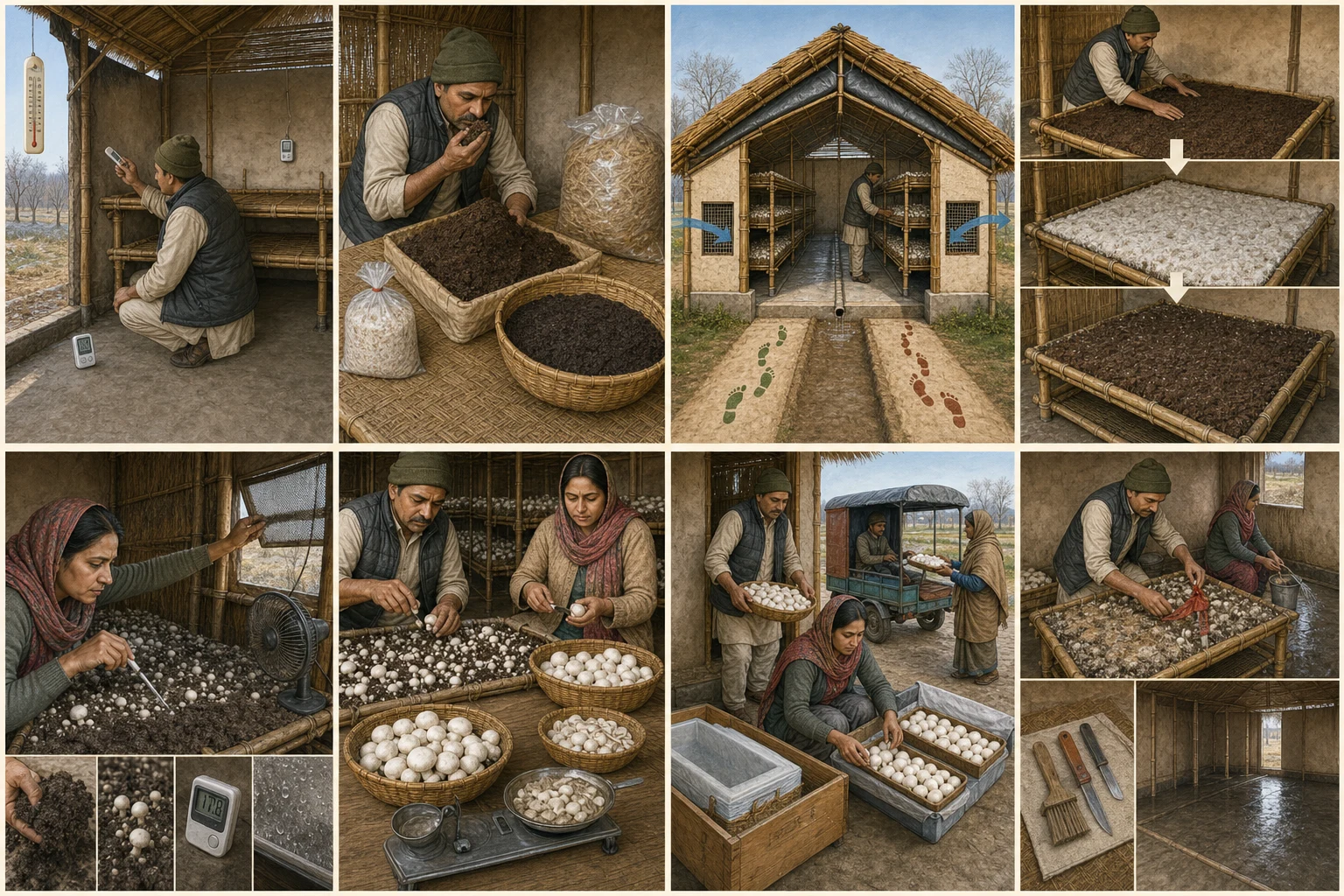
- Look for
- Outdoor shade, room centre, warm rack and cold wall, four different readings.
- Tools / materials
- Min/max thermometer, hygrometer, labels, notebook or phone, fixed observation times.
- Pass checkpoint
- A repeatable 14-day pattern with margin for a warmer day.
- Record
- Point, time, weather, door/water action and the next reading.
Common mistake: Calling the location suitable from one afternoon reading.
Write the min/max or fixed-time reading in each cell. Below it, note door, water, rain/fog/sun and any unusual event.
Map
Choose repeatable points: shaded outdoor air, room centre, the likely warm rack and the likely cold/wet surface.
Record
Log at repeatable times spanning the coldest and warmest parts of the day. Note rain, fog, sun, wind and every door or water action.
Challenge
Run the hut empty. Test normal opening schedules, screening, floor/wall wetting and drainage without pretending this is crop validation.
Compare
Compare the evidence with both spawn-run and fruiting needs. The fruiting window, not the word ‘winter’, sets the loading decision.
Empty-hut evidence is plausible and leaves apparent weather margin. It does not validate compost metabolic heat, moisture or CO₂. Run one bounded, instrumented loaded pilot before commercial release.
The window is plausible but narrow, uneven or untested with real compost heat. Use one bounded, traceable lot.
The fruiting band cannot be held, surfaces condense, drainage fails or the market window ends before the crop can finish.
Chapter 02 · buy a process, not loose material
Write the acceptance specification before calling a supplier.
- Look for
- Three separate, labelled inputs on a clean surface, never one anonymous mixed pile.
- Tools / materials
- Purchase sheet, marker, clean sample tray, torch, phone camera and supplier contact.
- Pass checkpoint
- Batch identity, release evidence, normal condition and transport history agree.
- Record
- Supplier, batch, date, arrival condition, accept/hold decision.
Common mistake: Loading sharp-smelling or abnormally hot compost and hoping to fix it later.
Ready compost
Supplier, batch, process date, loading basis, moisture/pH/ammonia release evidence and transport time
Unknown batch; sharp ammonia; abnormal heat, wet pockets, sour/putrid odour or obvious non-uniformity
Spawn
Correct species and declared strain, producer, batch, manufacture/use-by information, storage and transport condition
Unlabelled pack, damaged seal, overheating, mixed identity or visible abnormal contamination
Casing
Material recipe/source, preparation and treatment record, clean storage, structure and water-holding behaviour
Unknown origin, insect activity, mould, foul odour, sludge-like texture or recontamination after preparation
Bags / trays
Food-contact suitability where relevant, clean condition, consistent fill capacity and unique position code
Reused contaminated container, sharp damage, no clean storage or no way to trace its crop position
Buyer route
Grade, pack size, daily receiving window, rejection rule, payment term, transport time and backup buyer
Only a verbal price, no grade agreement, no receipt trail or no plan for unsold product
Chapter 03 · commission the empty hut
A completed hut is not a ready hut.
- Look for
- Opposing screened vents, dry insulated roof, draining washable floor and separated footsteps.
- Tools / materials
- Repair kit, screen mesh, drain brush, clean ribbon/tissue, compared probes and route signs.
- Pass checkpoint
- The room is clean, dry, drainable, screenable and measurable at every mapped point.
- Record
- Leak, drain, air-path and probe tests plus operator sign-off.
Common mistake: Treating a rustic-looking hut as a functioning crop room.
Envelope
Repair roof leaks, cracks, rodent paths and direct sun entry. Confirm that walls and roof are dry.
Clean route
Mark receiving, clean work, harvest and dirty exit routes. Spent material must not cross clean incoming materials.
Water test
Wet only the surfaces the operating plan permits. Confirm drainage, no splash-back, no stagnant pocket and no leak onto racks.
Air test
Use clean tissue or ribbon to confirm opposing openings move air across the occupied zone; screen and control every opening.
Instrument test
Compare probes together, label them and fix their repeatable locations. A single wall thermometer cannot represent the crop.
Response drill
Assign who opens, waters, records, calls the buyer and isolates a suspect bag. Run the actions before loading.
Release the room only when it is clean, dry, drainable, screenable, measurable and has a named operator for every shift.
Chapter 04 · stage handoffs
The crop moves by evidence, not by date alone.
- Look for
- Even compost depth, uniform white colonisation and an open-clod casing surface.
- Tools / materials
- Clean filling tools, lot labels, bed probe, prepared casing, gentle water delivery and stage sheet.
- Pass checkpoint
- The biological evidence for the previous stage is complete, not only the date.
- Record
- Load code, bed readings, colonisation pattern, casing date/depth and release signature.
Common mistake: Casing incomplete spawn run merely to match a calendar.
This is source-based orientation, not a deadline. C0 is the actual casing day. Stop the clock when the biological checkpoint fails.
Load / spawn
Accepted compost and spawn; clean room; position map ready
Fill evenly, assign lot and position codes, record starting bed temperatures
Every unit is traceable and the room response is stable
Spawn run
Day 0 after loading
Protect moisture, observe bed heat and colonisation pattern; avoid fruiting-style fresh-air changes
Reviewed colonisation is complete and uniform enough to case; DMR foundational guidance describes roughly 12–14 days under managed conditions
Casing
Only after reviewed spawn-run completion
Apply prepared casing uniformly with an open clod structure; water in installments without runoff into compost
Surface is even, moist rather than saturated, and each bed remains identified
Case run
Immediately after casing
Hold the case-run environment and watch mycelium distribution, temperature and surface condition
Mycelium reaches casing valleys; DMR guidance describes about one week under managed conditions
Fruiting shift
After case-run evidence
Move temperature, fresh air and RH together; do not make a blind overnight shock
The room can hold the fruiting band without condensation or rapid casing drying
Pin set
After the fruiting shift
Protect the surface microclimate, read CO₂ with crop form and avoid heavy rescue watering
Pins are distributed and developing; investigate rack-side or patch patterns before a whole-room correction
Harvest / flush
Buyer grade reached before veil opening
Harvest before watering, disturb nearby pins as little as possible, weigh by grade and restore casing holes
Dispatch and rejection records close each harvest; the next watering decision uses surface need
Close-out
Output no longer covers harvest risk or the crop is unsafe
Remove through dirty route, segregate suspect material, clean, dry and review the crop ledger
A signed crop review identifies repeat, redesign or stop
Chapter 05 · coupled controls
Water, fresh air and heat must be changed as one system.
- Look for
- Surface, pins, bed probe, airflow and a wet cold surface as one coupled system.
- Tools / materials
- Bed probe, RH meter, CO₂ meter where possible, gentle watering tool and condensation note.
- Pass checkpoint
- The next round shows the intended response without creating a new risk.
- Record
- Reason, location, exact action, time and next-round response.
Common mistake: One heavy rescue watering or opening every door suddenly to solve high CO₂.
Casing looks dull or begins to crack
Touch/structure at several points, bed heat, recent water, air movement
Restore moisture in small installments and recheck penetration
A large rescue dose that runs into compost
Caps or cold surfaces are wet
Dew-point risk, overnight temperature fall, direct spray and air stagnation
Stop direct wetting; correct the condensation cause and restore gentle air movement
Assuming high RH is always beneficial
Long stems / small caps
Distribution, opening schedule, CO₂ reading where available and crop load
Correct the air path progressively and watch crop response
Opening everything suddenly and drying casing
Bed temperature rises
Multiple bed points, room air, crop age and loading density
Increase observation, review heat removal and seek technical help if the rise persists
Cooling the room while ignoring the compost core
Pins stall after watering
Water timing, droplet size, pooling, casing depth and recent ventilation
Hold further heavy water, map the affected pattern and protect unaffected pins
Repeating the same watering because the calendar says so
Every intervention needs four entries: reason → action → location → response at the next round. If the response is unknown, the control loop is incomplete.
Chapter 06 · quality ends at the customer
Harvest is a cold-chain and payment operation, not just picking.
- Look for
- Pick before watering, clean trim, separate grades and distinct saleable/reject weights.
- Tools / materials
- Clean-hand policy, trim knife, grade baskets, verified scale and lot labels.
- Pass checkpoint
- Buyer grade, clean surface, no suspect mushroom and traceable weight.
- Record
- Gross picked, each saleable grade, rejection reason, picker and time.
Common mistake: Calling total picked kilograms the saleable yield or profit.
- 01 Pick
Pick to the agreed button stage before watering. Twist gently, trim adhering casing cleanly and protect nearby pins.
- 02 Grade
Separate saleable grades, rejects and suspect mushrooms. Never blend quality problems into a good lot.
- 03 Weigh
Record gross picked, grade-wise saleable, reject and sample weight. Yield without saleable weight is not business evidence.
- 04 Cool
Move crop out of the warm room quickly and begin the available cooling chain. DMR post-harvest guidance stresses rapid cooling and continuous cool handling.
- 05 Pack
Use the buyer-agreed pack, avoid crushing depth, identify harvest date/lot and keep dirty outer transport surfaces away from crop contact.
- 06 Dispatch
Record departure, arrival, accepted kg, rejected kg, realized rate, commission/transport and payment due date.
DMR warns that washed mushrooms deteriorate faster than dry-packed mushrooms. Do not wash routinely merely for appearance; agree the cleanliness and handling method with the buyer.
Chapter 07 · ownership
Every crop decision needs one named owner and one record.
- Look for
- Quick exit from the warm hut, shallow packs, protected cool transport and buyer receipt.
- Tools / materials
- Clean packs, suitable liner, cool box/cold-room access, dispatch sheet and receipt trail.
- Pass checkpoint
- Accepted kilograms, condition, rate and payment date close with the buyer.
- Record
- Pack/lot, departure, arrival, accepted/rejected kg, costs and payment.
Common mistake: Holding mushrooms in the warm crop room until all picking is finished.
Crop lead
Stage release, climate change approval, stop decision
Stage handoff sheet
Room operator
Rounds, temperature/RH/CO₂ where available, openings and watering
Daily environment log
Hygiene lead
Entry control, tools, screens, drains, suspect material and close-out
Hygiene and incident log
Harvest lead
Grade, weights, pack identity, cooling and dispatch
Harvest and rejection ledger
Market / cash
Buyer confirmation, receipt, payment follow-up and actual selling costs
Sales and cash ledger
No verbal-only handoff. The next person must see crop stage, last readings, last action, unresolved risk and next decision time.
Chapter 08 · protect the next crop
Know when to hold, isolate, call or end the crop.
- Look for
- Marked isolation, separate tools, photo evidence, dirty exit and dry-room release.
- Tools / materials
- Barrier labels, dedicated tools, camera, incident sheet and current specialist/disposal contact.
- Pass checkpoint
- Root cause and corrective action are reviewed; room release is signed before reload.
- Record
- First sighting, distribution, readings, movement, advice, disposal and release.
Common mistake: Disturbing a suspect bed and carrying its tools into a healthy room.
Local + boundedMark → isolate → photograph → separate tools
Spreading / unknownHold work → call specialist → share full evidence
Environment / food safety failsStop crop → protect other rooms → controlled close-out
Compost release is doubtful, ammonia is present, spawn identity is uncertain or the weather gate has weakened
Keep the lot outside the clean route; document and escalate before opening or mixing
A local abnormal patch, suspect bag/tray, flies concentrated at one point or water leak
Mark the boundary, restrict tools/movement and photograph the pattern before disturbance
Bed heat keeps rising, disorder spreads, identity is unclear or a corrective action worsens the crop
Share the lot, stage, distribution, readings, photos and action history, not one close-up photo
The hut cannot hold the fruiting environment, contamination is spreading, food safety is uncertain or continued harvest cannot cover handling risk
Protect people and other rooms, follow current local disposal guidance and close the record honestly
Root cause, cleaning release, supplier issue or structural fault remains unresolved
Complete a written crop review and corrective-action check before the next lot enters
Field sequence · one complete crop
A seasonal crop is a chain of nine handoffs.
- 1
Verify the window
Record local weather; count backwards from the warming period and leave failure margin.
- 2
Prepare the hut
Empty, clean, dry, repair, screen openings, map clean/dirty movement and test instruments.
- 3
Accept compost
Check supplier/batch, temperature, moisture pattern, uniformity and absence of residual ammonia before spawning.
- 4
Spawn & fill
Use traceable spawn, hygienic handling and even filling. Record bag/tray identity and loading position.
- 5
Run the spawn
Follow colonisation and bed heat. Uncontrolled huts may take longer; readiness matters more than the calendar.
- 6
Case the crop
Apply prepared casing evenly after the stated readiness checks. PAU describes about 3.2–3.8 cm (1.25–1.5 in) in its seasonal package.
- 7
Shift to fruiting
Use the natural cooling window, controlled fresh air and careful surface-water management. Do not shock a warm crop blindly.
- 8
Harvest & sell
Pick to buyer specification, protect remaining pins, grade saleable weight and dispatch quickly.
- 9
Close the crop
Remove spent material through the dirty route; clean, dry, repair and review the whole crop record before reloading.
Field sheet · 2–3 rounds every day
Observe first. Change one thing with a reason.
- Outside minimum / maximum and current weather
- Room air temperature at mapped points
- Representative compost or bed temperature
- Relative humidity and condensation
- CO₂ if available; otherwise crop form plus ventilation history
- Casing surface: sheen, dryness, pooling and cracking
- Crop pattern: uniform, rack-side, patch or whole room
- Odour, flies, drains, screens and recent work
Record every round
After a change, record the response in the next round. This links the action to evidence.
DIY field records · print-ready
Print four sheets. Keep hut decisions on paper.
Choose A4 landscape. Photocopy the blank rows; a signed paper record makes a clearer handoff than a phone screenshot.
14-day empty-hut audit
Complete at morning, afternoon and night, or fixed local times, before buying the crop. Print a second sheet if needed.
Input acceptance
Give every compost, spawn and casing batch its own decision before it crosses into the clean route.
Daily crop-control round
Connect one observation to a reasoned action and the response seen at the next round.
Harvest, dispatch & cash
Never call picked kilograms saleable kilograms; close buyer acceptance and cash evidence.
Failure map
Read the pattern before choosing the correction.
Ammonia / unready compost
Sharp odour, weak or uneven spawn run
Hold spawning; verify compost release with the supplier or trained advisor. Do not mask the smell.
Bed overheating
Bed temperature rises while room looks acceptable
Increase observation points, reduce heat load where possible and review air exchange without drying the crop.
High CO₂ / low fresh air
Long stems, small caps, weak pin quality
Check distribution and opening schedule; use CO₂ measurement if available before a broad change.
Dry casing
Dull, pale or cracked surface; stalled pins
Correct gently in stages. Large rescue watering can damage pins and create lower-zone saturation.
Condensation / over-wet caps
Water films, cap spotting risk, wet cold surfaces
Compare surface temperature with dew point, correct the cause and avoid direct cap wetting.
Sciarid / phorid flies
Adults on traps or near openings and drains
Repair screens, remove breeding material, improve exclusion and identify the pest; do not begin with an unverified spray.
Pilot economics
Use one ledger. Ignore the universal ₹/bag claim.
Seasonal farms concentrate supply into the same cool months, so market pressure is a structural risk. The older NHB report also noted winter-market gluts; treat that as a warning to validate today’s local buyers, not as a current price statement.
Input basis
Purchased compost kg, spawn, casing, containers and crop consumables
Operating cost
Hut repair, water, electricity, labour hours, hygiene, transport and cooling
Saleable output
Grade-wise sold kg, not total picked kg
Realized price
Actual invoice/receipt value after rejection, commission and unsold product
Decision
Contribution per crop, cash timing, loss events and whether the pilot was repeatable
Investment infographic
Investment is not one number. It has eight separate pockets.
You see the real funding need only when fixed assets, crop costs, selling costs, working cash and risk reserve are separated.
Structure
Hut, insulated roof, washable floor and screened openings
Crop holding
Racks, trays/bags, access and handling
Measurement
Thermometer, bed probes, RH and optional CO₂
Crop inputs
Compost, spawn, casing and packaging
People
Loading, observation, watering, picking and cleaning
Market route
Grading, cooling, transport and commission
Working cash
The gap between crop spending and buyer payment
Risk reserve
Rejection, repair, weather loss and failed batch
Interactive crop economics · your numbers only
Build the profit picture before you call it profit.
Enter quotations and records from your own location. The chart separates permanent investment, one-crop operating cost, revenue and the share of fixed investment you choose to charge to this crop.
Merit / demerit
Low-cost does not mean low-risk.
The method’s strength and weakness come from the same source: dependence on natural weather.
Merits
- Lower refrigeration demand in a genuinely suitable winter
- Locally repairable materials and incremental expansion
- A small pilot can test both method and market
- Can fit family labour and nearby fresh markets
- Lower initial complexity than a controlled farm
Demerits
- A narrow weather window that changes year to year
- Less repeatability than a controlled room
- Winter supply concentration can pressure price
- Frequent observation of bed heat, RH and fresh air
- A hut cannot rescue a hot spell or poor compost
- The asset may be used for only part of the year
Current-use safety boundary
Legacy pesticide recipes are not current instructions.
Some older extension documents contain chemicals whose status has changed. India’s PPQS list records lindane as banned. Never copy an old pesticide dose from a PDF or neighbour’s notebook. Verify the current crop label, registration/status and local extension advice; prioritize exclusion, hygiene, monitoring and correct identification.
Evidence record · Evidence rechecked 2 September 2026 · external scientist review not yet recorded
Primary Indian sources used
Source context is preserved. Study yields, older package values and enterprise stories are not converted into guarantees.
Farm Design for White Button Mushroom Cultivation
Seasonal-system definition, farm design and crop-room context.
Open official sourceMushroom Cultivation, Marketing and Consumption
Seasonal windows, crop sequence and production-system boundaries.
Open official sourceCrop Advisory 2026
Current month- and stage-specific fruiting, humidity and ventilation guidance.
Open official sourcePost Harvest Technology of Mushrooms
Rapid cooling, packaging, transport and continuous cold-chain principles.
Open official sourceDiseases and Competitor Moulds of Mushrooms
Symptom patterns, hygiene boundaries and diagnostic context; old chemical directions are not copied.
Open official sourcePackage of Practices for Fruits and Vegetables
Punjab seasonal calendar, house layout, compost readiness and crop operations.
Open official sourceButton Mushroom production report
Natural-winter cultivation, mud/thatch structures and broader climate ranges.
Open official sourceNatural bamboo-hut cultivation study
A bounded low-hill study; useful context, not a universal yield forecast.
Open official sourceSeasonal bamboo-hut enterprise case
Evidence for a small seasonal pilot before expansion.
Open official sourceLow-cost small-scale mushroom production-unit norm
A government cost norm and assistance reference, not an actual project quote or automatic entitlement.
Open official sourceBanned and restricted pesticides list
Current legal-safety check for obsolete chemicals in legacy documents.
Open official source