


A practical guide to growing mushrooms in IndiaA joint educational initiative by MushroomWale & DMR Solan
MushroomFarming.in

A joint educational initiative by

MushroomWale.com
ICAR–Directorate of Mushroom Research, Solan logoICAR–DMRSolan

MushroomFarming / guide

Button Mushroom Compost

From raw materials and microbial fermentation to pasteurization, conditioning and ready-to-spawn selective compost.

4 full chapters + technical referenceSources & review ↓
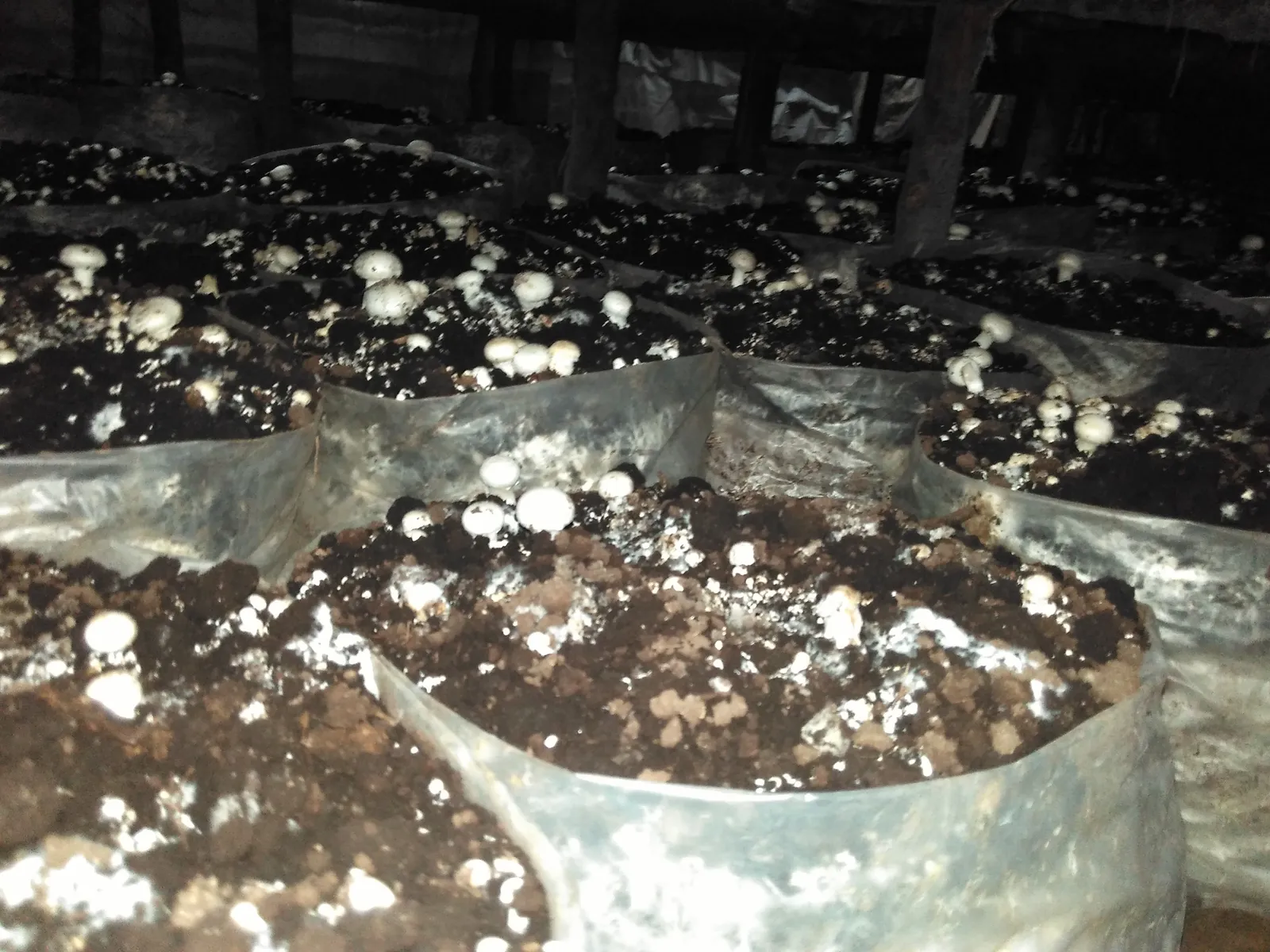
Polythene compost bags topped with dark casing soil and emerging button-mushroom pinheads in a dim cropping room, Tamil Nadu (uploader is a TNAU student; Tamil caption 'mushroom cultivation method').
Real cultivation photograph. Read its source for location and context; it is not a universal operating specification.Rahumath nisha · CC BY-SA 4.0View full photograph ↗
On this pageChoose a section, or keep reading below

New to this topic? Begin here.

Compost, explained before the process charts

Button mushroom compost is a prepared growing substrate, not ordinary garden compost. The important question is what stage it has reached and which job remains. Start with the sequence below, then use the full chapters for ingredients, equipment and process control.

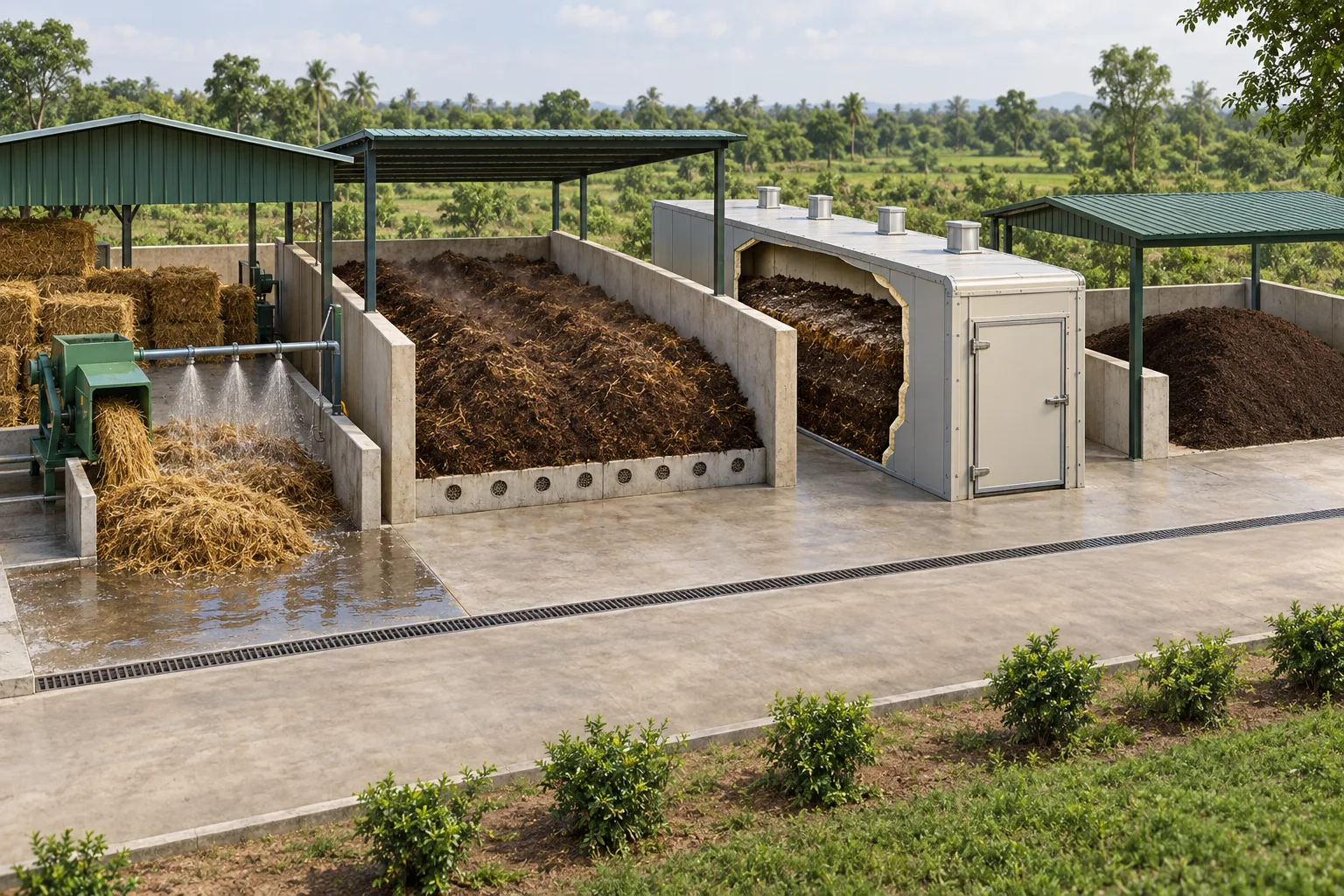
Conceptual teaching scene showing input preparation, a compost bunker, a Phase II tunnel and material handling.
AI-generated process overview. Read it as a list of process areas, not a construction layout, recipe or validated operating sequence.
Phase I
Initial composting: microbes transform mixed ingredients while water, air and material structure affect their activity.
Pasteurisation
A controlled treatment to reduce unwanted organisms. In mushroom composting it is not the same as making the whole material sterile.
Conditioning
The continuing biological work that helps make the compost suitable for mushroom mycelium, including conversion of ammonia-containing compounds. Heating alone does not prove this is complete.
Spawn run / Phase III material
After inoculation, mushroom mycelium colonises the prepared compost. A supplier selling colonised material has completed work that a buyer of unspawned Phase II compost must still do.

Learn it in this order

  1. Identify and prepare inputs

    Check which ingredients the selected formulation actually uses. Record received weight and moisture basis; wet kilograms and dry material are not interchangeable.

    Open this lesson →
  2. Manage Phase I

    Follow the chosen preparation system and compare conditions across the batch. A hot centre is one observation, not proof that every part of a pile has developed equally.

    Open this lesson →
  3. Complete Phase II

    Distinguish equalisation, pasteurisation, conditioning and cooling. Use the process operator’s validated programme and release measurements; do not deliberately sniff compost to test ammonia safety.

    Open this lesson →
  4. Release, spawn or receive

    Match the supplied compost stage to the work your farm will perform. Keep the batch record and receiving decision with the crop; hold unresolved material for competent assessment.

    Open this lesson →

Work through an example

Why two “100 kg” inputs may not be equivalent

The situation
Arithmetic example only: one 100 kg input contains 20% water by wet mass; another contains 60% water. These are invented values, not a compost formula or moisture target.
Think it through
The first contains 80 kg dry matter and 20 kg water. The second contains 40 kg dry matter and 60 kg water. To obtain 80 kg dry matter from the second material would require 200 kg of it, bringing 120 kg water.
Your next decision
The material balance changes even though the original wet weights match. Compare measured moisture and dry-matter contributions before revising a formulation. This calculation says nothing about equal nitrogen, carbon or suitability of the materials.
Check your understanding

Try answering first, then open the explanation.

The tunnel completed its heating period. Is the batch automatically ready for spawn?

No. Pasteurisation, conditioning and cooling have different purposes. Review representative measurements and the release criteria for that process before spawning.

Can I make one recipe by combining steps from different online compost methods?

That can produce an inconsistent process. First choose a complete, applicable method and understand its ingredient basis, equipment and stage controls. Have a trained compost operator review substitutions.

What is the next lesson?

Follow the illustrated chapters below, then open the specific Phase I, Phase II or receiving guide for the part of production you actually operate.

Learning sources and limits

Editorial teaching explanation, not an independently reviewed operating protocol. Worked scenarios are illustrative.

Continue to the detailed walkthrough ↓
The full field guide

Understand and document a compost batch

Follow raw materials through wetting, Phase I, Phase II and release. Learn what measurements mean and how to investigate a failed handoff.

Choose a picture to understand that part of the process.

  1. 01Start with the inputs
  2. 02Structure and air
  3. 03Understand the tunnel
  4. 04Release with evidence

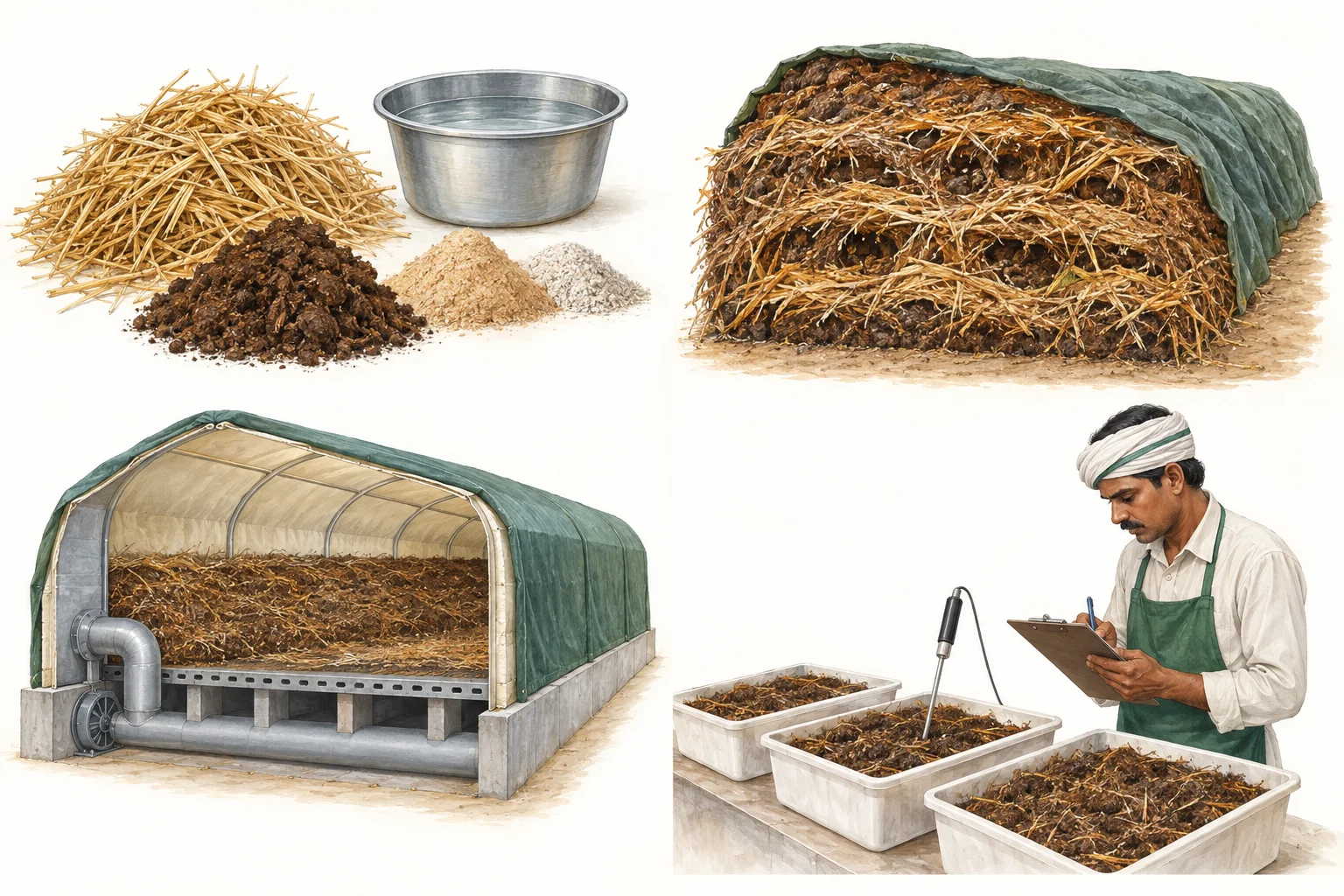
AI-generated teaching illustrations · Not photographs of actual farms

Chapter 01

A recipe starts with the material, not the bag count

Straw and manure deliveries vary in moisture, structure and composition. Record the source, receipt date, storage condition and as-received weight of each lot. A formula copied as truckloads or bags can change substantially when a new supplier delivers wetter or denser material. Keep the weight basis visible whenever you compare two recipes.

Use one documented formulation suited to the available process. List what each ingredient contributes and who may authorise substitutions. If laboratory results are available, record the test method, sample identity and whether values are expressed on a wet or dry basis. A chemical analysis cannot replace physical structure: air still needs pathways through the prepared mass.

During wetting, assess uniformity across the material. Water that drains away does not become useful substrate moisture, and visibly wet outer straw does not establish that the centre is equally wetted. Record additions and representative checks so the next operator understands how the batch reached its present condition.

Chapter 02

Read Phase I as a changing biological process

The first phase changes the raw material through microbial activity. Temperature is one sign of that activity, but a high peak does not describe the condition of the whole mass. Record several positions and interpret the pattern with moisture, structure, additions and turning or aeration events. Keep sensor location on the same chart as the reading.

Compare what happened before a change. Did the batch become compacted? Was a different lot introduced? Did aeration stop? Was water added unevenly? These questions help decide what evidence is missing before an operator changes the process. Follow the established method for the system; an outdoor heap and an aerated bunker should not be forced into one identical calendar.

  1. 01

    Before an operation

    Record readings and note where the material looks or behaves differently.

  2. 02

    During an operation

    Write the time, additions, turning or aeration change, and any equipment interruption.

  3. 03

    After an operation

    Measure at the planned locations again and compare the trend rather than a single peak.

Chapter 03

Distinguish pasteurisation, conditioning and cooling

Phase II is a controlled treatment of the compost with more than one objective. The pasteurisation stage and subsequent conditioning have different purposes. Completing a heating stage is therefore not, by itself, permission to add spawn. The process must also produce a suitable, conditioned material and bring it to the appropriate spawning condition.

Uniform loading and airflow matter because the air display and the coldest or warmest material location can differ. A time-and-temperature record should identify its measurement points. Record interruptions and corrective action instead of concealing gaps in the chart. Tunnel and steam-system operation needs a trained operator and a process suitable for the actual load and equipment.

At release, use the defined specification for the selected compost system, including its ammonia assessment, temperature, moisture and physical condition. Do not use a deliberate smell test to establish gas safety or substitute for the relevant measurement. Store the release decision with the batch, and keep unresolved material separate from accepted material.

What each record can and cannot establish
RecordIt helps establishIt cannot establish alone
Air temperature chartConditions at the air sensorTemperature at every point in the compost
Mapped compost readingsSpatial variation and responseAll aspects of maturity or hygiene
Ammonia assessmentOne release criterion under the chosen methodA complete quality certificate
Crop result linked to batchHow the delivered batch performed in contextThat compost caused every later crop problem
Chapter 04

Investigate the batch before changing the formula

If colonisation is poor, compare retained records from successful and unsuccessful batches. Start with delivered raw materials, moisture basis, mixing, loading, process continuity, cooling and transport. Then check spawn, handling and the receiving grow room. Altering the nitrogen addition immediately can hide a process or handling failure and create a new variable in the next batch.

Make the review specific enough to change one future decision. ‘Compost bad’ is not useful; ‘rear sensor remained cooler after filling density changed’ is an observation that can be investigated. Record the proposed change, its reason and what result would support or contradict the explanation. Use the testing and process-control guides for the relevant measurements.

Chapter sources & scope

These are educational explanations, not an independently reviewed operating protocol. Worked examples do not predict your yield or income.

Back to the chapter list ↑
देखें · समझें · जाँचें / See · understand · check

Understand the compost journey in four practical chapters.

For Button mushroom compost. Other mushrooms may use different substrate treatments. Start with the picture, then open the detailed stage guide.

AI teaching cutaway: input wetting, compost bunker, Phase II tunnel and material handling areas.
AI-generated teaching illustrationAreas are juxtaposed to explain their jobs—not a validated hygiene layout, handling method or construction design.
Educational illustration of straw, compost ingredients and water shown separately.
AI teaching illustration · Concept, not field evidenceRead this picture

Wet weight is not the same as dry matter.

Why it matters

Two equally heavy ingredient loads can contain different amounts of dry material.

Chapter 01

Know what goes into the batch

A compost batch starts with identifiable inputs, not an unlabelled heap. Ingredient condition and moisture change what a weighed load contributes.

What to check
Check straw condition, ingredient identity, storage protection and the basis used in the selected formulation.
Write this in the record
Supplier, lot, received weight, moisture basis, water added and formulation revision.
Open the detailed guide
Conceptual compost heap cutaway showing straw structure and internal spaces.
AI teaching illustration · Concept, not field evidenceRead this picture

The heap has structure, depth and internal variation.

Why it matters

One central reading does not describe every part of the material.

Chapter 02

Manage structure, water and air in Phase I

Phase I transforms the mixed materials. Moisture, the spaces between particles and air movement act together; a dense wet pocket can behave differently from the rest of a batch.

What to check
Compare representative locations and review the actual wetting, mixing, turning or aeration sequence. One temperature reading is not a batch profile.
Write this in the record
Time, sampling position, temperatures, additions, equipment state and every process intervention.
Open the detailed guide
Conceptual cutaway of a compost conditioning tunnel with material above an air plenum.
AI teaching illustration · Concept, not field evidenceRead this picture

Air must pass through the loaded material.

Why it matters

Pasteurisation, conditioning and cooling have distinct purposes.

Chapter 03

Separate pasteurisation, conditioning and cooling

In a short-method system, Phase II is a controlled sequence with distinct objectives. Heating alone does not demonstrate completion of conditioning or readiness for spawn.

What to check
Check filling uniformity, air passage through the load, sensor placement, process records and the approved release criteria.
Write this in the record
Tunnel and batch identity, loading pattern, representative trends, deviations and the release decision.
Open the detailed guide
Illustration of an operator recording a compost probe reading beside material samples.
AI teaching illustration · Concept, not field evidenceRead this picture

The batch record brings measurements and observations together.

Why it matters

The calendar alone cannot prove compost is ready for spawning.

Chapter 04

Release and receive with traceable evidence

Link the finished material to its production history. Purchased Phase II compost and colonised Phase III compost are different handovers; establish exactly what was supplied.

What to check
Reconcile supplier records, transport conditions, arrival observations and the agreed spawning or receiving requirements.
Write this in the record
Batch, supplied stage, arrival measurements, acceptance or hold decision, receiving room and responsible person.
Open the detailed guide
Before the next decision

Is the batch ready—or is information missing?

A checklist organises the evidence. It does not certify a batch or replace the release protocol.

  1. Identify the batch, ingredients and process route.
  2. Review representative process and quality records.
  3. Explain deviations and verify the corrective action.
  4. Record accept, hold or reject with a named reviewer.
Open the batch-release review

Understand the topic

The key ideas, at a glance.

The operator manages a batch through material acceptance, wetting, mixing, Phase I, Phase II, cooling and release while preserving traceability.

Part 01

Simple explanation

Compost is a biologically transformed growth medium. It is not raw straw and it is not a universal recipe.

Conceptual compost heap cutaway showing straw structure and internal spaces.
AI teaching illustrationStructure and air

The heap has structure, depth and internal variation. One central reading does not describe every part of the material.

Conceptual explanation—not a real farm photograph, diagnostic finding or construction specification.
Part 02

What is happening

Microorganisms, water, oxygen, heat, structure and nitrogen transformations interact to create a substrate that supports Agaricus bisporus more selectively than the original ingredients.

Part 03

Operator explanation

The operator manages a batch through material acceptance, wetting, mixing, Phase I, Phase II, cooling and release while preserving traceability.

Part 04

What to look for

Observation should describe stage, location, pattern and change history before interpretation.

  • Material-lot consistency
  • heat and gas patterns
  • moisture distribution
  • air paths
  • ammonia evidence
  • final structure
Part 05

What to measure

Measurement must retain method, unit, location, timing, calibration and sample identity.

  • Representative temperature map
  • declared moisture method
  • safe ammonia method
  • batch mass and process history
Part 06

Equipment and process boundary

Equipment is useful only when its role in the biological process is explicit.

  • Pre-wetting and mixing area
  • Phase I system
  • Phase II system
  • sensors
  • clean transfer equipment
Part 07

Variables that interact

Every stage changes the physical, chemical and biological starting condition of the next stage.

Part 08

What can go wrong

A symptom may have several mechanisms. Verify the cause before changing the process.

  • Recipe thinking
  • unregistered numeric setpoints
  • poor sampling
  • dirty-to-clean backtracking
  • equipment selected without process duty
Part 09

What changes at commercial scale

Scaling changes geometry, repeatability, instrumentation, material flow and failure consequence.

  • Small seasonal operations depend more on weather and manual uniformity
  • Commercial systems add forced aeration, tunnels, instrumentation and batch scheduling
Part 10

What the evidence can tell you

Mapped evidence: Mushroom Cultivation, Marketing and Consumption; Farm Design for White Button Mushroom Cultivation; Technologies Developed by ICAR-DMR for Commercial Use; Dynamics of microbial community and enzyme activities during Agaricus bisporus compost preparation. Foundational, current operational, research and engineering sources retain their different roles.

Illustration of an operator recording a compost probe reading beside material samples.
AI teaching illustrationRelease with evidence

The batch record brings measurements and observations together. The calendar alone cannot prove compost is ready for spawning.

Conceptual explanation—not a real farm photograph, diagnostic finding or construction specification.

Keep exploring

Every part of this topic.

Choose the stage, material or decision you need to understand next.

01

What Is Selective Button Mushroom Compost?

Understand why raw straw becomes a specialized microbial substrate that can support Button Mushroom cultivation.

02

Compost Raw Materials

Treat every straw, manure, concentrate, conditioner and water source as a variable material lot.

03

Phase I Composting

Manage wetting, mixing, microbial heat, oxygen, moisture, ammonia and structure as a dynamic first-stage process.

04

Phase II Composting

Treat filling, equalization, pre-pasteurization conditioning (PPC), pasteurization, post-pasteurization conditioning (POPC), cooling and unloading as distinct process objectives.

05

Compost Bunkers

Plan bunker geometry, loading, aeration, drains, probes and operator access around the process duty.

06

Phase II Compost Tunnels

Understand the insulated envelope, plenum, air floor, return path, fan, dampers, sensors, door and drainage.

07

Compost Quality Control

Combine sensory, physical, chemical, biological and process-history evidence before a spawning release.

08

Compost Troubleshooting

Investigate symptoms through raw material, water, mixing, structure, oxygen, temperature, airflow, equipment, sensors, timing, operator and hygiene domains.

Go deeper

Technical reference, records and tools.

Detailed crop-stage information, parameters, diagrams and specialist tools are kept together below. This material retains its source conditions and review limits.

Open the complete technical reference

Science, process and engineering

Button mushroom compost, step by step.

From raw materials and microbial fermentation to pasteurization, conditioning and ready-to-spawn selective compost.

Crop context
Agaricus bisporus
Coverage
Raw materials to release
Technical values
Registry governed
Evidence model
Applicability retained

Choose your entry point

Start with your role, stage or current uncertainty.

End-to-end production system

Each stage inherits the last stage's condition.

The map connects material decisions, biological transformation, engineered control and release evidence.

  1. 01Raw MaterialsTreat every straw, manure, concentrate, conditioner and water source as a variable material lot.
  2. 02Water in CompostingUnderstand water as a process input whose absorption, retention, drainage and evaporation are different records.
  3. 03FormulationCompare sourced formulation families without turning one ingredient list into a universal recipe.
  4. 04Phase I CompostingManage wetting, mixing, microbial heat, oxygen, moisture, ammonia and structure as a dynamic first-stage process.
  5. 05MicrobiologyFollow microbial succession from wetting through thermophilic transformation, conditioning and selective compost.
  6. 06ChemistryConnect carbon, nitrogen, ammonia, pH, minerals and microbial biomass without reducing compost to one laboratory number.
  7. 07Ammonia in Mushroom CompostDistinguish ammonia origin, presence, concentration, smell, biological transformation, operator safety and spawning suitability.
  8. 08Phase II Tunnel FillingBuild a uniform loaded mass whose depth, density and sensor map support air distribution and process verification.
  9. 09Phase II EqualizationReduce temperature differences through the loaded compost before advancing to the treatment objective.
  10. 10PasteurizationUnderstand pasteurization as a verified time, temperature and uniformity objective within a living compost process.
  11. 11Phase II Conditioning: PPC and POPCDistinguish conditioning before pasteurization from the post-pasteurization finishing phase used to reduce residual ammonia and establish spawning readiness.
  12. 12Controlled Cooling Before SpawningCool the compost mass under control and verify spawning readiness beyond the temperature of the tunnel air.
  13. 13Quality ControlCombine sensory, physical, chemical, biological and process-history evidence before a spawning release.
  14. 14Testing and SamplingChoose representative samples, declared methods and units before interpreting laboratory or field results.
  15. 15Maturity and Ready-to-Spawn ReviewEvaluate ammonia, temperature stability, moisture, structure, chemistry and complete process history without falsely certifying a remote batch.

Knowledge architecture

Forty-one governed routes, organized as one system.

What happens when one variable changes?

Explore defensible directional relationships, with their uncertainty still attached.

Increase retained moisture

  1. 1Water films may occupy pore pathways
  2. 2Free air space may decrease
  3. 3Air resistance may increase
  4. 4Anaerobic risk may rise
  5. 5Heat and microbial patterns may change

Direction depends on starting moisture, structure, particle form and distribution.

The numbers for this step, with their source.

Process values are published from ICAR-DMR guidance with the stage and measuring point they apply to. A parameter still marked pending has no published Indian value yet.

Biological and process parameters

COMPOST.QUALITY.MATURITYpending technical verification

Compost maturity evidence

Technical value pending verification
Stage
Quality release
Measurement context
Batch record plus representative samples
Conditions
Ammonia; temperature stability; structure; moisture; process history
COMPOST.AMMONIA.RESIDUALsource contextual

Residual ammonia release criterion in the cited DMR method

Technical value pending verification
Stage
POPC and release
Measurement context
Representative compost and process-air evidence using a declared safe method
Conditions
The cited release criterion is strictly below 10 ppm; State sampling location, instrument or method, temperature and cooling status; Do not use odour alone as a release measurement

Engineering design metrics

COMPOST.AERATION.AIRFLOWpending technical verification

Required airflow

Project value pending verification
Component
Aeration system
Design context
Process stage and loaded compost resistance
Method
Project-specific engineering calculation required
COMPOST.AERATION.STATIC_PRESSUREpending technical verification

Required static pressure

Project value pending verification
Component
Aeration system
Design context
Complete floor, duct and compost system
Method
Project-specific engineering calculation required
Evidence, applicability and review4 mapped sources

Sources support mechanisms and architecture. Technical and engineering values publish only through their separate governed registries.

Tier Afoundational

Mushroom Cultivation, Marketing and Consumption

Indian Button Mushroom compost methods, cultivation context, Phase I and Phase II process vocabulary.

Publisher
ICAR-Directorate of Mushroom Research
Accessed
2026-08-22
Open original source
Tier Afoundational

Farm Design for White Button Mushroom Cultivation

Indian farm workflow, compost-unit components, tunnel and controlled-farm engineering vocabulary.

Publisher
ICAR-Directorate of Mushroom Research
Accessed
2026-08-22
Open original source
Tier Acurrent operational

Technologies Developed by ICAR-DMR for Commercial Use

Documents distinct Indian composting methods, including aerated indoor Phase I and ZEPT concepts.

Publisher
ICAR-Directorate of Mushroom Research
Accessed
2026-08-22
Open original source
Tier Cresearch

Dynamics of microbial community and enzyme activities during Agaricus bisporus compost preparation

Microbial succession, thermophilic communities, lignocellulose transformation and conditioning mechanisms.

Publisher
ISME Communications
Accessed
2026-08-22
Open original source

Read the evidence

Sources & review.

Editorial update: 2026-08-22. Independent technical review is not recorded for this entry.

  1. Mushroom Cultivation, Marketing and Consumption

    ICAR-Directorate of Mushroom Research

  2. Farm Design for White Button Mushroom Cultivation

    ICAR-Directorate of Mushroom Research

  3. Technologies Developed by ICAR-DMR for Commercial Use

    ICAR-Directorate of Mushroom Research · 2020

  4. Dynamics of microbial community and enzyme activities during Agaricus bisporus compost preparation

    ISME Communications · 2022

Reading a source is not the same as applying its instructions to every farm. Confirm species, strain, crop stage, system, region and publication date. Old chemical recommendations are not current-use instructions.

See something that needs correcting? Tell us →