


Beginner-to-project manual · India
How to plan a commercial Button Mushroom farm in India.
A beginner-first guide to the decisions behind a controlled farm. Start with the buyer, choose how you will source compost, calculate rooms and utilities, check the money, then build and test in stages.
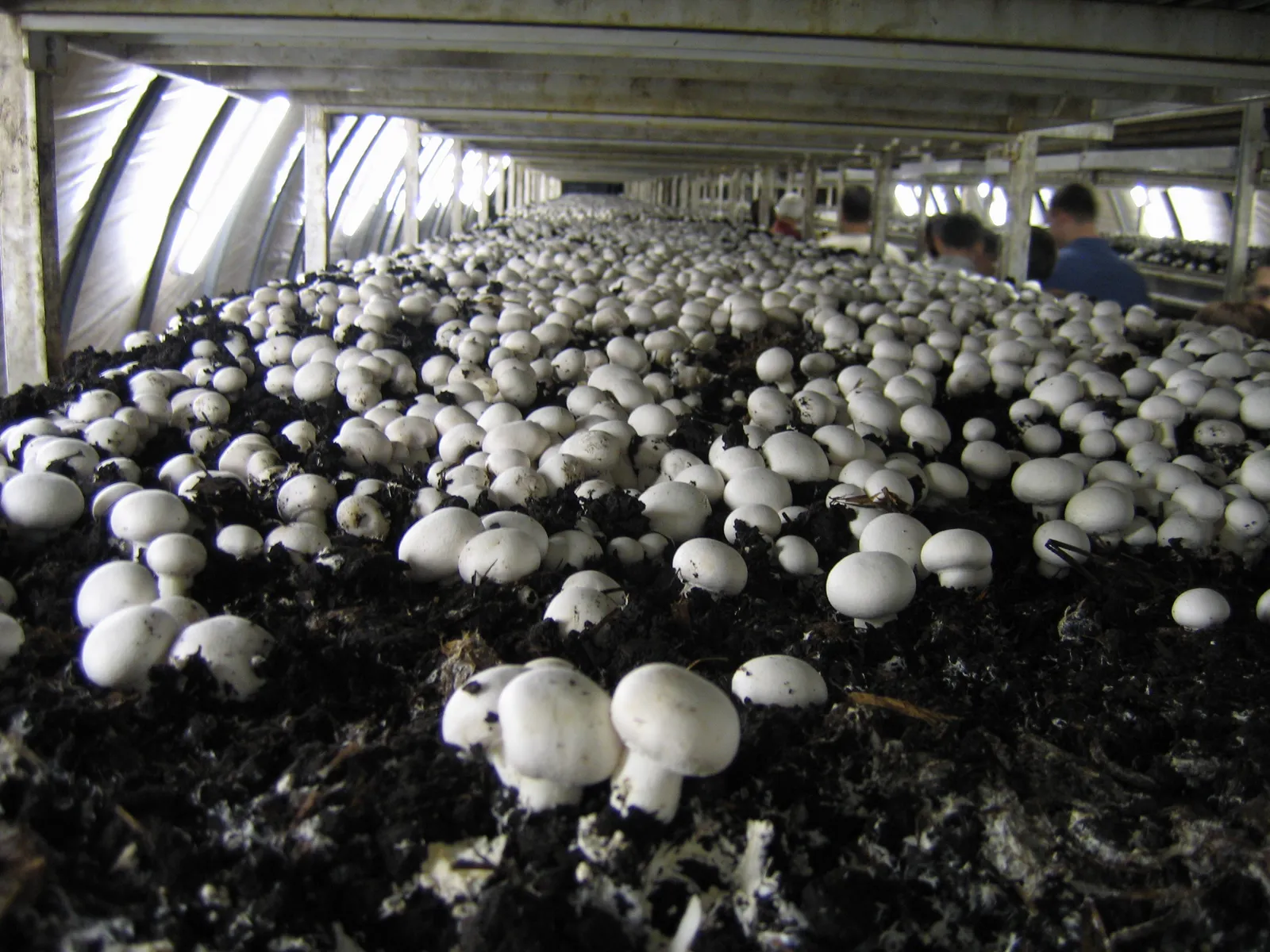
 Real contextual photo
Real photograph of cultivated Button Mushrooms. It provides crop context, not proof of a particular farm, yield, climate setpoint or diagnosis.
Photo: I. G. Safonov (IGSafonov). CC BY-SA 3.0. Source and licence- Start with
- Buyer demand
- Then calculate
- Saleable kg/day
- Before construction
- Project requirements
- Before first crop
- Test every room
New to commercial mushroom farming?
See the whole project as six simple decisions first.
The technical detail below matters, but it is not where a beginner should start. Follow this short route from top to bottom, then open the detailed section you actually need.
- 01Buyer
Who will buy every day?
Write the grade, daily quantity, price, rejection rule and payment days.
See the detail - 02Farm type
Will you buy or make compost?
Choose a model only after understanding the extra complexity it adds.
See the detail - 03Capacity
How much can you really sell?
Work backwards from buyer demand to compost, rooms and cooling capacity.
See the detail - 04Farm flow
Can clean and dirty routes stay apart?
Draw loading, crop, harvest, packing and waste movement before construction.
See the detail - 05Money
What cash is needed end to end?
Separate building cost, running cost and the payment-delay cash gap.
See the detail - 06Pilot
Can one small cycle prove the system?
Test rooms and people first; increase loading only after the evidence repeats.
See the detail
Tap a technical word to see its simple meaning.
Compost+
The prepared growing material in which Button Mushroom mycelium grows. It is not ordinary soil or manure.
Crop room+
An insulated room where temperature, humidity, fresh air and carbon dioxide are controlled.
CAPEX+
The one-time cost of constructing the farm and installing equipment.
OPEX+
The recurring cost of running, harvesting, cooling and selling each crop.
Commissioning+
Proving the rooms, alarms, backup and cooling before crop loading and again with a real load.
URS+
A written list of what the farm must do and how that performance will be tested on site.
See the farm before reading the manual
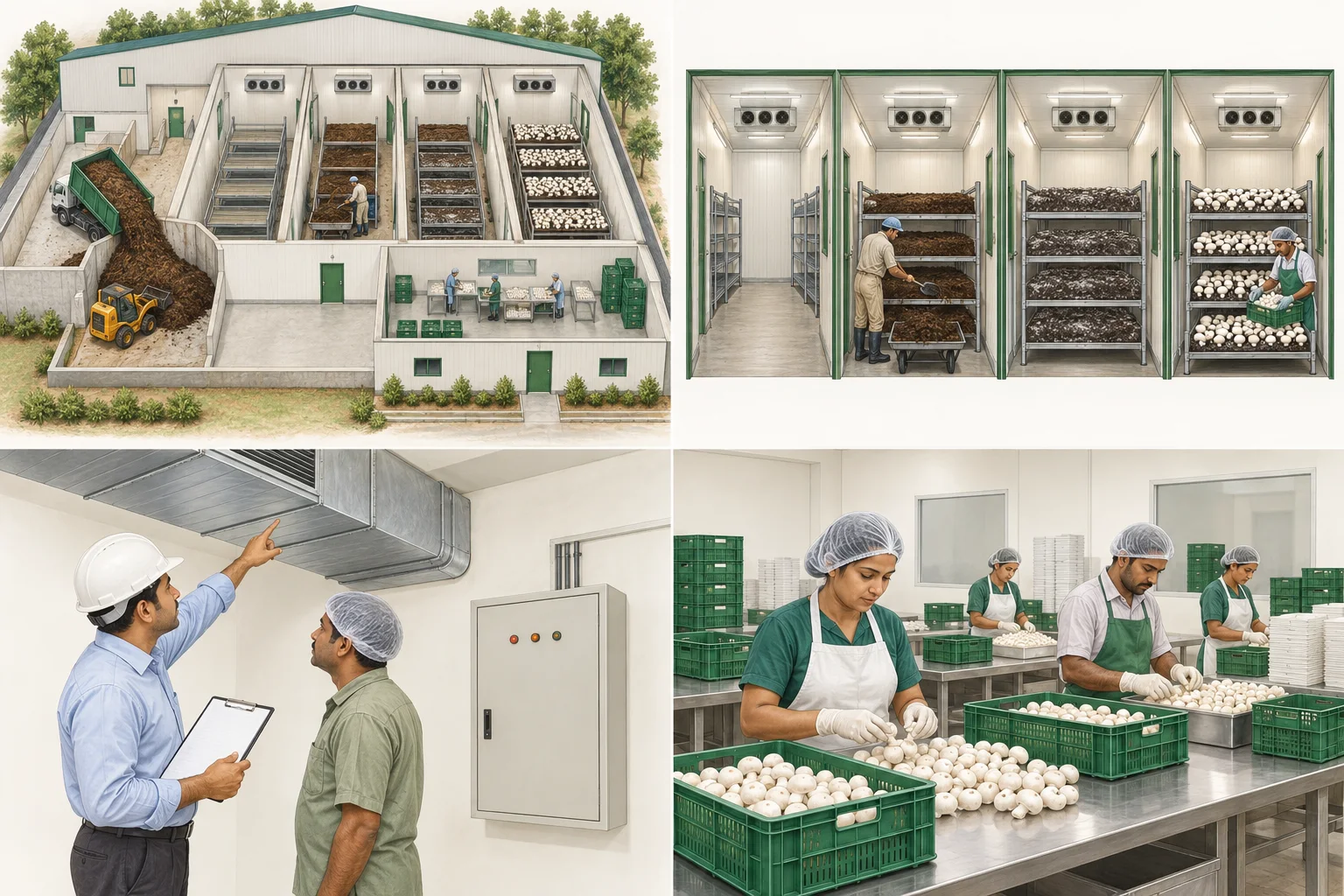
A commercial crop is six connected systems moving together.
A delay or failure in one box reaches the next. Use this visual as the mental map for the entire project.
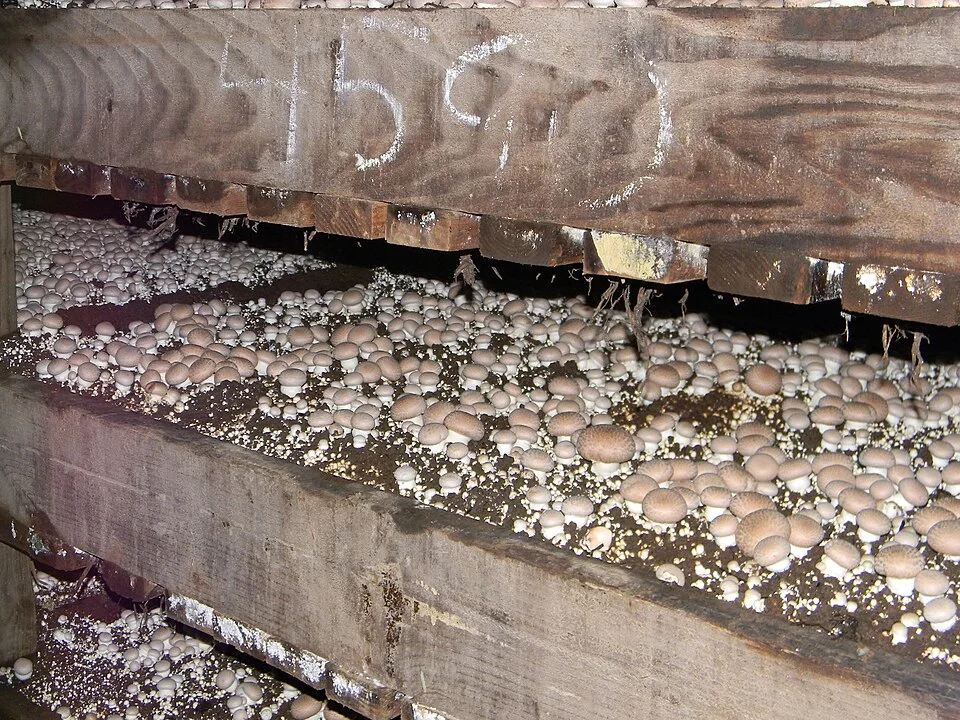 Real contextual photo
Real cultivation photograph showing Button Mushrooms across tiered beds. The rack, spacing and crop density are context, not a construction drawing or yield standard.
Photo: I. G. Safonov (IGSafonov). CC BY-SA 3.0. Source and licence- 01
Compost
Receive a qualified, traceable batch
- 02
Load rooms
Fill rooms on staggered dates
- 03
Control crop
Watch air, temperature and moisture
- 04
Harvest
Pick, grade and record every day
- 05
Cool quickly
Remove product heat without delay
- 06
Buyer close
Track accepted kilograms through payment
- 1Buyer demand
- 2Saleable kg/day
- 3Compost + rooms
- 4Harvest peak
- 5Cool + dispatch
- 6Acceptance + cash
Project boundary
Define the operating system before the equipment list.
A commercial farm is not a collection of insulated rooms. It is a scheduled flow of accepted compost, biological stages, air and refrigeration duty, trained labour, cold product and buyer cash. No room size, equipment brand or subsidy percentage can replace that reconciliation.
Understand the working room
AI-generated educational illustrations. Not actual farm photographs, diagnostic evidence or construction specifications.
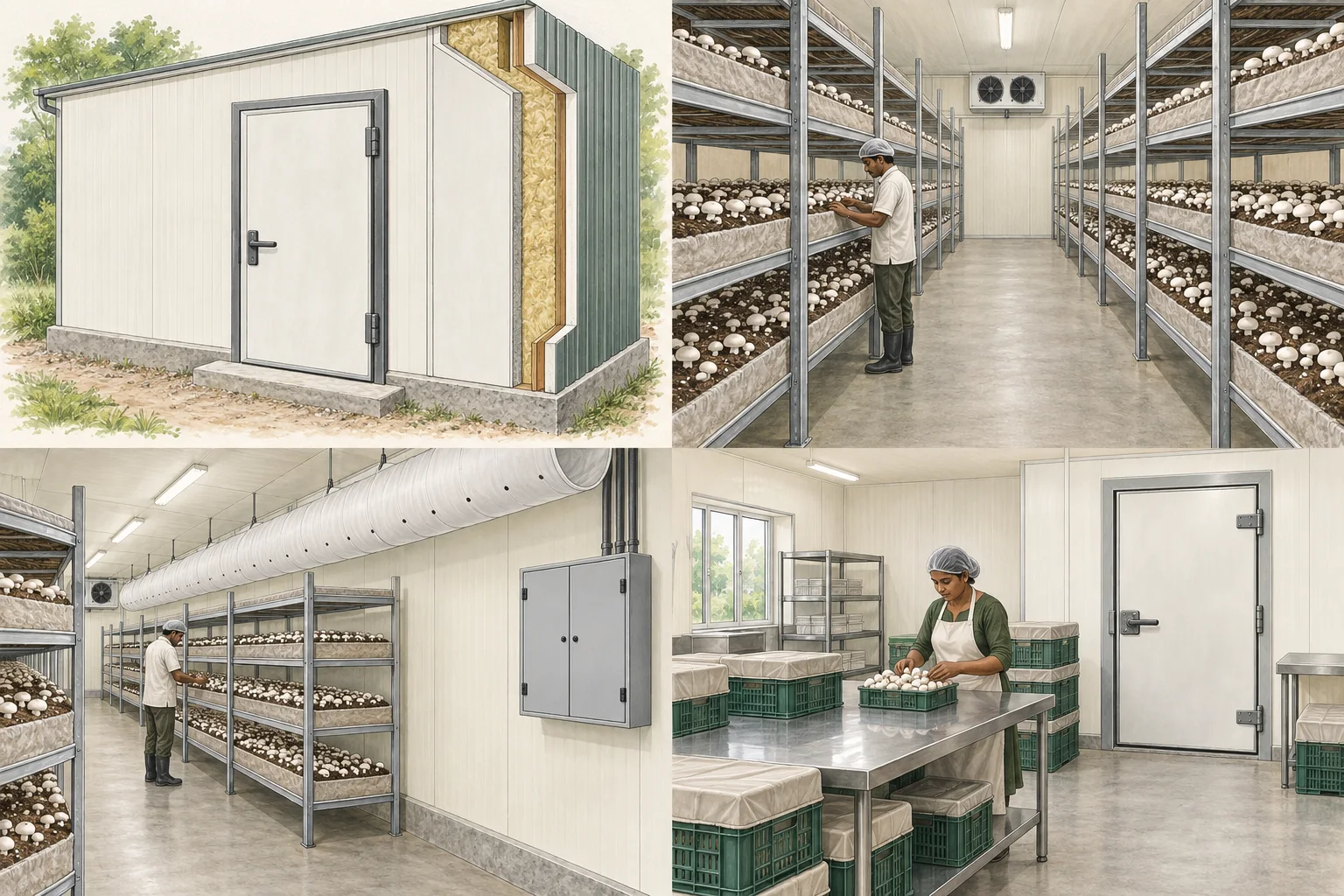
Keep the room envelope continuous
Walls and doors form one enclosure. Joints, penetrations and door use affect the room as well as insulation. This cutaway is not a material or fire-safety specification.
Ask a qualified designer to review the envelope, moisture protection, cleanability and local safety requirements together.
Leave room for people to work
People need access to every growing level. Adding shelf area changes handling, access and air distribution. An attractive room picture cannot establish safe rack dimensions.
Walk through loading, harvesting, cleaning and emergency access with the designer before fixing the rack arrangement.
Distribute air through the crop
The duct serves a room containing racks and crop. Air delivery must be evaluated in the loaded room. Equipment capacity alone does not demonstrate uniform crop conditions.
Include representative loaded-room measurements, maintenance access and alarm checks in commissioning. Keep electrical cabinets closed.
Connect packing and dispatch
Harvested mushrooms move through handling and storage spaces. Growing, grading and dispatch need a coordinated workflow. A closed door does not prove a suitable storage temperature.
Confirm buyer specifications, storage conditions, cleaning routines and dispatch timing before the first commercial harvest.
MushroomWale’s commercial project experience connects this guide to real implementation questions across grow rooms, compost units, EPC, BOQs, DPRs, training and maintenance. Education and sales claims still remain distinct: vendor prices, room capacities and yield assumptions do not become universal facts.
Visit the MushroomWale project platformThis is an editorially published, source-linked educational framework. Source links and internal checks are not independent endorsement; have qualified reviewers check project-specific design, crop, finance and compliance decisions.
01 · Pre-investment decision
If one gate fails, the project is conditional.
A quotation is not a gate. Equipment orders or subsidy assumptions do not make the project ready while evidence remains open.
Market absorption
Named buyers, grade, pack, daily acceptance, receiving time, rejection rule, net rate and credit days.
PASS · CONDITIONAL · FAILCompost route
Qualified purchased ready compost, or a fully designed Phase I/II operation with raw-material, odour, water and batch controls.
PASS · CONDITIONAL · FAILSite & logistics
All-weather truck access, clean/dirty movement, drainage, expansion, neighbours, waste route and legal land use.
PASS · CONDITIONAL · FAILUtilities
Measured supply quality, connected and peak load, transformer/generator path, water test, storage, drainage and communications.
PASS · CONDITIONAL · FAILOperating team
A crop lead, room operators, hygiene, harvest/cold-chain, maintenance, data and market ownership, not only casual labour.
PASS · CONDITIONAL · FAILFinance & failure margin
Installed cost, working capital, debt timing, ramp-up, downtime, rejection, price stress and corrective reserve.
PASS · CONDITIONAL · FAIL02 · Choose the architecture
Do not confuse integration complexity with investment quality.
Production farm
Buy reviewed ready compost- Merit
- Lowest process complexity and faster project entry
- Primary risk
- Supplier dependence, transport heat and batch variability
- Choose when
- Best when supply is proven through several traceable cycles
Integrated farm
Phase I + Phase II + growing + pack/cold- Merit
- Control over compost schedule and repeated process learning
- Primary risk
- More land, odour/water duty, batch science, equipment and working capital
- Choose when
- Choose only when growing and compost throughput reconcile
Advanced integration
Add spawn, processing or external compost sales as separate projects- Merit
- Potential control or diversified revenue
- Primary risk
- Sterile competence, food compliance, QA, market and management complexity
- Choose when
- Stage after the core farm operates repeatably
03 · Capacity chain
Room count is the sixth answer in the chain, not the first.
Interactive project model · assumptions visible
Work from daily market demand to room count, not from room size to profit.
The fields begin blank by design. The model will not invent a universal answer without your buyer, crop, room and quotation evidence.
01 · Capacity logic
02 · Calculated production system
The result will reconcile crop-room count, compost throughput and the loading rhythm on one basis.
03 · Finance assumptions
04 · Operating scenario
The model uses realized price and saleable kilograms, not headline yield or a quoted market price.
04 · Site zoning
Separate product and contamination routes on the drawing.
Raw materials, compost, clean loading, crop, harvest, cold dispatch and spent material must be visible without uncontrolled crossings.
- 01RAW
- 02COMPOST
- 03CLEAN LOAD
- 04CROP
- 05PACK
- 06DISPATCH
05 · Compost strategy
Make versus buy is not a ₹/bag comparison.
- 01BUY + ACCEPT
- 02OR
- 03MAKE + RELEASE
- 04TRACE BATCH
Batch quality
Write supplier release and arrival acceptance
Own sampling, Phase I/II curves and release authority
Schedule
Protect delivery slots and alternate supplier
Balance bunker, tunnel, spawning and crop-room rhythm
Site impact
Receiving/quarantine and covered handling
Raw-material yard, runoff, odour, process air and spent route
People
Skilled acceptance and crop team
Dedicated compost process lead plus maintenance and lab support
Economics
Delivered ready-compost cost and failure exposure
Raw material, dry-matter loss, power, labour, depreciation and reject batches
Decision evidence
Several traceable bought-compost crops
Pilot batches and independently reviewed release data
06 · Room rotation
If every room shares one stage, labour and market demand will spike together.
- 01LOAD
- 02SPAWN RUN
- 03CASE
- 04FRUIT
- 05HARVEST
- 06CLEAN
This is not a crop schedule. Build the rotation from actual occupied days, turnaround, crop response, compost availability and buyer demand, and preserve sanitation/recovery margin.
A beginner can pause here. Use the detail below with your engineer, consultant and operating team.
This is not an equipment shopping list. It is a checklist of questions, proof and documents so the project does not depend on quotations alone.
07 · Engineering URS
Put a design basis and acceptance proof beside every equipment item.
- 01OUTDOOR AIR
- 02AHU
- 03CROP ZONE
- 04RETURN
- 05EXHAUST
Envelope
Outdoor design weather, vapour path, cleanability and pressure intent
Leak, thermal, condensation and door-seal tests
Racks & handling
Room load, access, harvest ergonomics, corrosion and cleaning
Load, clearance, cleanability and movement trial
Air handling
Crop load, distribution, return/fresh air and pressure losses
Mapped air/CO₂/temperature response, not fan nameplate
Refrigeration
Peak sensible/latent/crop/ventilation/transmission load
Pull-down, hold and recovery under design load
Humidification
Water quality, droplet separation, hygienic access and control interaction
Uniform response without wet caps or surfaces
Sensors & controls
Measurement map, calibration, alarms, trends and manual fallback
Compared instruments, alarm challenge and time-stamped records
Electrical & backup
Connected/starting demand, power quality, protection, earthing and critical-load priority
Load test, changeover, alarm and safe-restart drill
Water & drainage
Quality, peak demand, storage, slope, segregation and treatment route
Flow, drain, backflow, stagnation and cleaning test
Pack & cold chain
Harvest peak, product heat, grade flow, pack depth and dispatch window
Timed harvest-to-cool and buyer handoff trial
08 · Utilities and failure design
A backup is useful only when the operating state is tested.
Grid failure
ProtectCritical ventilation, controls, cold chain and safe restart
EvidenceAutomatic notification, named responder and tested backup duration
Refrigeration failure
ProtectRoom prioritisation, crop stage, service access and parts
EvidenceTemperature trend, escalation threshold and recovery log
Water failure
ProtectHumidification, cleaning and staff hygiene priorities
EvidenceTested storage, quality release and alternate supply
Sensor/control failure
ProtectIndependent reference instruments and manual operating state
EvidenceFault indication, replacement and data-gap annotation
Compost delay/failure
ProtectRoom schedule and buyer commitments
EvidenceHold loading, supplier escalation and rescheduled dispatch plan
Cold-chain/vehicle failure
ProtectHarvest peak and buyer receiving window
EvidenceBackup cooling, alternate vehicle/buyer and lot decision
09 · People and records
Automation does not remove ownership.
Promoter / project owner
Market, finance, scope decisions and stop/go authority
Project decision registerCrop lead
Stage release, room rotation and biological response
Batch and stage handoffEngineering lead
URS, loads, integration, commissioning and change control
Design basis and test dossierCompost lead
Supplier acceptance or Phase I/II batch release
Compost batch recordQuality & hygiene
Zoning, traceability, deviations and room release
Hygiene and CAPA registerMarket & finance
Buyer schedule, dispatch, receipts, credit and cash forecast
Sales and working-capital ledger10 · Market and cold chain
Crop success closes at buyer acceptance and payment.
- 01PICK
- 02GRADE
- 03COOL
- 04PACK
- 05DISPATCH
- 06ACCEPT
Harvest lot
Pick time · grade · gross/saleable/reject
Cooling
Product temperature · start time · pack depth
Dispatch
Vehicle · departure · arrival · condition
Buyer close
Accepted kg · net rate · rejection · payment due
11 · Full project economics
Keep CAPEX, OPEX and the cash gap in separate pockets.
Build the farm
Civil work, rooms, racks, cooling, electrical work and installation
Run every crop
Compost, labour, power, packing, freight and maintenance
Survive delay and failure
Ramp-up, buyer credit, rejection, downtime and subsidy delay
Installed asset stack
- 01Land/legal/site development
- 02Civil and insulated envelope
- 03Racks and material handling
- 04Climate/refrigeration/controls
- 05Electrical, transformer and backup
- 06Water, drainage and treatment
- 07Compost infrastructure or supplier setup
- 08Pack-house, cooling and transport
- 09Lab/QA/IT where justified
- 10Pre-operative, finance and contingency
Cost to produce and sell
- 01Ready compost or compost raw materials
- 02Spawn, casing and crop consumables
- 03Power, fuel, water and treatment
- 04Production, harvest and management labour
- 05Packaging, cooling, freight and commission
- 06Maintenance, calibration, AMC and spares
- 07Rejects, downtime and sanitation
- 08Interest, insurance, admin and compliance
12 · DPR, bank and subsidy
A cost norm is not a project quotation. Assistance is not cash in hand.
Mushroom production unit
Compost-making unit
Spawn-making unit
General / specified special regions; credit linkage can be conditional on project cost and implementing-agency procedure
Annexure V describes private assistance as credit-linked and back-ended, while the general provision says credit linkage may be optional for projects up to ₹30 lakh and describes two-instalment release through TRA/Escrow/SRF after satisfactory joint inspection. Obtain written confirmation of the procedure for the actual project from the current state agency and lender.
13 · Procurement and EPC
Choose the most complete comparable scope, not the lowest total.
Design basis
URS, site data, room load, crop schedule and peak conditions
Signed basis before quotation comparison
Scope split
Vendor supply, installation, civil coordination and client work
One responsibility matrix with no unowned interface
BOQ
Make/model or performance class, quantity, material, duty and accessories
Itemised commercial comparison; GST/freight clearly separated
Acceptance
Factory/site tests, empty and loaded commissioning
Pass criteria, instruments, witnesses and retest rule
Documentation
Drawings, manuals, certificates, warranties and as-built records
Handover index and controlled revisions
Training & support
Operator/maintenance curriculum, response time and spare strategy
Named trainees, competency check and AMC boundary
Change control
Every substitute, deletion, site variation and price effect
Written approval before execution
14 · Delivery roadmap
Decisions before construction. Proof before loading.
- 00
Reject, pilot or proceed
Close the six gates; do not use construction to discover market fit.
- 01
Project brief
Freeze promoter objective, location, saleable kg/day, product form and integration boundary.
- 02
Site & market evidence
Complete buyer ledger, utility data, access, drainage and legal checks.
- 03
Concept and URS
Reconcile process flow, room rotation, compost route, cold chain and critical failure cases.
- 04
TEFR / DPR / finance
Use current quotations and explicit assumptions; align means of finance and working capital.
- 05
Detailed engineering & BOQ
Issue coordinated civil, mechanical, electrical, controls and drainage documents.
- 06
Procurement & construction
Control materials, interfaces, deviations, progress evidence and payment milestones.
- 07
Installation & pre-commissioning
Verify completeness, wiring, flow direction, access, calibration and safety.
- 08
Empty then loaded commissioning
Prove distribution, alarms, failures, room recovery and crop response.
- 09
Ramp-up & review
Increase loading only after saleable output, buyer acceptance, utilities and team response repeat.
15 · Project risk register
Name the owner and trigger before the risk occurs.
Market
Single buyer or verbal demand
Buyer ledger, staggered commitments, alternate grade/channel
PromoterCompost
Unknown batch or unstable supply
Written acceptance, quarantine, alternate route, release authority
Crop/compost leadClimate
Equipment sized from floor area alone
Documented peak loads, distribution model and commissioning
Engineering leadPower
No starting-load or outage plan
Electrical study, priority loads, safe changeover and drills
Electrical ownerBiosecurity
Clean and dirty routes intersect
Physical zoning, schedule, tools and deviation containment
Quality leadLabour
Harvest peak and night rounds unstaffed
Shift plan, cross-training, relief and competency records
OperationsFinance
Subsidy treated as day-zero cash
Full funding bridge, delay stress and lender-confirmed schedule
Promoter/CARamp-up
All rooms loaded before system proof
Phased rooms, reviewed first cycles and stop-loss trigger
Project steering team16 · Commissioning and handover
Equipment running is not proof that the farm is crop-ready.
- 01DESIGN BASIS
- 02EMPTY TEST
- 03LOADED TEST
- 04HANDOVER
Document release
Approved drawings, manuals, calibration, electrical tests and open-punch list are controlled.
Empty-room proof
Envelope, drains, airflow, temperature/RH response, alarms, backup and cleaning route are demonstrated.
Loaded-room proof
Representative compost heat, distribution, fresh air, moisture and recovery are verified with the actual load.
Product-chain proof
Harvest peak, grading, cooling, storage, vehicle and buyer receipt close as one timed trial.
People handover
Operators diagnose scripted faults, record actions and sign role-specific competence before final release.
Printable implementation pack
Carry four sheets into meetings, banking and the site.
Print in A4 landscape. Copy the blank rows to build evidence for every buyer, vendor, room and test.
Project definition
Market validation
URS and BOQ acceptance
Commissioning handover
Evidence and disclosure
Read both the source and its limit.
An older project report can teach structure without proving current cost or market. A vendor catalogue can clarify scope without becoming independent performance evidence.
Farm Design for White Button Mushroom Cultivation
Facility functions, commercial-room context and workflow design.
Open source100 TPA Integrated Sample Project Report
Historical sample structure for capacity, process, project cost and financial schedules. Its market, cost and chemical content is not current.
Open sourceTEFR consultancy
Official project-formulation service and capacity-based TEFR pathway.
Open sourceEntrepreneurs training curriculum
Commercial farm design, controlled production, economics, crop protection and post-harvest training scope.
Open sourcePost Harvest Technology of Mushrooms
Rapid cooling, pack-depth and cold-chain principles.
Open sourceOperational Guidelines
Official cost norms and assistance patterns; current implementation and later amendments must be checked.
Open sourceCurrent schemes and guidelines
Current notices, applicant eligibility, technical standards and scheme documents.
Open sourceParent organization and commercial project platform
Practical implementation context for grow rooms, compost units, BOQ/DPR packaging, EPC, training and maintenance; vendor assumptions remain distinct from independent scientific evidence.
Open sourceFrom MushroomFarming.in learning to MushroomWale execution
Ready to turn the learning into a project?
MushroomFarming.in, an educational initiative by MushroomWale, provides the learning, evidence and decision framework. Site surveys, detailed engineering, BOQs, DPRs, procurement, construction and commissioning continue through MushroomWale’s clearly identified commercial pathway.