


A practical guide to growing mushrooms in IndiaA joint educational initiative by MushroomWale & DMR Solan
MushroomFarming.in

A joint educational initiative by

MushroomWale.com
ICAR–Directorate of Mushroom Research, Solan logoICAR–DMRSolan

MushroomFarming / guide

Mushroom Environmental Control

A governed climate guide to connect crop biology, heat, carbon dioxide, water vapour, air movement and control actions as one room system.

4 full chapters + technical referenceSources & review ↓
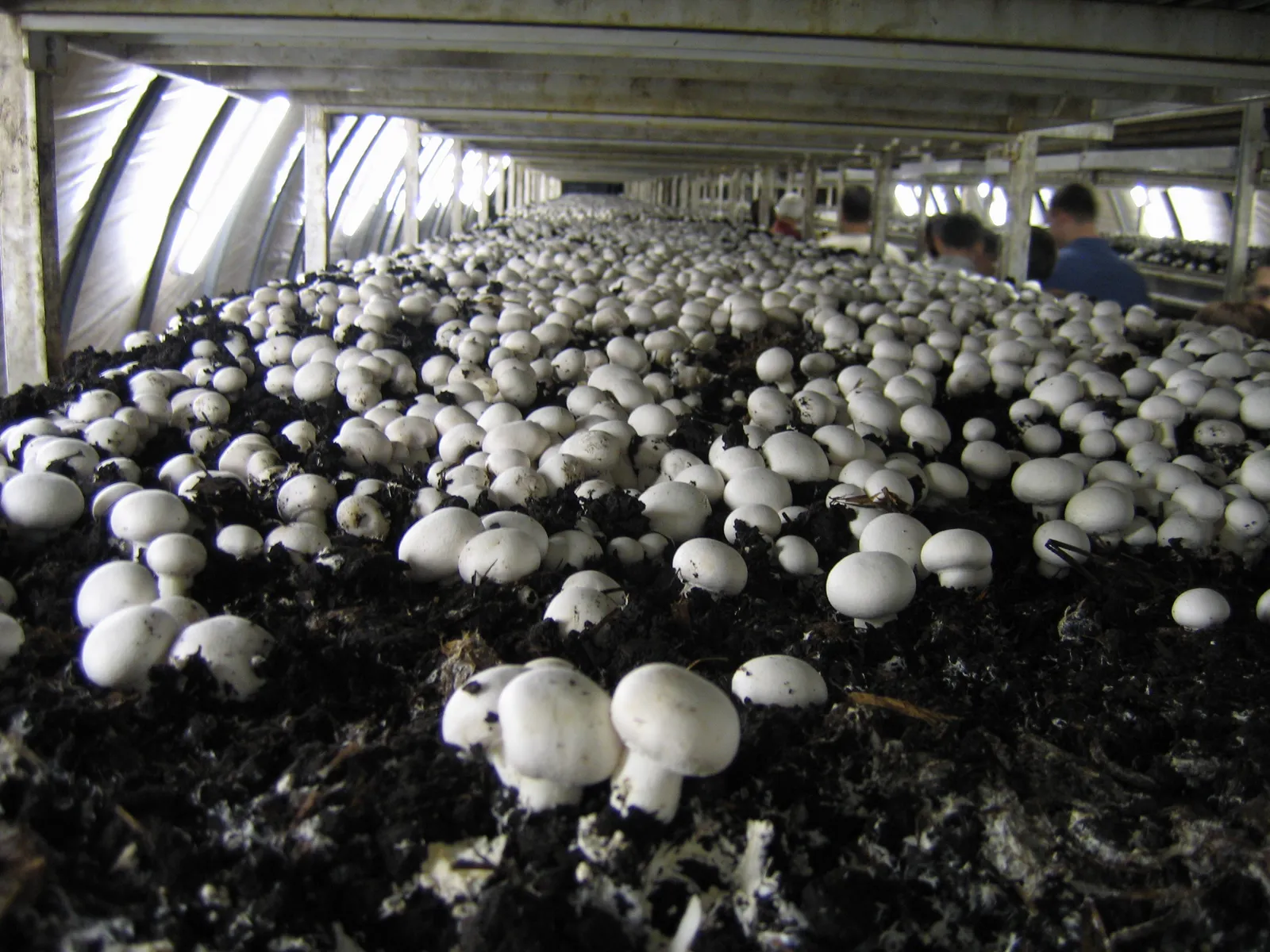
White button mushrooms on casing soil in long shelf beds inside a commercial cropping room near Eger, Hungary.
Real cultivation photograph. Read its source for location and context; it is not a universal operating specification.Andrew Bossi · CC BY-SA 2.5View full photograph ↗
On this pageChoose a section, or keep reading below
The full field guide

Read the room and make a controlled adjustment

Connect air temperature, substrate heat, humidity, carbon dioxide and air distribution to what the crop is doing.

Choose a picture to understand that part of the process.

  1. 01Air versus bed
  2. 02Three places for water
  3. 03Follow the air
  4. 04Prepare for failure

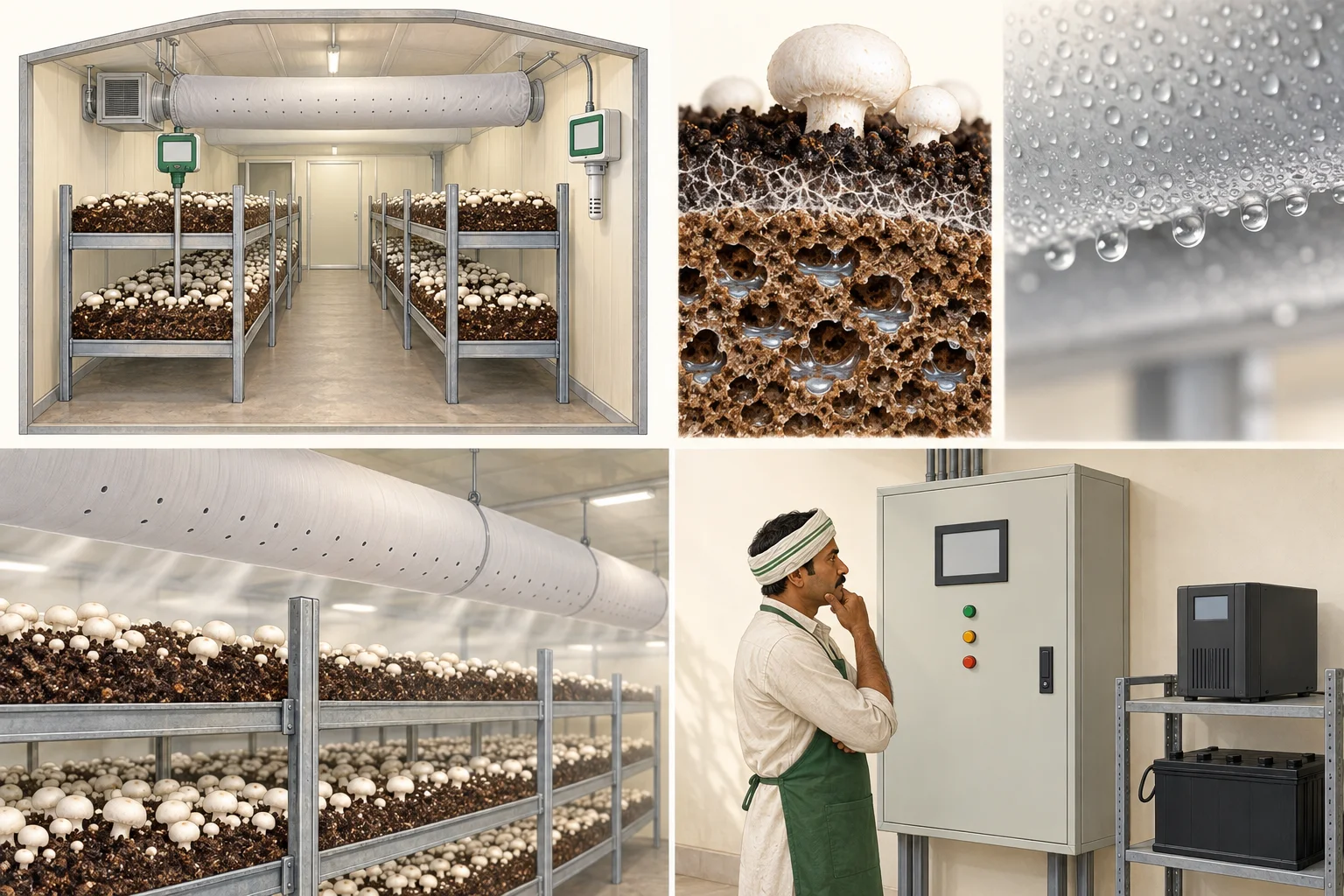
AI-generated teaching illustrations · Not photographs of actual farms

Chapter 01

Give every measurement a location and a purpose

Write the crop species, strain and stage before selecting a climate programme. Then distinguish room air, supply air, return air, compost or bag temperature, and product temperature. They are different measurement locations. A controller can hold its sensor at the selected value while the rear of the crop remains warmer or a nearby bed receives a drying draught.

Prepare a simple room map with marked front, middle and rear positions and representative upper and lower crop levels. Keep probes away from accidental direct spray and position them according to the instrument's instructions. Compare portable and fixed instruments using a suitable check method; two disagreeing sensors create uncertainty that should be resolved before making a large adjustment.

Collect a time history. A reading immediately after watering, a door opening or an equipment restart may represent a short event. Relate readings to those events and to crop response. Give the next shift a written record of changes so it does not reverse an adjustment before its effect has been assessed.

Different readings answer different questions
ReadingQuestion answeredCommon misinterpretation
Room air temperatureWhat surrounds the crop at this location?Assuming all substrate is at the same temperature
Substrate temperatureWhat is happening inside growing material?Treating one probe as the whole batch
Relative humidityHow close is this air to saturation at its temperature?Assuming wet air means correctly watered casing
CO₂ and air distributionIs gas removal reaching the occupied crop zones?Equating a spinning fan with adequate fresh air
Chapter 02

Separate humidity, watering and condensation

Water inside the substrate or casing is a crop resource. Humidity describes water vapour in the air. Surface wetness is liquid water on the mushroom or structure. These conditions interact but cannot be substituted for one another. Increasing humidification may not restore water to a dry casing layer, and adding water to a bed may leave unwanted wetness on caps.

Condensation occurs when a surface is cool enough for moisture in surrounding air to condense. Review product or surface temperature, air conditions and recent cooling or door-opening events when droplets appear. Air movement can help evaporation but can also dry exposed crop zones. The useful question is where moisture goes after an adjustment, not whether the room feels damp.

Observe the crop after watering under the selected crop protocol. Record water applied, time, affected zone and surface response. Keep observations comparable between flushes. An operator who can explain those changes has more useful control than one who only repeats a fixed number of watering cans each morning.

Chapter 03

Make an adjustment that can be evaluated

Begin with the observed problem and the most plausible explanation. Write the relevant reading, its location and the expected effect of the proposed adjustment. Change within the approved crop programme and equipment limits. Monitor the variables that the adjustment may also affect: fresh-air changes influence heat and moisture loads, and humidification can change both air and surface conditions.

Define when to inspect again using the response expected from the system and crop. A slow thermal response inside a bed should not prompt repeated large controller changes. If evidence becomes inconsistent, pause and verify the sensor or operating condition. Keep a record of the outcome even when the adjustment does not help; that result narrows the next investigation.

  1. 01

    Describe

    State the crop stage, affected zone and trend.

  2. 02

    Check

    Verify the measurement and recent operational events.

  3. 03

    Adjust

    Record the chosen change, its purpose and the responsible operator.

  4. 04

    Review

    Compare the expected and actual crop response before making another change.

Chapter 04

Prepare the response to equipment and power failure

List which loads are essential for the crop and which can wait during a power interruption. Have an engineer check the electrical supply, starting loads, protection and backup arrangement for the actual equipment. Room volume alone does not determine cooling capacity: outside conditions, building heat gain, fresh air, crop heat and operating schedule also matter.

Practise the reporting and recovery procedure with trained staff. Identify who receives an alarm, who checks the crop and who may work on equipment. After a failure, preserve the event history and inspect the affected crop locations. Restarting the machine does not prove the crop has already recovered.

Chapter sources & scope

These are educational explanations, not an independently reviewed operating protocol. Worked examples do not predict your yield or income.

Back to the chapter list ↑

Understand the topic

The key ideas, at a glance.

Use this page to connect crop biology, heat, carbon dioxide, water vapour, air movement and control actions as one room system.

Part 01

Simple explanation

Mushroom Environmental Control helps the grower connect crop biology, heat, carbon dioxide, water vapour, air movement and control actions as one room system. The crop requirement is the starting question, not an equipment size.

Educational grow-room illustration showing separate crop and room measurement locations.
AI teaching illustrationAir versus bed

Air and growing material are different measurement locations. An active crop releases heat; the wall display is not every bed's temperature.

Conceptual explanation—not a real farm photograph, diagnostic finding or construction specification.
Part 02

Biological purpose

The biological purpose is to keep the crop's stage, respiration, heat, gas exchange and surface-water behaviour visible.

Part 03

Operator explanation

Observe the crop, room pattern and change history before changing a control. Record what changed, where, when and under which operating mode.

Part 04

Engineering explanation

Define the control volume, design case, load components, equipment boundaries, instrumentation and expected response. Biological requirement is not equipment size.

Part 05

What to look for

Look for spatial gradients, time trends, surface condition, crop response, door events, water events, equipment state and alarms rather than a single display value.

Part 06

What to measure

Retain sensor ID, unit, location, height or depth, timestamp, calibration state, crop stage, room load and operating mode with every measurement.

Part 07

Variables that interact

connect crop biology, heat, carbon dioxide, water vapour, air movement and control actions as one room system. Temperature, moisture, carbon dioxide, air movement, crop load and control actions can move together, oppose one another or hide a local problem.

Part 08

What can go wrong

Common errors include a non-representative sensor, an undefined design case, a fan rating treated as delivered airflow, an air-change rate treated as distribution, or a biological target treated as plant capacity.

Part 09

What changes at commercial scale

Larger crop loads, longer air paths, more simultaneous equipment, tighter recovery needs and higher failure consequences increase the need for redundancy, commissioning and data history.

Part 10

Reference and review boundary

Background/reference map: Mushroom Cultivation, Marketing and Consumption; ICAR-DMR Crop Advisory. This map supports further editorial work; it is not route-specific technical validation. Foundational, current, regulatory and engineering references retain their distinct roles, and manufacturer literature may only establish equipment-specific data.

Illustration of a responsible operator inspecting a closed control cabinet.
AI teaching illustrationPrepare for failure

Controls, alarms and operator response work as a system. An alarm only helps when someone knows what to do next.

Conceptual explanation—not a real farm photograph, diagnostic finding or construction specification.

Keep exploring

Every part of this topic.

Choose the stage, material or decision you need to understand next.

01

Environmental Control Fundamentals

A governed climate guide to separate biological requirements, measured room conditions, control actions and equipment duties.

02

Crop-Stage Climate Control

A governed climate guide to translate each crop stage into environmental objectives without flattening the crop cycle into one setpoint.

03

Room Air Temperature

A governed climate guide to interpret dry-bulb temperature through stage, location, time, humidity and crop response.

04

Compost Temperature

A governed climate guide to treat bed temperature as a biological signal and heat-removal obligation distinct from room-air temperature.

05

Humidity and Moist-Air State

A governed climate guide to distinguish relative humidity, humidity ratio, dew point and moisture load.

06

Carbon Dioxide in Production Rooms

A governed climate guide to balance crop generation, fresh air, return air, exhaust, leakage and sensor placement.

07

Oxygen and Crop Respiration

A governed climate guide to understand oxygen as part of gas exchange without using carbon dioxide as a perfect proxy.

08

Fresh-Air Control

A governed climate guide to admit enough conditioned outdoor air for the crop objective while accounting for its heat and moisture load.

09

Recirculation

A governed climate guide to use return air for mixing and conditioning while detecting short circuits and trapped zones.

10

Airflow and Distribution

A governed climate guide to separate fan volume, nominal air changes, velocity, direction and crop-level distribution.

11

Evaporation and Crop Water Demand

A governed climate guide to connect air state, air movement, surface condition, watering and crop development.

12

Vapour-Pressure Deficit

A governed climate guide to use VPD as a derived moisture-demand lens with an explicit surface or air reference.

13

Dew Point

A governed climate guide to compare air moisture state with surface temperature to anticipate condensation.

14

Condensation

A governed climate guide to trace condensation to dew point, thermal bridges, leakage, wetting and local air-state gradients.

15

Crop Respiration

A governed climate guide to connect biological activity to carbon dioxide, heat, oxygen use and water-vapour release.

16

Crop Heat and Room Heat Balance

A governed climate guide to turn stage- and load-dependent biological heat into a declared engineering load component.

17

Environmental Measurement

A governed climate guide to make sensor identity, placement, calibration, logging and uncertainty part of every reading.

18

Environment-First Diagnostics

A governed climate guide to start from a spatial and temporal observation, then test competing environment and equipment mechanisms.

Go deeper

Technical reference, records and tools.

Detailed crop-stage information, parameters, diagrams and specialist tools are kept together below. This material retains its source conditions and review limits.

Open the complete technical reference

Crop biology · room response · engineered control

The crop never experiences a setpoint in isolation.

A governed climate guide to connect crop biology, heat, carbon dioxide, water vapour, air movement and control actions as one room system.

System boundary
Crop to electrical supply
Numeric policy
Zero magic numbers
Calculation model
Inputs and assumptions visible
Verification
Empty and loaded commissioning

Choose an operating question

Read the crop, room and air as one changing system.

Environmental systems map

Follow the crop signal through the room, equipment, sensors and utilities.

1 of 6

Crop biology

Stage, crop load and respiration create changing heat, gas and moisture duties.

Trace both directions: crop demand to equipment duty, then equipment response back to crop.

Crop-stage climate matrix

The full data architecture is live. Numeric cells stay unpublished until crop, strain, system and current sources are approved together.

Crop stageAir temperatureCompost temperatureRelative humidityCO₂AirflowEvaporation objective
Spawn runPending reviewPending reviewPending reviewPending reviewPending reviewPending crop-climate review
Case runPending reviewPending reviewPending reviewPending reviewPending reviewPending crop-climate review
Initiation transitionPending reviewPending reviewPending reviewPending reviewPending reviewPending crop-climate review
PinningPending reviewPending reviewPending reviewPending reviewPending reviewPending crop-climate review
CroppingPending reviewPending reviewPending reviewPending reviewPending reviewPending crop-climate review
Between flushesPending reviewPending reviewPending reviewPending reviewPending reviewPending crop-climate review
TerminationPending reviewPending reviewPending reviewPending reviewPending reviewPending crop-climate review

Canonical route architecture

19 connected climate routes.

Educational digital-twin architecture

A future model can link room geometry, crop stage, sensor history, actuator states, load assumptions and maintenance events. It remains an educational architecture, not an autonomous controller or remote commissioning certificate.

Printable field sheets

Download a blank CSV, open it in a spreadsheet, and record the actual observations with units and references. These educational templates are not acceptance criteria or engineering certificates.

Evidence and review

Source type, applicability and limitations stay visible so older farm guidance is not mistaken for current engineering law.

foundational · biologyMushroom Cultivation, Marketing and Consumption

Indian Button Mushroom crop stages, environmental responses and cultivation vocabulary.

Published stage values remain source-specific and require strain, system and current-review context before approval.

Open primary source
current · biologyICAR-DMR Crop Advisory

Current India-season cultivation context and stage-specific environmental advisories.

An advisory is time, crop and context specific; it is not a universal equipment design basis.

Open primary source

Read the evidence

Sources & review.

Editorial update: 2026-08-23. Independent technical review is not recorded for this entry.

  1. Mushroom Cultivation, Marketing and Consumption

    ICAR-Directorate of Mushroom Research

  2. ICAR-DMR Crop Advisory

    ICAR-Directorate of Mushroom Research

Reading a source is not the same as applying its instructions to every farm. Confirm species, strain, crop stage, system, region and publication date. Old chemical recommendations are not current-use instructions.

See something that needs correcting? Tell us →