


CO₂, Fresh Air & Distribution
Mushrooms breathe out carbon dioxide all day. Whether that gas helps you or ruins the crop depends entirely on which stage the room is in.
- By the end you can say when high carbon dioxide helps and when it harms.
- By the end you can set fresh air and air changes by stage.
- By the end you can tell a ventilation problem from a distribution problem.
Controlled room: how the air moves
Cooled, humid air drops from the overhead duct onto the beds, returns through the room, and 20 to 30 percent fresh air is mixed in. About 15 cm per second over the beds, 4 to 6 air changes an hour. Source: ICAR-DMR manual.
Read numerical examples with their source, method and crop context. They are not universal operating instructions. Historical prices are not current quotations.
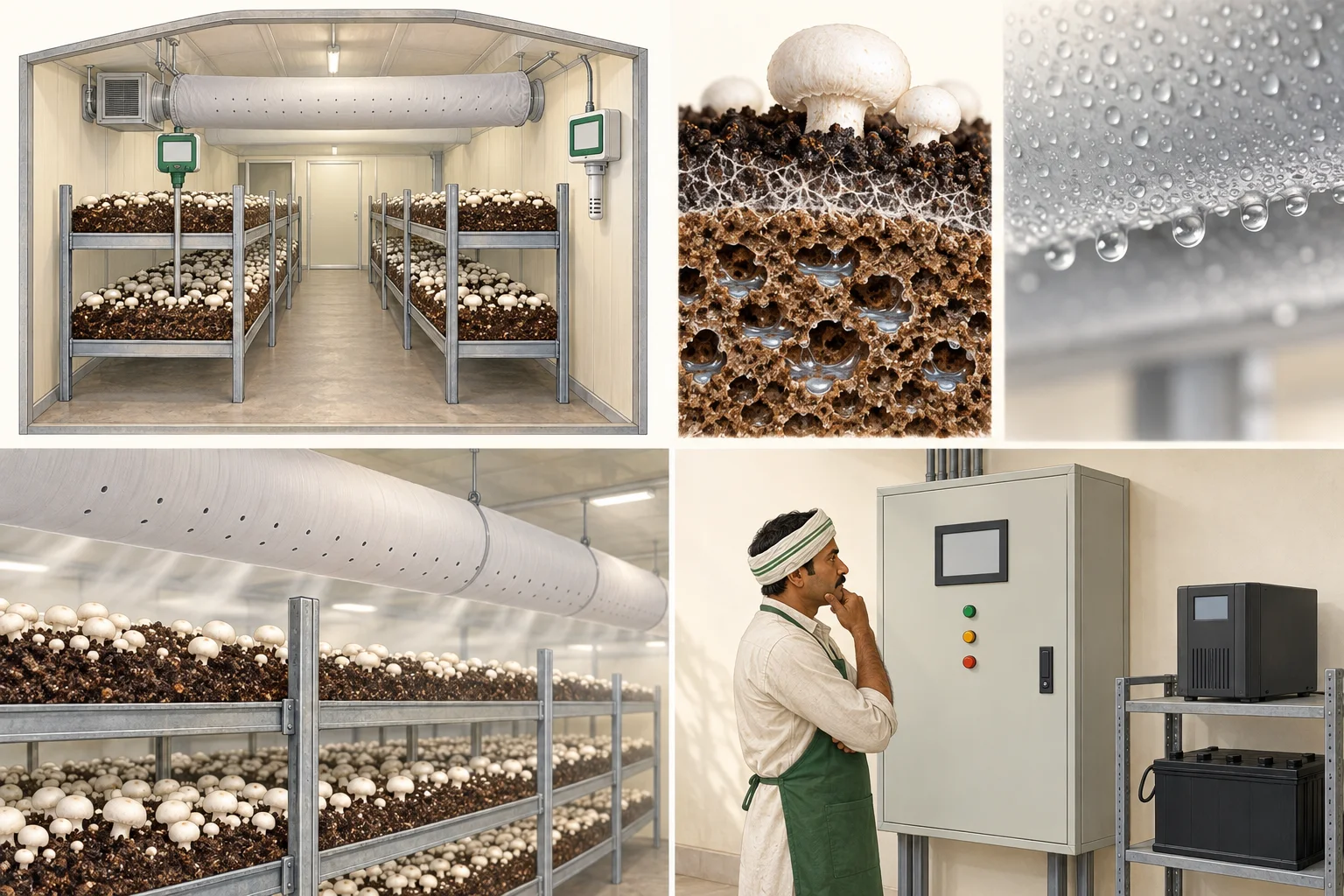
Follow the air
- Notice
- Air distribution changes with room layout and crop loading.
- Understand
- A correct sensor reading can coexist with a poorly supplied corner.
- Try it
- Compare crop response across locations before changing the whole room.
01The crop is breathing
A button bed gives off about 10 grams of carbon dioxide per square metre every hour during the first two flushes, when the mycelium is most active.
During spawn run that gas is wanted. ICAR-DMR keeps 10,000 to 15,000 parts per million with the whole air recirculated and no fresh air entering, because high carbon dioxide speeds the spawn through the compost. Case run continues above 7,500 parts per million with no fresh air introduced.
So a closed room is correct for two weeks and wrong on the day after. This is the single largest stage error in small units.
02Venting for pins
Fruiting starts with a deliberate change. DMR brings the room down to 800 to 1,000 parts per million, which is what pinhead formation needs, and holds 1,000 to 1,500 parts per million once pinheads become buttons.
Get it wrong and the crop tells you. High carbon dioxide at pinning gives onion shaped mushrooms with a bulbous base and small cap; later it gives long stalks with small open caps.
Other species sit far lower. For oyster, the 2011 manual asks for less than 600 parts per million during cropping, while the Hindi folder sets the limit at 800. Both are ICAR-DMR.
03How much fresh air
DMR converts this into air changes. From venting to the end of the second flush, about six air changes per hour are recommended. From the third flush, four per hour hold oxygen near 16 percent.
The damper position follows: 30 percent fresh air and 70 percent recirculation for the first two flushes, then 20 percent fresh and 80 percent recirculated. A milky crop needs a minimum of three to four air changes per hour.
Fresh air is also a doorway. DMR asks for two micrometre filters on fresh air entry points, and NHB asks for nylon net of 35 mesh or finer on doors and ventilators against flies.
04Distribution, not just volume
Air changes describe volume. They say nothing about whether air reaches the third rack in the corner.
DMR gives the distribution target: air speed over the crop beds of about 15 centimetres per second. Fast enough to carry heat and gas away, slow enough not to dry the caps.
The site engineering guides make the same point in a harder way: a fan rating is not delivered airflow, and an air change rate is not distribution. Two rooms with identical fans can crop differently because one has a dead corner. Walk the room with a smoke source or a ribbon and watch where the air does not go.
Check whether your air arrives
- Mark five points in the room: near the supply, middle, far corner, top rack, bottom rack.
- Hold a light ribbon at each point and note whether it moves.
- Record the stage of the crop and the damper position that day.
- Compare stalk length and cap size at the five points after the flush.
- Move one baffle or duct outlet and repeat the same walk.
Write in your farm diary: Stage, damper setting, ribbon movement at each point, and the stalk and cap difference between points.
Mistakes that cost a crop
- Keeping the room closed after case run, so pins never form properly.
- Copying button carbon dioxide levels onto an oyster crop, which needs far less.
- Adding a bigger fan when the real fault is a dead corner in the room.
Check yourself
Three questions, instant answersWhen is high carbon dioxide wanted?
Long stalks with small caps usually mean what?
Two rooms have the same air changes but crop differently. Why?
An editorial self-check, not a certificate. Answers are not stored, not even on this device.
Words used in this lesson
- Air change
- Replacing the full volume of room air one time.
- Recirculation
- Sending room air back through the cooler instead of outdoors.
- Damper
- The adjustable flap that sets how much outside air enters.
References & further reading
Biological requirements are not equipment selections.
Open current reference