


RH, Evaporation & Condensation
Humidity is the number growers guess most and measure worst. Water in a mushroom room is always moving between the air, the bed and the walls.
- By the end you can read humidity together with its temperature.
- By the end you can explain where the bed loses its water.
- By the end you can tell condensation problems from substrate problems.
From symptom to cause
A first look, not a diagnosis. Source: ICAR-DMR manual and disease bulletin.
| What you see | Likely cause | First step |
|---|---|---|
| Long stems, small caps | CO₂ too high (above about 1,500 ppm) | More fresh air |
| Green patches on compost | Trichoderma; low pH or leftover ammonia | Isolate, remove; check next batch |
| No pins after casing | Room not aired and cooled | 16 to 18 °C, ventilate |
| Brown sunken spots on caps | Bacterial blotch; wet caps | Dry the surface, humidity under 85% |
| White wet lumps | Wet bubble from casing | Salt, remove; steam next casing |
| Small flies | Sciarid or phorid flies | Screens, light traps, hygiene |
Read numerical examples with their source, method and crop context. They are not universal operating instructions. Historical prices are not current quotations.
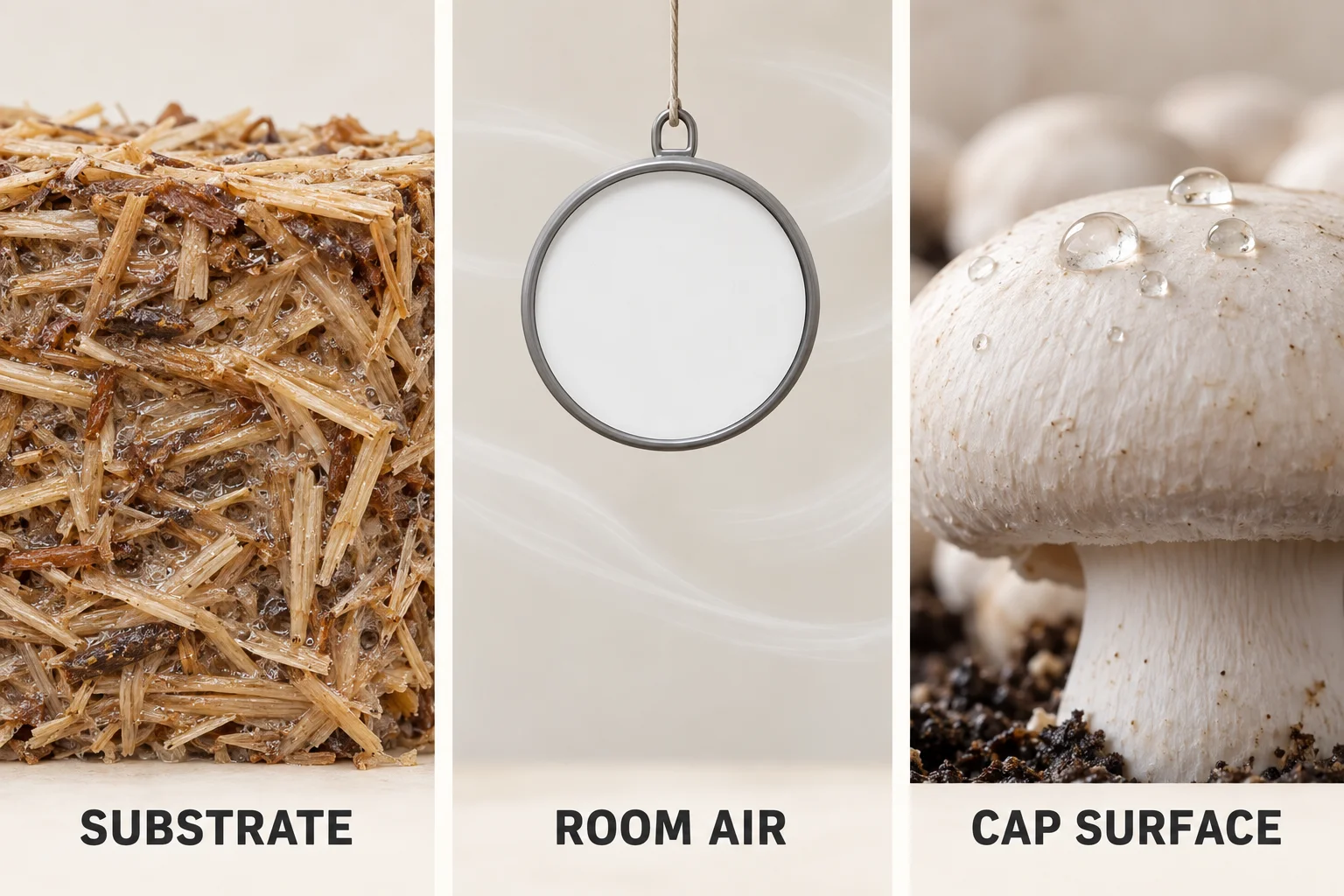
Look, explain, then apply
Three different water observations. The blank dial is symbolic, not a measurement, and the pictured wet substrate and cap are not target conditions.
See where this fits in the full workflow →01Humidity is a ratio, not an amount
Relative humidity says how full the air is compared with how much it could hold at that temperature. Warm the same air and the reading falls without a drop of water leaving the room.
So a humidity figure means nothing on its own. Always write the dry bulb temperature next to it.
ICAR-DMR sets 95 percent during button spawn run and case run in a controlled room, then reduces it to 85 percent for cropping. A naturally ventilated seasonal shed cannot hold 95 percent, which is why the Hindi folder gives 80 to 90 percent for the same stage.
02Evaporation is the crop drinking
DMR measures the loss: about 31 grams of water evaporates from one square metre of bed every hour at 17 C and 85 percent humidity.
That water has to be replaced or the casing dries and pinning stops. The manual gives a simple rule for watering after picking: for every kilogram of mushroom harvested, add one litre of water.
Casing moisture at pinning should sit near 50 percent, which DMR states as 50 plus or minus 2 percent. Water lightly and often rather than heavily once, and water the casing surface rather than the mushrooms themselves.
03Condensation is a surface problem
When moist air touches a surface colder than its dew point, water forms on that surface. In a mushroom room those surfaces are the ceiling, the cold panel near the air handler, and the mushroom cap itself.
This matters because of one threshold. DMR records that bacterial blotch spreads when a free water film stays on the cap for more than three hours, and at 20 C or above.
NHB adds the operational rule: avoid humidity above 85 percent together with temperature above 20 C, and give extra ventilation and air movement after watering so that caps dry quickly.
04Substrate moisture is a different measurement
Air humidity and substrate moisture are separate numbers and separate instruments. Mixing them is a common error.
DMR gives finished synthetic compost at 68 to 72 percent moisture at spawning and 64 to 66 percent after Phase II. Above 72 percent the compost cannot breathe and plaster moulds appear. Below 64 percent, with a wet casing over it, NHB reports weeper mushrooms.
Other crops carry their own figures: milky substrate at 65 to 70 percent, shiitake blocks at 60 to 65 percent. Learn to test moisture by squeezing a handful, and record what your hand felt each time.
Find where the water goes
- Write the humidity and the temperature together at every reading.
- After watering, time how long free water stays on the caps.
- Touch the ceiling and the coldest wall an hour after watering.
- Weigh the mushrooms picked and add one litre of water per kilogram.
- Squeeze a handful of casing and note whether the palm stays damp.
Write in your farm diary: Time, humidity with its temperature, minutes until caps dried, litres added, and where condensation was found.
Mistakes that cost a crop
- Recording humidity without its temperature, which makes the number unusable later.
- Heavy watering just before closing the room, leaving films on caps all night.
- Treating air humidity and substrate moisture as the same measurement.
Check yourself
Three questions, instant answersWhy must humidity be written with a temperature?
How much water does DMR add after picking?
Free water stays on caps for four hours. What is the risk?
An editorial self-check, not a certificate. Answers are not stored, not even on this device.
Words used in this lesson
- Relative humidity
- How full the air is with water at its current temperature.
- Dew point
- The temperature at which air starts forming water on a surface.
- Dry bulb
- The plain air temperature read by an ordinary thermometer.
References & further reading
Biological requirements are not equipment selections.
Open current reference