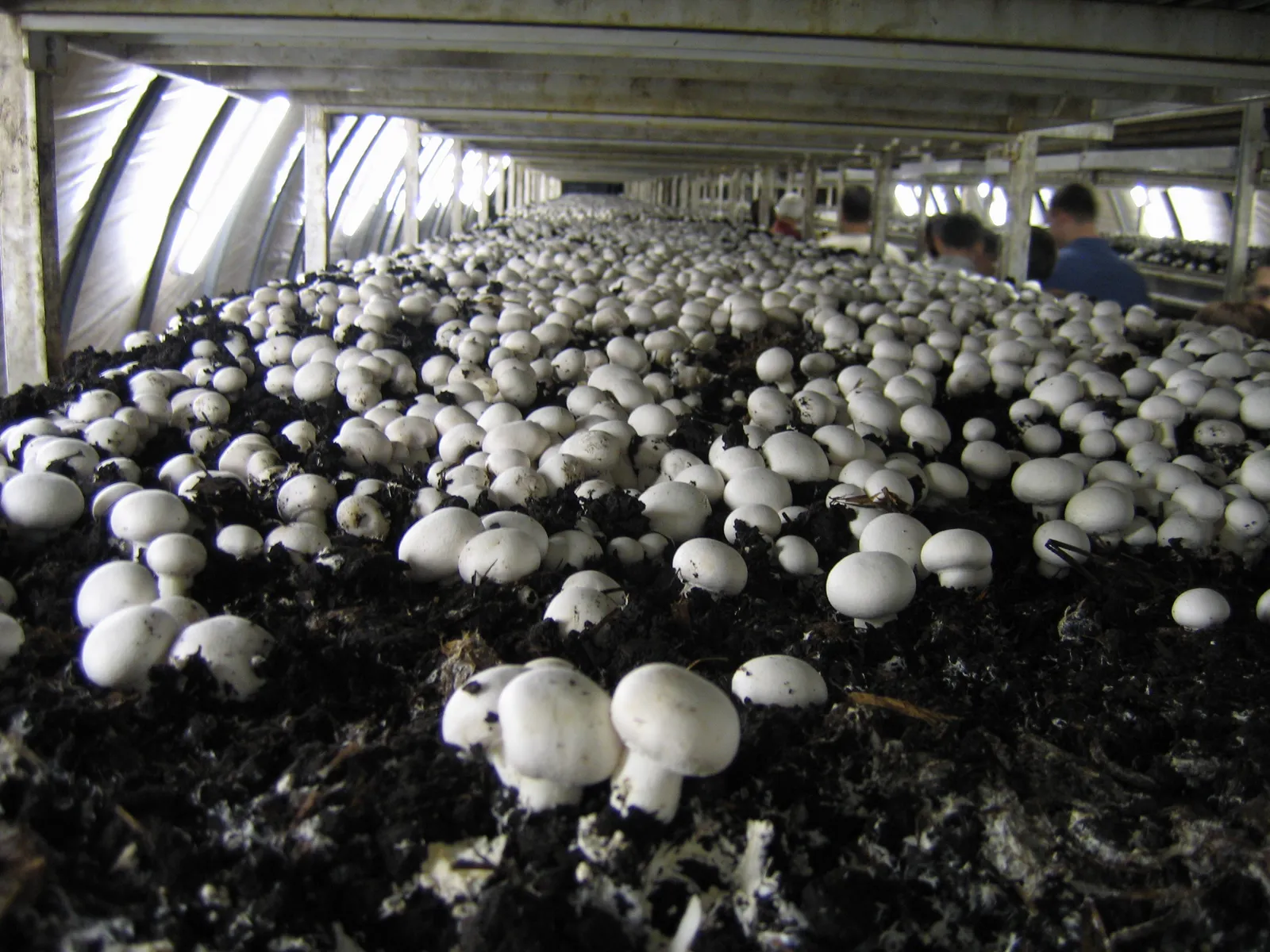
Real cultivation photograph. Read its source for location and context; it is not a universal operating specification.Andrew Bossi · CC BY-SA 2.5View full photograph ↗On this pageChoose a section, or keep reading below
Understand six room jobs before comparing machines
A production room is a connected system. Start with what each part does, then follow the air and water through it. The equipment catalogue and the engineering calculations come later; a beginner should not have to understand fifty component pages before understanding the room.
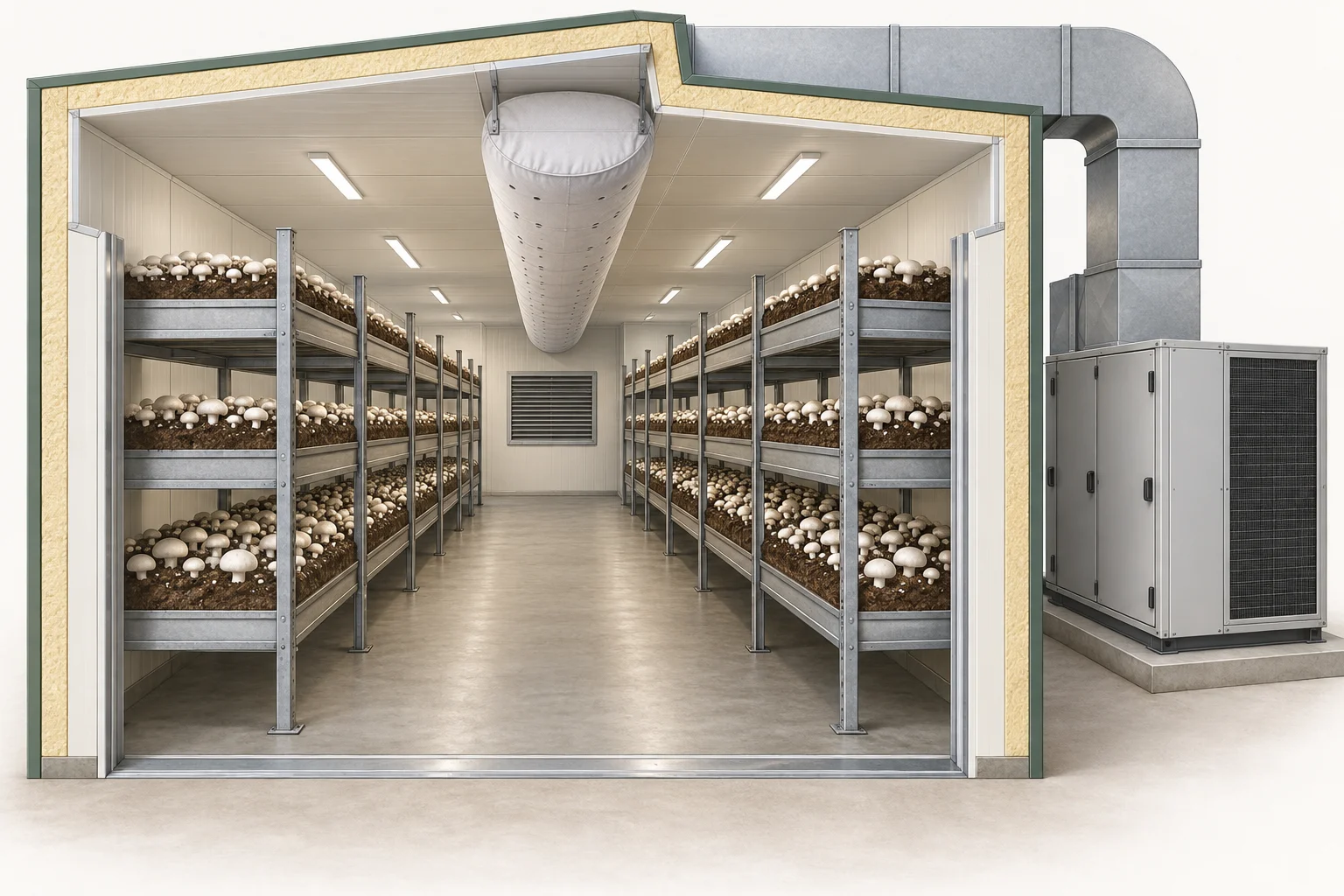
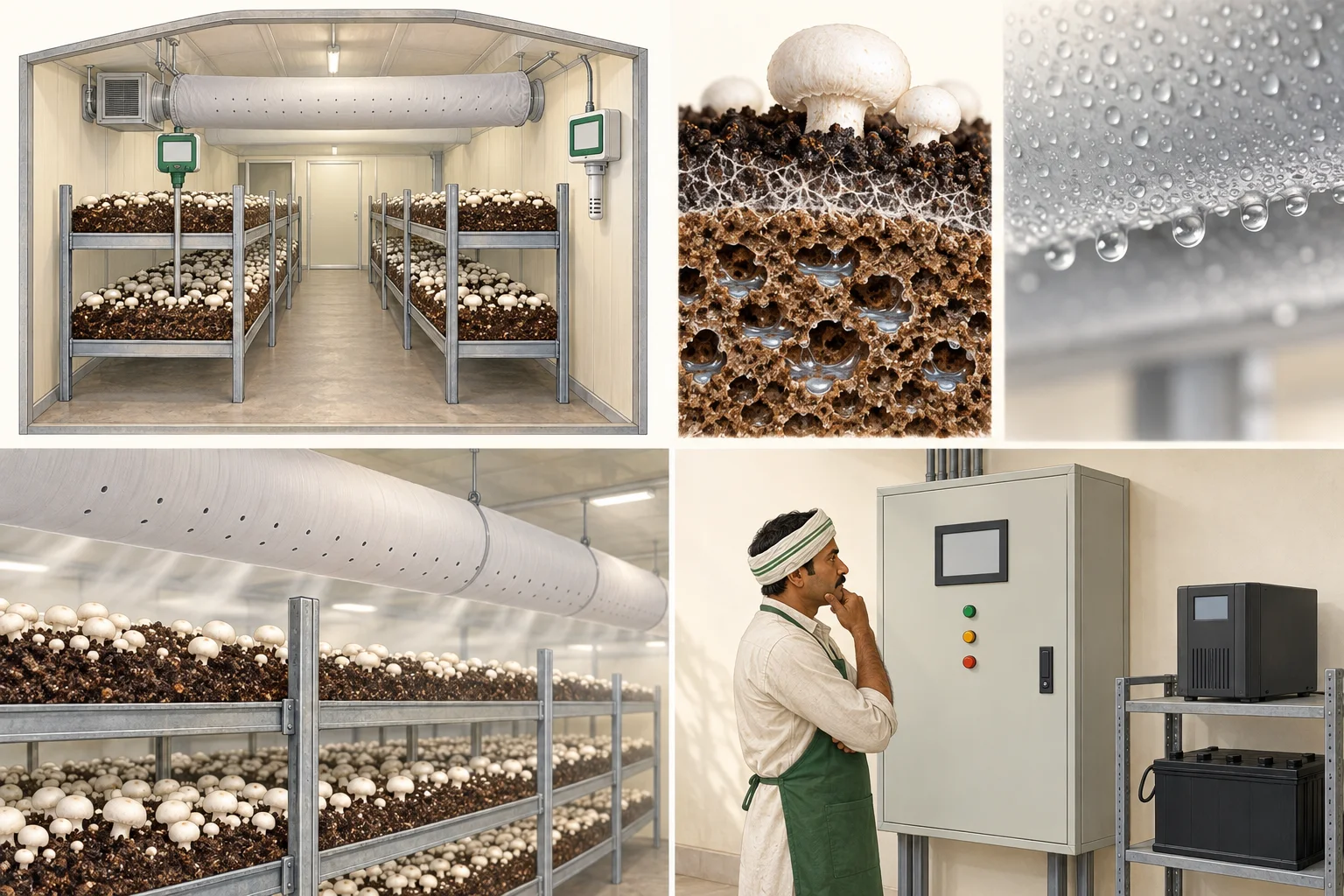
AI-generated teaching cutaway. Component positions explain concepts; this is not a complete HVAC circuit or an installation drawing.
Enclosure and insulation
The walls, roof, doors and joints form the room boundary. Insulation limits heat transfer; it does not itself cool an active crop.
Cooling and moisture control
Cooling removes heat. Adding or removing moisture is a separate requirement, even though the air-handling processes interact.
Circulation and ventilation
Circulation moves air around the room. Ventilation exchanges indoor and outdoor air. A recirculating fan is not proof that fresh air is reaching the crop.
Measurement and control
Sensors report conditions at their own locations. The controller acts on those signals, so readings and placement must be checked against representative crop zones.
Learn it in this order
1
Describe the crop and room
Write the crop, supplied compost stage, batch loading and working routes. List the conditions the room must achieve and what happens during filling, cropping and emptying.
Identify supply, return, outside-air entry and exhaust. Ask the designer how the loaded racks will receive air and where maintenance access is provided.
Review cooling, water, drainage, power and controls together. Ask for the load calculation and the assumptions behind it—not only a machine capacity printed in a quotation.
Agree the test conditions, sensor comparisons, failure response and operator training. Record defects and retests before accepting the room as ready for its intended production duty.
Illustrative investigation: a controller displays 17°C while a verified probe at one upper crop zone reads 22°C. Neither number is offered as a recommended operating target.
Think it through
First label what each instrument measures: room air, supply air or the growing material itself. Record time and crop stage, and compare instruments together at the same location to check disagreement. Then repeat at the marked locations. Two different measurement types cannot be treated as interchangeable.
Your next decision
Give the engineer the comparison and location map. Investigate sensing, local heat and distribution before changing the whole-room setpoint. Do not infer an equipment size or a crop diagnosis from this example.
Check your understanding
Try answering first, then open the explanation.
If I install a larger fan, have I solved ventilation?
Not necessarily. Check whether it recirculates indoor air or introduces outside air, what resistance it works against and whether air reaches the loaded crop zones.
Can the same cooling unit suit any room with the same floor area?
Floor area alone is not a design basis. Crop loading, stage, enclosure, outdoor conditions and ventilation duty may differ. A qualified designer must establish the duty.
Where do I go for the detailed component pages?
Use the grouped topic directory below: room fabric, air movement, cooling, moisture, controls, power and commissioning. All existing component guides remain available.
Learning sources and limits
Editorial teaching explanation, not an independently reviewed operating protocol. Worked scenarios are illustrative.
For a controlled Button mushroom production room. These reading and inspection prompts help you work with a qualified engineer; they are not a DIY construction specification.
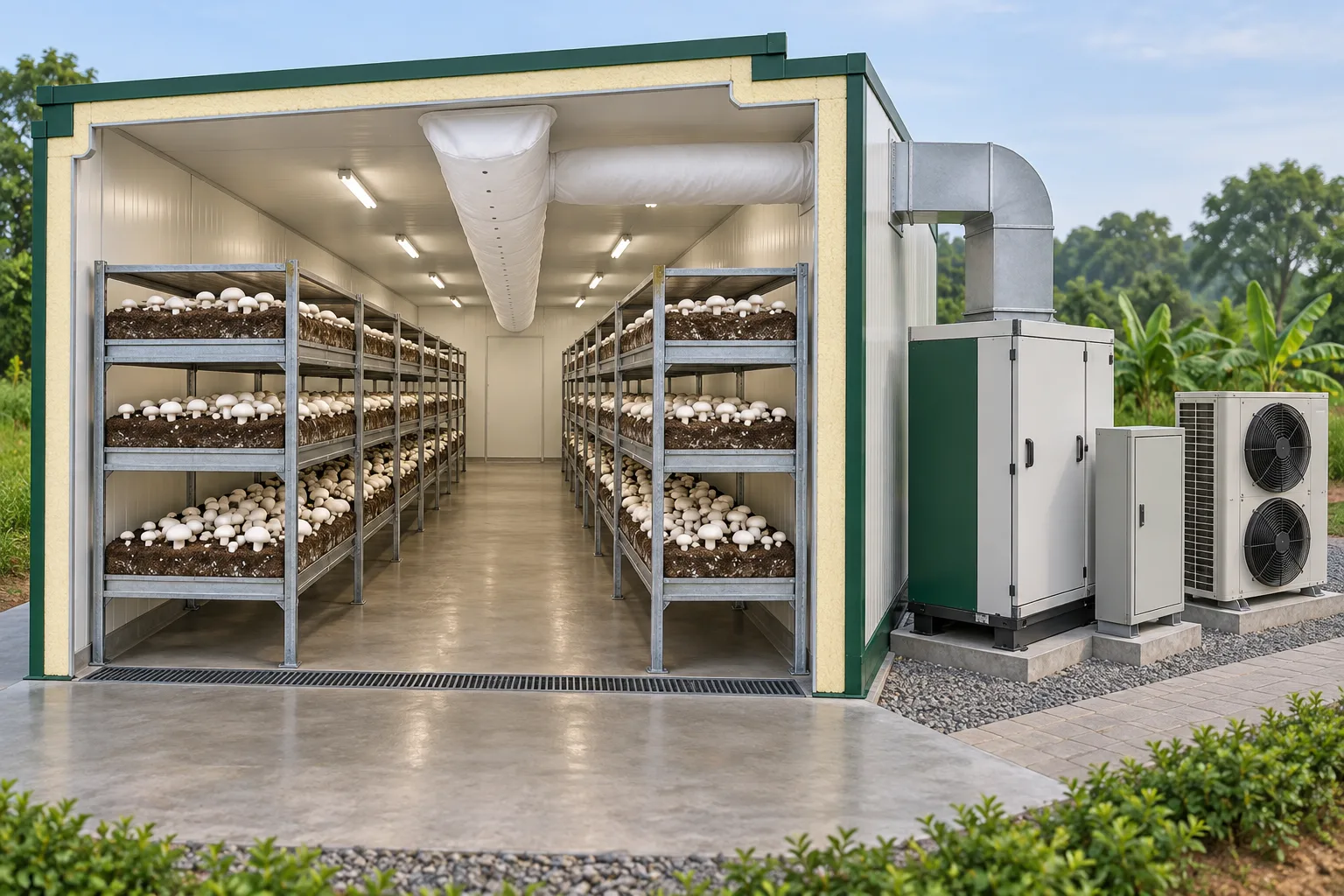
AI-generated teaching illustrationRecognise the main components—not their required size, spacing, airflow or construction specification.
AI teaching illustration · Concept, not field evidenceRead this picture
Walls and doors form one enclosure.
Why it matters
Joints, penetrations and door use affect the room as well as insulation. This cutaway is not a material or fire-safety specification.
Chapter 01
Start with the room and people
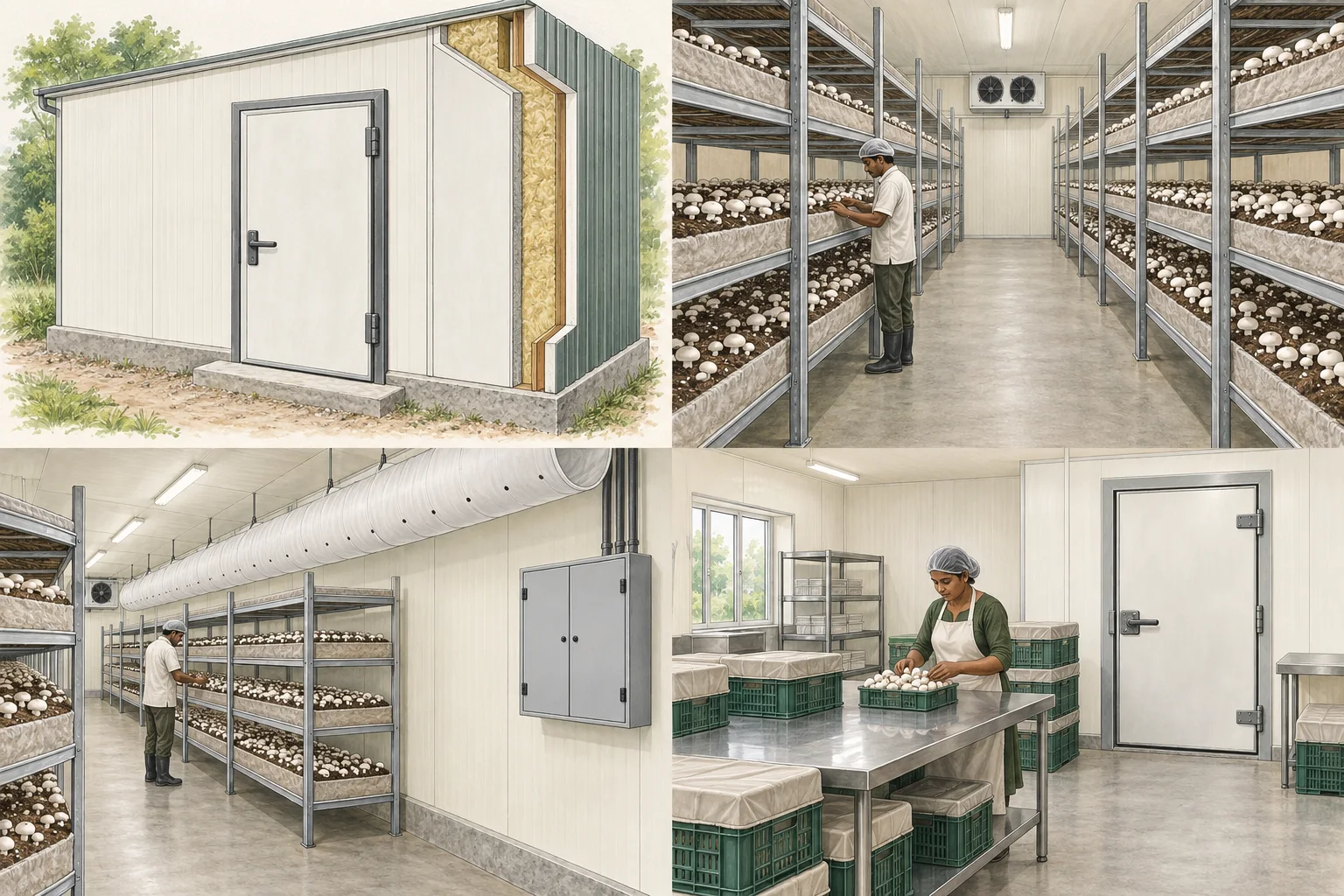
The enclosure, racks and work routes must suit the crop and the people handling it. More shelf area changes access, handling and how air reaches the crop.
What to check
Walk the proposed filling, harvesting, cleaning and emergency routes with the designer. Check envelope continuity and maintainable joints.
Write this in the record
Room geometry, rack loading, access requirements, clean and dirty movements, and responsibilities for structural and fire-safety review.
AI teaching illustration · Concept, not field evidenceRead this picture
The duct serves a room containing racks and crop.
Why it matters
Air delivery must be evaluated in the loaded room. Equipment capacity alone does not demonstrate uniform crop conditions.
Chapter 02
Trace supply, return and fresh air
Supply air must reach the loaded growing area and return through an intended route. Fresh air and recirculated air do different jobs; neither is established by fan size alone.
What to check
Ask where air enters, where it returns, how outside air is controlled, and how representative loaded-room distribution will be verified.
Write this in the record
Air-path drawing, fan and damper states, sensor positions, accessible filters and the measurement plan.
AI teaching illustration · Concept, not field evidenceRead this picture
Air and growing material are different measurement locations.
Why it matters
An active crop releases heat; the wall display is not every bed's temperature.
Chapter 03
Size the system from a written load basis
Refrigeration duty depends on more than floor area. The designer must reconcile crop activity, outside-air treatment, the enclosure, equipment, operating conditions and recovery requirements.
What to check
Request the calculation inputs and design conditions. Review power demand, water, condensate drainage and maintenance access together.
Write this in the record
Crop loading and stage schedule, site weather basis, ventilation duty, calculated loads, equipment selections and exclusions.
AI teaching illustration · Concept, not field evidenceRead this picture
Controls, alarms and operator response work as a system.
Why it matters
An alarm only helps when someone knows what to do next.
Chapter 04
Prove operation before expanding
An installed room is not yet a proven production system. Commission the equipment, measurement system, alarms and staff response, then review performance under an agreed representative load.
What to check
Witness the planned empty and loaded tests, instrument comparisons, power-failure response and documented handover.
Write this in the record
Test conditions, measured results, open defects, corrective action, retests, manuals and operator training.
Use this page to translate crop requirements into rooms, loads, equipment, controls, electrical services and commissioning evidence.
Part 01
Simple explanation
Production Room Engineering helps the grower translate crop requirements into rooms, loads, equipment, controls, electrical services and commissioning evidence. The crop requirement is the starting question, not an equipment size.
AI teaching illustrationKeep the room envelope continuous
Walls and doors form one enclosure. Joints, penetrations and door use affect the room as well as insulation. This cutaway is not a material or fire-safety specification.
Conceptual explanation—not a real farm photograph, diagnostic finding or construction specification.
Part 02
Biological purpose
Engineering begins only after the crop stage, biological load and acceptable room response are declared.
Part 03
Operator explanation
Observe the crop, room pattern and change history before changing a control. Record what changed, where, when and under which operating mode.
Part 04
Engineering explanation
Define the control volume, design case, load components, equipment boundaries, instrumentation and expected response. Biological requirement is not equipment size.
Part 05
What to look for
Look for spatial gradients, time trends, surface condition, crop response, door events, water events, equipment state and alarms rather than a single display value.
Part 06
What to measure
Retain sensor ID, unit, location, height or depth, timestamp, calibration state, crop stage, room load and operating mode with every measurement.
Part 07
Variables that interact
translate crop requirements into rooms, loads, equipment, controls, electrical services and commissioning evidence. Temperature, moisture, carbon dioxide, air movement, crop load and control actions can move together, oppose one another or hide a local problem.
Part 08
What can go wrong
Common errors include a non-representative sensor, an undefined design case, a fan rating treated as delivered airflow, an air-change rate treated as distribution, or a biological target treated as plant capacity.
Part 09
What changes at commercial scale
Larger crop loads, longer air paths, more simultaneous equipment, tighter recovery needs and higher failure consequences increase the need for redundancy, commissioning and data history.
Part 10
Reference and review boundary
Background/reference map: Farm Design for White Button Mushroom Cultivation; National Building Code of India 2016; 2025 ASHRAE Handbook Fundamentals table of contents; ISHRAE standards and position papers. This map supports further editorial work; it is not route-specific technical validation. Foundational, current, regulatory and engineering references retain their distinct roles, and manufacturer literature may only establish equipment-specific data.
Keep exploring
Every part of this topic.
Start with the part of the room you need to understand. Every component guide remains available inside these groups.
Detailed crop-stage information, parameters, diagrams and specialist tools are kept together below. This material retains its source conditions and review limits.
Open the complete technical reference+
Crop biology · room response · engineered control
Production room engineering, explained visually.
A governed engineering guide to translate crop requirements into rooms, loads, equipment, controls, electrical services and commissioning evidence.
Original diagrams expose system boundaries, air paths, feedback and engineering handoffs.
Production room relationshipsConceptual relationships, not a physical cross-section: coordinate the enclosure, crop, air distribution and separate return-air and drainage paths.On a small screen, scroll sideways to see the complete diagram.Air-handling unit systemFilters, coil, moisture device, fan and dampers operate at a commissioned duty point.On a small screen, scroll sideways to see the complete diagram.Refrigeration cycleThe evaporator absorbs heat, the compressor raises refrigerant-vapour pressure, the condenser rejects heat and the expansion device reduces pressure before the evaporator.Background: Danfoss refrigeration-cycle explanation ↗On a small screen, scroll sideways to see the complete diagram.Environmental control architectureSensors, priorities, control loops, actuators, alarms and records form a traceable control system.On a small screen, scroll sideways to see the complete diagram.Cooling-load breakdownEnvelope, outdoor air, crop, moisture, equipment and pull-down loads remain visible before selection margin.On a small screen, scroll sideways to see the complete diagram.
Educational digital-twin architecture
A future model can link room geometry, crop stage, sensor history, actuator states, load assumptions and maintenance events. It remains an educational architecture, not an autonomous controller or remote commissioning certificate.
Printable field sheets
Download a blank CSV, open it in a spreadsheet, and record the actual observations with units and references. These educational templates are not acceptance criteria or engineering certificates.
Reading a source is not the same as applying its instructions to every farm. Confirm species, strain, crop stage, system, region and publication date. Old chemical recommendations are not current-use instructions.