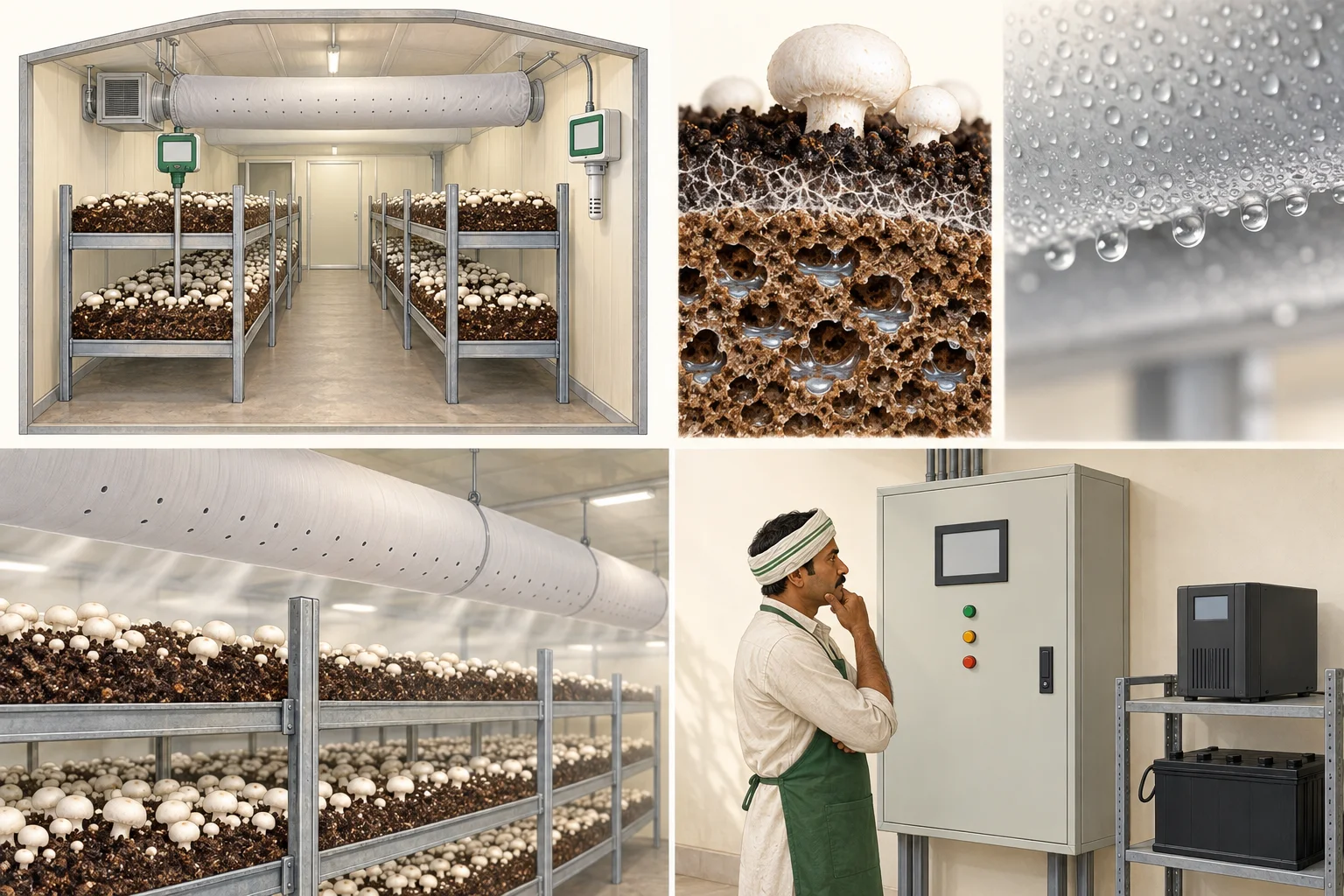


Quick orientation
Use this page to record nameplate, running, coincident, starting, essential and future loads without collapsing kW and kVA.
Simple explanation
Electrical Load Schedule helps the grower record nameplate, running, coincident, starting, essential and future loads without collapsing kW and kVA. The crop requirement is the starting question, not an equipment size.
Biological purpose
Engineering begins only after the crop stage, biological load and acceptable room response are declared.
Operator explanation
Observe the crop, room pattern and change history before changing a control. Record what changed, where, when and under which operating mode.
Engineering explanation
Define the control volume, design case, load components, equipment boundaries, instrumentation and expected response. Biological requirement is not equipment size.
What to observe
Look for spatial gradients, time trends, surface condition, crop response, door events, water events, equipment state and alarms rather than a single display value.
What to measure
Retain sensor ID, unit, location, height or depth, timestamp, calibration state, crop stage, room load and operating mode with every measurement.
Variables that interact
record nameplate, running, coincident, starting, essential and future loads without collapsing kW and kVA. Temperature, moisture, carbon dioxide, air movement, crop load and control actions can move together, oppose one another or hide a local problem.
What can go wrong
Common errors include a non-representative sensor, an undefined design case, a fan rating treated as delivered airflow, an air-change rate treated as distribution, or a biological target treated as plant capacity.
What changes at commercial scale
Larger crop loads, longer air paths, more simultaneous equipment, tighter recovery needs and higher failure consequences increase the need for redundancy, commissioning and data history.
Reference and review boundary
Background/reference map: Farm Design for White Button Mushroom Cultivation; National Building Code of India 2016; 2025 ASHRAE Handbook Fundamentals table of contents; ISHRAE standards and position papers. This map supports further editorial work; it is not route-specific technical validation. Foundational, current, regulatory and engineering references retain their distinct roles, and manufacturer literature may only establish equipment-specific data.
Engineering unit converter
NIST-traceable conversion factors. Conversion does not validate the design basis.
Enter a value to convert.
Technical diagrams
Original diagrams expose system boundaries, air paths, feedback and engineering handoffs.
The numbers for this room, with their source.
Crop-climate values are published from ICAR-DMR guidance with the stage they apply to. Equipment sizes stay project-specific and are never published as defaults.
ENV.ELECTRICAL.CONNECTED_LOADpending technical verificationConnected electrical load
Technical value pending verification- Unit
- kW
- Context
- Nameplate schedule with voltage, phase and efficiency
- Review needed from
- Qualified HVAC or electrical engineer
ENV.ELECTRICAL.RUNNING_DEMANDpending technical verificationCoincident running demand
Technical value pending verification- Unit
- kW
- Context
- Sequence and diversity retained
- Review needed from
- Qualified HVAC or electrical engineer
ENV.ELECTRICAL.STARTING_CURRENTpending technical verificationMotor starting current
Technical value pending verification- Unit
- A
- Context
- Manufacturer and starting method required
- Review needed from
- Qualified HVAC or electrical engineer
ENV.ELECTRICAL.DG_CAPACITYpending technical verificationGenerator capacity
Technical value pending verification- Unit
- kVA
- Context
- Essential loads, transient response, power factor and sequence required
- Review needed from
- Qualified HVAC or electrical engineer
Transparent calculation framework
Equations expose variables, units, assumptions, validation and the point where project data must enter.
ENV.FORMULA.DEMANDStructure a coincident electrical demand schedule
Required variables
- P_running,i · equipment running input
- kW; nameplate or measured input
- coincidence_i · scenario coincidence
- ratio; documented operating sequence
Assumptions
- Starting transient is evaluated separately
- Power factor and kVA are not inferred from kW
Validation
- Coincidence factors are between zero and one
- Every included load has a declared scenario
Printable field sheets
Download a blank CSV, open it in a spreadsheet, and record the actual observations with units and references. These educational templates are not acceptance criteria or engineering certificates.
Evidence and review
Source type, applicability and limitations stay visible so older farm guidance is not mistaken for current engineering law.
foundational · buildingFarm Design for White Button Mushroom Cultivation
Indian production-room workflow, farm components, controlled-room and air-handling context.
Foundational farm guidance does not replace current structural, refrigeration, electrical or safety design.
Open primary sourcecurrent · buildingNational Building Code of India 2016
Building, fire, services, refrigeration, sanitation, electrical and facility-management context.
Local adoption, amendments, authority requirements and specialist codes must be verified for each project.
Open primary sourcecurrent · hvac2025 ASHRAE Handbook Fundamentals table of contents
Current chapter architecture for psychrometrics, refrigeration cycles, heat transfer, controls and measurement.
The public index identifies the current edition; detailed design use requires access to the handbook.
Open primary sourcecurrent · hvacISHRAE standards and position papers
Indian HVAC standards context including air-handling units and commissioning.
Standard titles are an index; design claims must cite and comply with the applicable edition and project jurisdiction.
Open primary source