


A practical guide to growing mushrooms in IndiaA joint educational initiative by MushroomWale & DMR Solan
MushroomFarming.in

A joint educational initiative by

MushroomWale.com
ICAR–Directorate of Mushroom Research, Solan logoICAR–DMRSolan

MushroomFarming / guide

Hygiene Zoning

A governed engineering guide to separate people, material, air, waste, harvest and maintenance routes by contamination risk.

Practical explanation + detailed referenceSources & review ↓
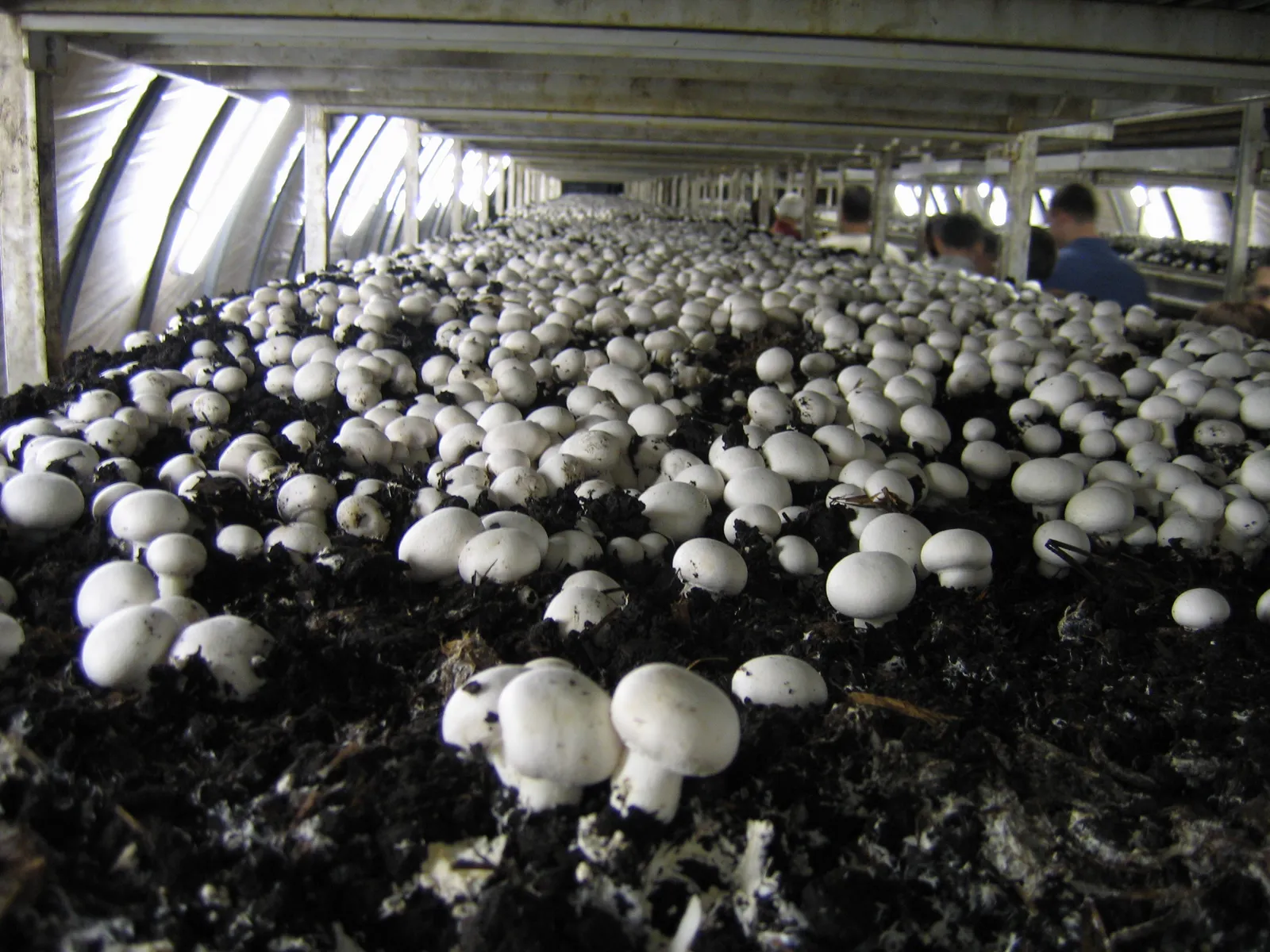
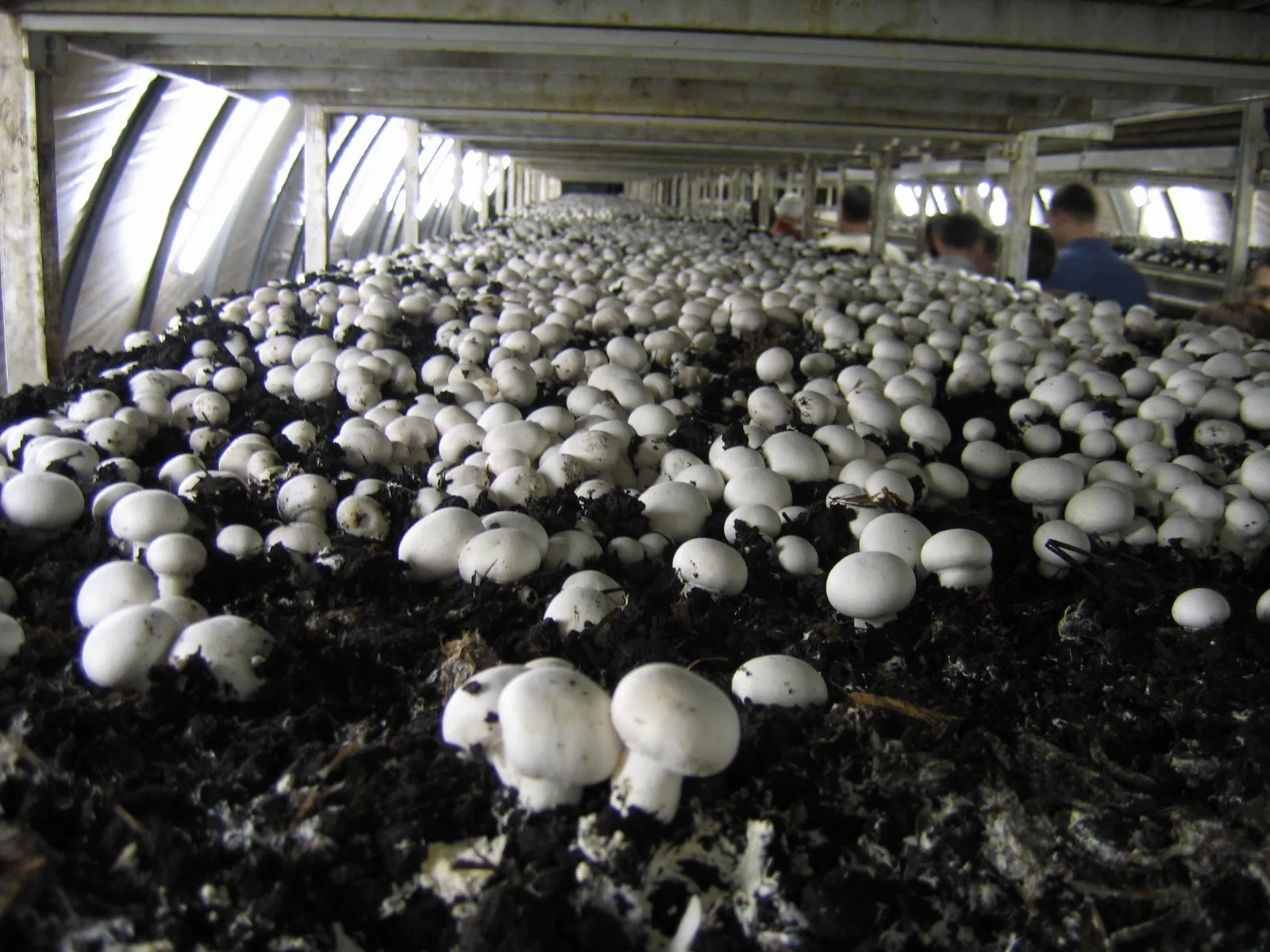
White button mushrooms on casing soil in long shelf beds inside a commercial cropping room near Eger, Hungary.
Real cultivation photograph. Read its source for location and context; it is not a universal operating specification.Andrew Bossi · CC BY-SA 2.5View full photograph ↗
On this pageChoose a section, or keep reading below

Read this in the full guide: Read the room and make a controlled adjustment

Understand the topic

Start with the explanation.

Use this page to separate people, material, air, waste, harvest and maintenance routes by contamination risk.

Part 01

Simple explanation

Hygiene Zoning helps the grower separate people, material, air, waste, harvest and maintenance routes by contamination risk. The crop requirement is the starting question, not an equipment size.

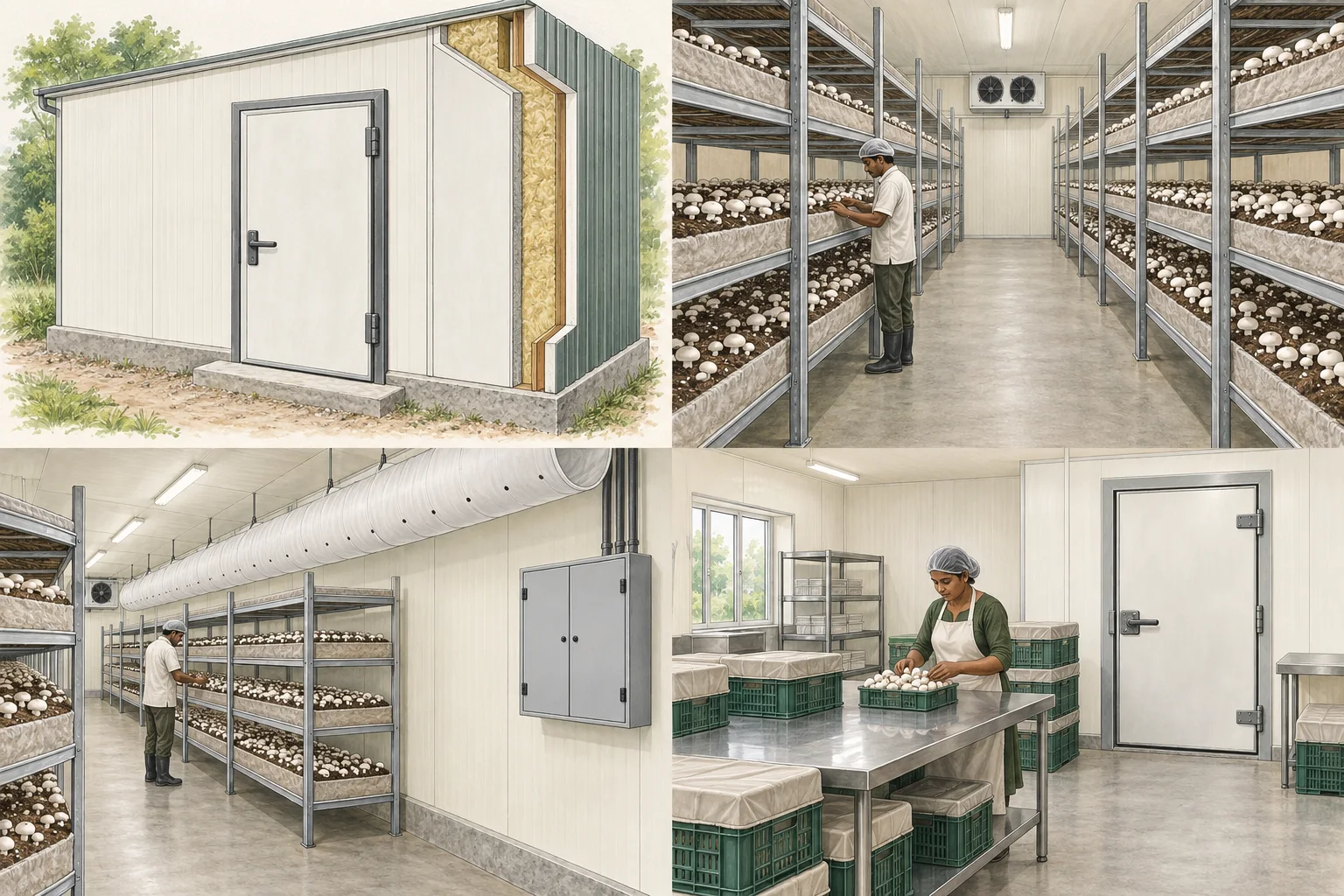
Generated conceptual cutaway of an insulated mushroom-room wall and closed door.
AI teaching illustrationKeep the room envelope continuous

Walls and doors form one enclosure. Joints, penetrations and door use affect the room as well as insulation. This cutaway is not a material or fire-safety specification.

Conceptual explanation—not a real farm photograph, diagnostic finding or construction specification.
Part 02

Biological purpose

Engineering begins only after the crop stage, biological load and acceptable room response are declared.

Part 03

Operator explanation

Observe the crop, room pattern and change history before changing a control. Record what changed, where, when and under which operating mode.

Part 04

Engineering explanation

Define the control volume, design case, load components, equipment boundaries, instrumentation and expected response. Biological requirement is not equipment size.

Part 05

What to look for

Look for spatial gradients, time trends, surface condition, crop response, door events, water events, equipment state and alarms rather than a single display value.

Part 06

What to measure

Retain sensor ID, unit, location, height or depth, timestamp, calibration state, crop stage, room load and operating mode with every measurement.

Part 07

Variables that interact

separate people, material, air, waste, harvest and maintenance routes by contamination risk. Temperature, moisture, carbon dioxide, air movement, crop load and control actions can move together, oppose one another or hide a local problem.

Part 08

What can go wrong

Common errors include a non-representative sensor, an undefined design case, a fan rating treated as delivered airflow, an air-change rate treated as distribution, or a biological target treated as plant capacity.

Part 09

What changes at commercial scale

Larger crop loads, longer air paths, more simultaneous equipment, tighter recovery needs and higher failure consequences increase the need for redundancy, commissioning and data history.

Part 10

Reference and review boundary

Background/reference map: Farm Design for White Button Mushroom Cultivation; National Building Code of India 2016; 2025 ASHRAE Handbook Fundamentals table of contents; ISHRAE standards and position papers. This map supports further editorial work; it is not route-specific technical validation. Foundational, current, regulatory and engineering references retain their distinct roles, and manufacturer literature may only establish equipment-specific data.

Go deeper

Technical reference, records and tools.

Detailed crop-stage information, parameters, diagrams and specialist tools are kept together below. This material retains its source conditions and review limits.

Open the complete technical reference

engineering · engineering guide

Hygiene Zoning

A governed engineering guide to separate people, material, air, waste, harvest and maintenance routes by contamination risk.

Crop context
Agaricus bisporus
Publication
Editorial review in progress
External review
Not yet recorded · needed from Qualified HVAC, refrigeration or electrical reviewer
Evidence records
4
White button mushrooms on casing soil in long shelf beds inside a commercial cropping room near Eger, Hungary.
Button mushrooms on casing in long shelf beds inside a grow room (Hungary). Photo: Andrew Bossi, CC BY-SA 2.5. Source

Controlled room: how the air moves

Cooled, humid air drops from the overhead duct onto the beds, returns through the room, and 20 to 30 percent fresh air is mixed in. About 15 cm per second over the beds, 4 to 6 air changes an hour. Source: ICAR-DMR manual.

Perforated supply ductAHUcooling coilhumidifierreturnfresh air 20-30%
Supply airReturn airBeds
Picture → explanation → field task

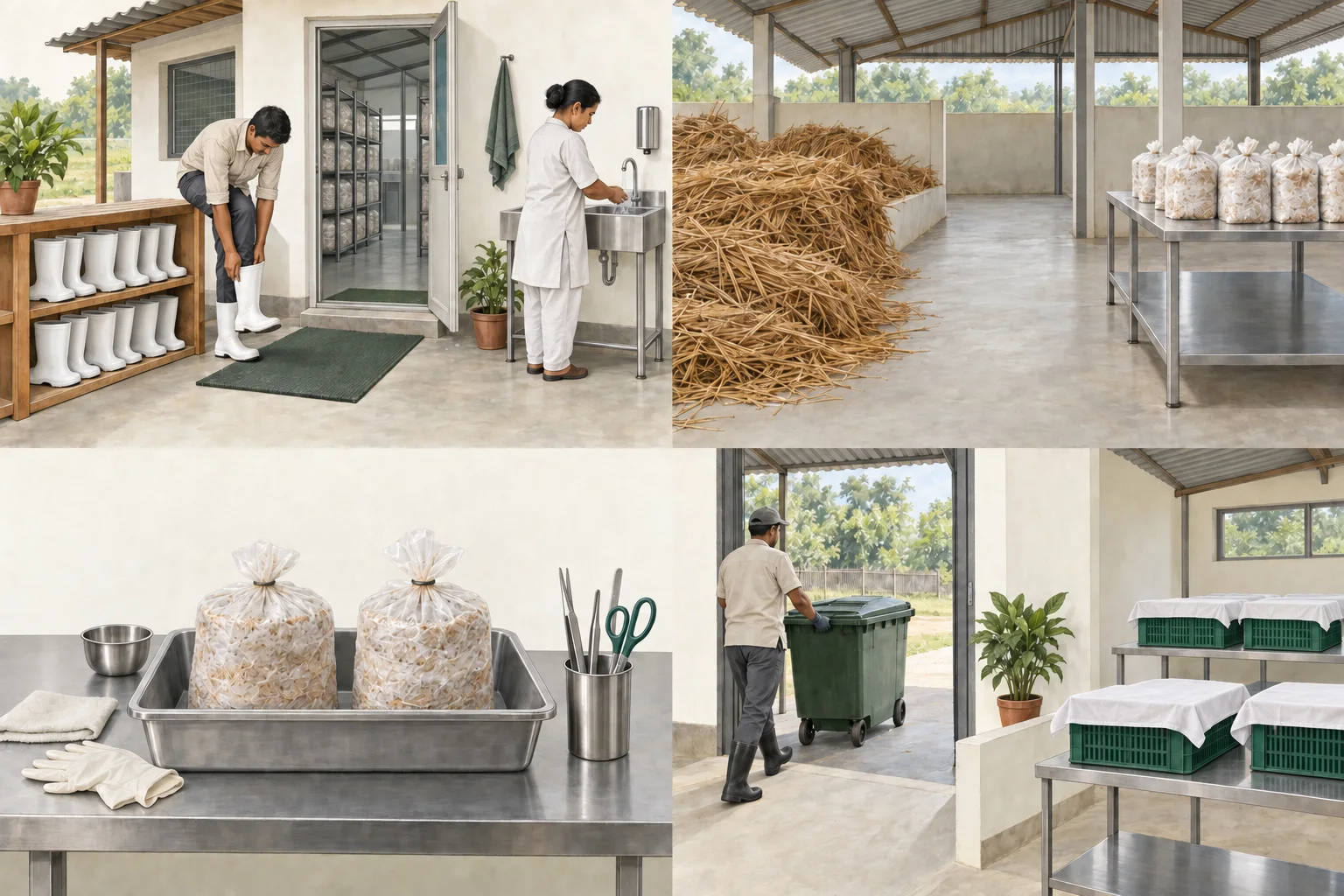
Keep clean and suspect work separate

AI-generated educational illustrations. Not actual farm photographs, diagnostic evidence or construction specifications.

Generated illustration of dedicated work footwear and a handwashing basin at a farm entrance.
01

Make clean entry a routine

Clean entry has a place and a repeatable sequence. Footwear, hands and movement between areas are part of farm hygiene. The illustration does not demonstrate a validated disinfection process.

Try this on your farm

Assign the entry routine, provide suitable facilities and check that visitors and workers follow it.

Generated illustration of raw straw separated from closed cultivation bags on a different bench.
02

Protect prepared material

Raw inputs and protected prepared material are separated. Treatment does not protect a substrate indefinitely. Handling afterwards can introduce contamination.

Try this on your farm

Keep work areas, tools and movement routes separated. Label batches so a later problem can be traced to its preparation history.

Generated illustration of two closed cultivation bags in a washable tray with dedicated tools.
03

Keep suspect bags closed

A separate tray helps identify material being held for investigation. The bags are illustrative and not diagnosed. Opening, shaking or smelling suspect material is not a confirmation method.

Try this on your farm

Mark the batch, limit movement and seek qualified advice on sampling or disposal. Do not return dedicated tools to clean work without the appropriate procedure.

Generated illustration of a covered waste tub leaving a separate area away from covered harvest crates.
04

Plan the spent-material route

Used material and saleable harvest follow different handling paths. A disposal route can undo clean-work separation if it crosses incoming materials or harvest handling.

Try this on your farm

Map the exit route and cleaning responsibility. Check the actual workflow during a busy room turnaround, not only on a drawing.

Quick orientation

Use this page to separate people, material, air, waste, harvest and maintenance routes by contamination risk.

01

Simple explanation

Hygiene Zoning helps the grower separate people, material, air, waste, harvest and maintenance routes by contamination risk. The crop requirement is the starting question, not an equipment size.

02

Biological purpose

Engineering begins only after the crop stage, biological load and acceptable room response are declared.

03

Operator explanation

Observe the crop, room pattern and change history before changing a control. Record what changed, where, when and under which operating mode.

04

Engineering explanation

Define the control volume, design case, load components, equipment boundaries, instrumentation and expected response. Biological requirement is not equipment size.

05

What to observe

Look for spatial gradients, time trends, surface condition, crop response, door events, water events, equipment state and alarms rather than a single display value.

06

What to measure

Retain sensor ID, unit, location, height or depth, timestamp, calibration state, crop stage, room load and operating mode with every measurement.

07

Variables that interact

separate people, material, air, waste, harvest and maintenance routes by contamination risk. Temperature, moisture, carbon dioxide, air movement, crop load and control actions can move together, oppose one another or hide a local problem.

08

What can go wrong

Common errors include a non-representative sensor, an undefined design case, a fan rating treated as delivered airflow, an air-change rate treated as distribution, or a biological target treated as plant capacity.

09

What changes at commercial scale

Larger crop loads, longer air paths, more simultaneous equipment, tighter recovery needs and higher failure consequences increase the need for redundancy, commissioning and data history.

10

Reference and review boundary

Background/reference map: Farm Design for White Button Mushroom Cultivation; National Building Code of India 2016; 2025 ASHRAE Handbook Fundamentals table of contents; ISHRAE standards and position papers. This map supports further editorial work; it is not route-specific technical validation. Foundational, current, regulatory and engineering references retain their distinct roles, and manufacturer literature may only establish equipment-specific data.

Evidence and review

Source type, applicability and limitations stay visible so older farm guidance is not mistaken for current engineering law.

foundational · buildingFarm Design for White Button Mushroom Cultivation

Indian production-room workflow, farm components, controlled-room and air-handling context.

Foundational farm guidance does not replace current structural, refrigeration, electrical or safety design.

Open primary source
current · buildingNational Building Code of India 2016

Building, fire, services, refrigeration, sanitation, electrical and facility-management context.

Local adoption, amendments, authority requirements and specialist codes must be verified for each project.

Open primary source
current · hvac2025 ASHRAE Handbook Fundamentals table of contents

Current chapter architecture for psychrometrics, refrigeration cycles, heat transfer, controls and measurement.

The public index identifies the current edition; detailed design use requires access to the handbook.

Open primary source
current · hvacISHRAE standards and position papers

Indian HVAC standards context including air-handling units and commissioning.

Standard titles are an index; design claims must cite and comply with the applicable edition and project jurisdiction.

Open primary source

Read the evidence

Sources & review.

Editorial update: 2026-08-23. Independent technical review is not recorded for this entry.

  1. Farm Design for White Button Mushroom Cultivation

    ICAR-Directorate of Mushroom Research

  2. National Building Code of India 2016

    Bureau of Indian Standards

  3. 2025 ASHRAE Handbook Fundamentals table of contents

    ASHRAE

  4. ISHRAE standards and position papers

    ISHRAE

Reading a source is not the same as applying its instructions to every farm. Confirm species, strain, crop stage, system, region and publication date. Old chemical recommendations are not current-use instructions.

See something that needs correcting? Tell us →