


Quick orientation
Use this page to admit enough conditioned outdoor air for the crop objective while accounting for its heat and moisture load.
Simple explanation
Fresh-Air Control helps the grower admit enough conditioned outdoor air for the crop objective while accounting for its heat and moisture load. The crop requirement is the starting question, not an equipment size.
Biological purpose
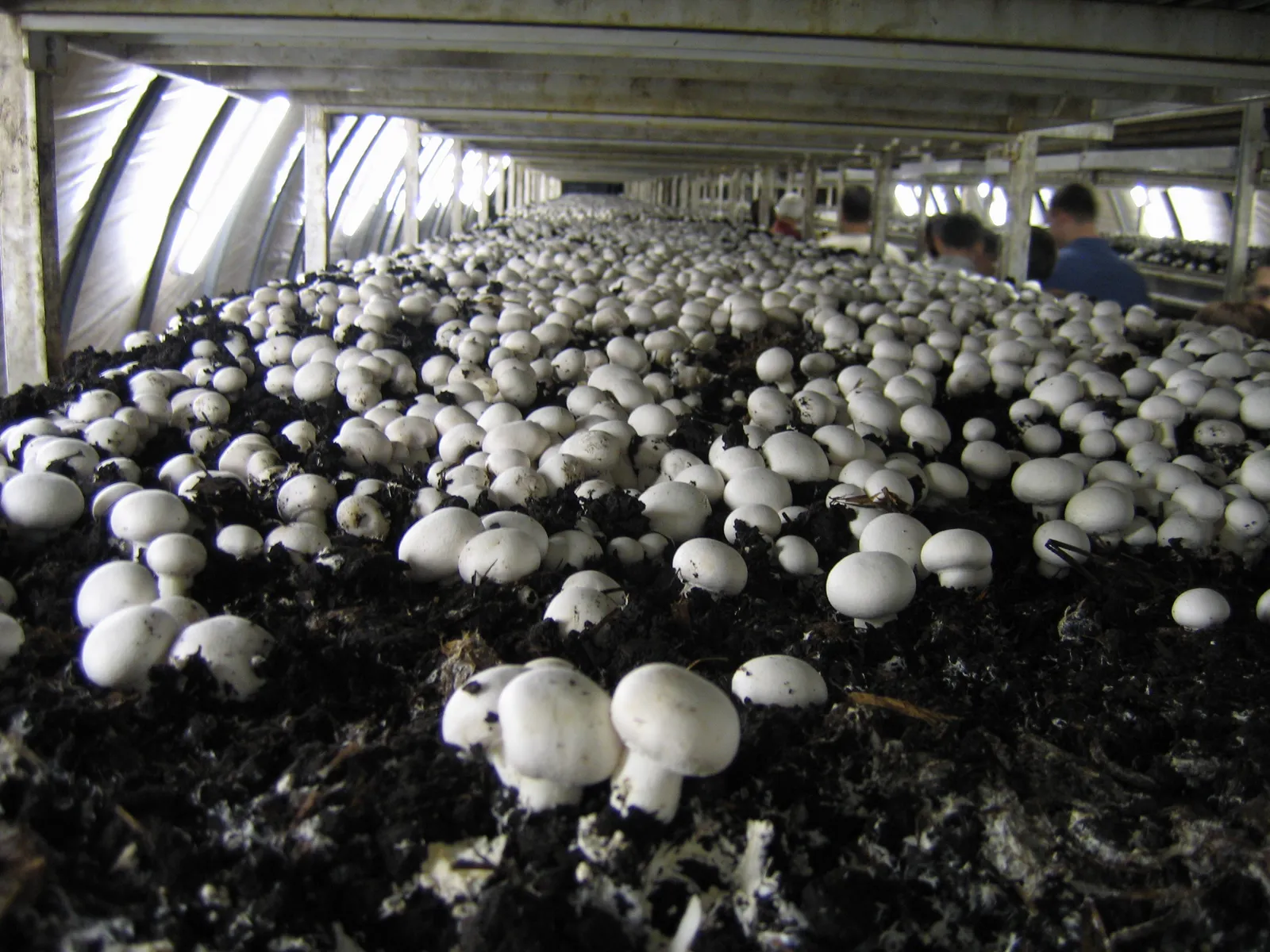
The biological purpose is to keep the crop's stage, respiration, heat, gas exchange and surface-water behaviour visible.
Operator explanation
Observe the crop, room pattern and change history before changing a control. Record what changed, where, when and under which operating mode.
Engineering explanation
Define the control volume, design case, load components, equipment boundaries, instrumentation and expected response. Biological requirement is not equipment size.
What to observe
Look for spatial gradients, time trends, surface condition, crop response, door events, water events, equipment state and alarms rather than a single display value.
What to measure
Retain sensor ID, unit, location, height or depth, timestamp, calibration state, crop stage, room load and operating mode with every measurement.
Variables that interact
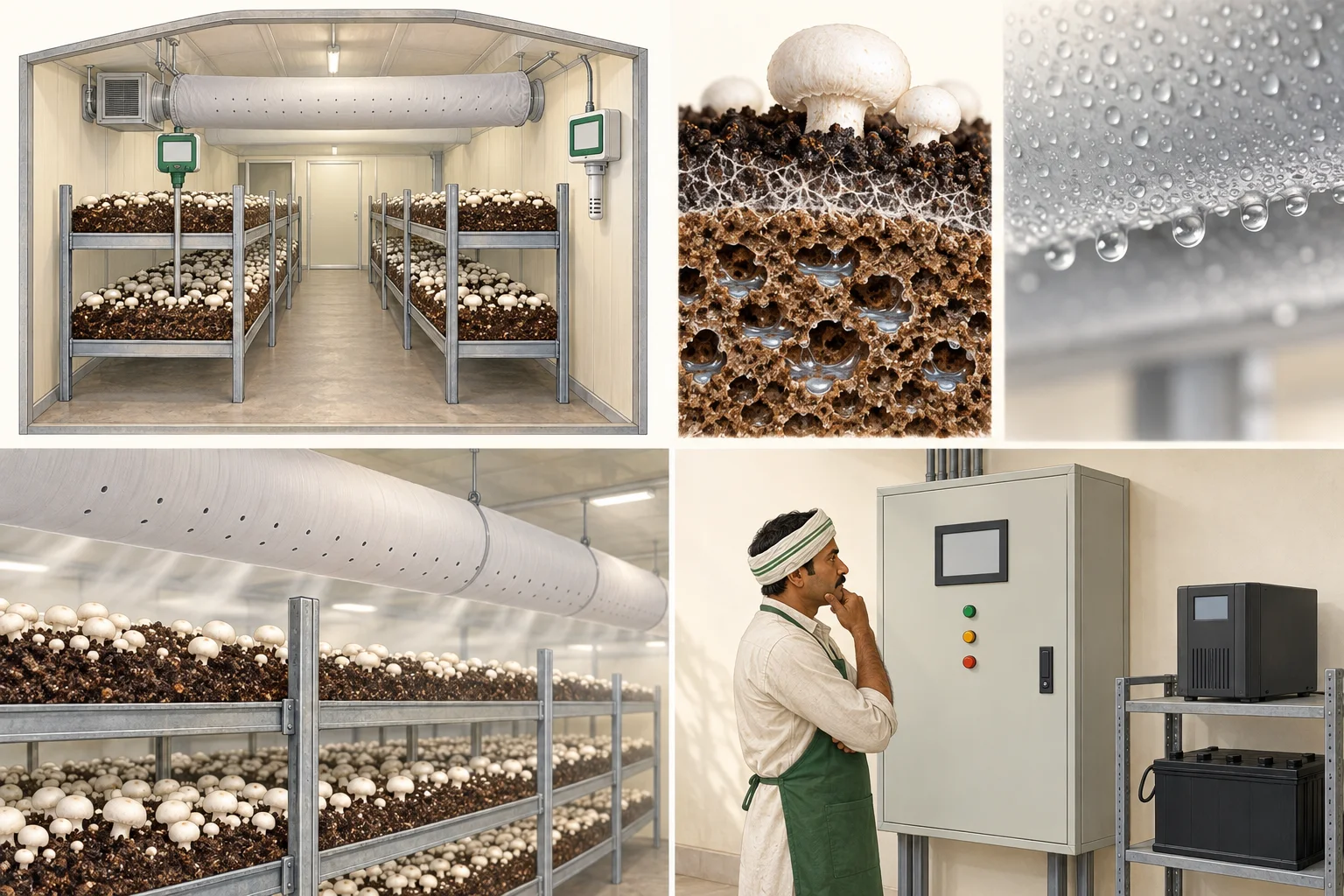
admit enough conditioned outdoor air for the crop objective while accounting for its heat and moisture load. Temperature, moisture, carbon dioxide, air movement, crop load and control actions can move together, oppose one another or hide a local problem.
What can go wrong
Common errors include a non-representative sensor, an undefined design case, a fan rating treated as delivered airflow, an air-change rate treated as distribution, or a biological target treated as plant capacity.
What changes at commercial scale
Larger crop loads, longer air paths, more simultaneous equipment, tighter recovery needs and higher failure consequences increase the need for redundancy, commissioning and data history.
Reference and review boundary
Background/reference map: Mushroom Cultivation, Marketing and Consumption; ICAR-DMR Crop Advisory. This map supports further editorial work; it is not route-specific technical validation. Foundational, current, regulatory and engineering references retain their distinct roles, and manufacturer literature may only establish equipment-specific data.
The numbers for this room, with their source.
Crop-climate values are published from ICAR-DMR guidance with the stage they apply to. Equipment sizes stay project-specific and are never published as defaults.
ENV.CLIMATE.CO2source contextualCarbon-dioxide concentration
800 to 15,000 ppmICAR-DMR: 10,000 to 15,000 ppm during spawn run with no fresh air; 800 to 1,000 ppm for pinning; 1,000 to 1,500 ppm during cropping with 20 to 30 percent fresh air
- Unit
- ppm
- Context
- Mapped by height, rack and air path
- Review needed from
- Button Mushroom crop-climate reviewer
ENV.CLIMATE.FRESH_AIRpending technical verificationOutdoor-air volume flow
Technical value pending verification- Unit
- m³/h
- Context
- Measured or commissioned at the operating damper position
- Review needed from
- Qualified HVAC or electrical engineer
ENV.LOAD.FRESH_AIRpending technical verificationFresh-air total load
Technical value pending verification- Unit
- kW
- Context
- Mass flow and outdoor/room enthalpy retained
- Review needed from
- Qualified HVAC or electrical engineer
ENV.AIRFLOW.SUPPLYpending technical verificationSupply-air volume flow
Technical value pending verification- Unit
- m³/h
- Context
- Duty point includes installed system resistance
- Review needed from
- Qualified HVAC or electrical engineer
ENV.AIRFLOW.STATICpending technical verificationFan total/static pressure
Technical value pending verification- Unit
- Pa
- Context
- Measured across declared system boundaries
- Review needed from
- Qualified HVAC or electrical engineer
ENV.CLIMATE.AIR_VELOCITYsource contextualCrop-level air velocity
0.15 m/sICAR-DMR: about 15 cm per second over the beds, with 6 air changes per hour in the first two flushes and 4 afterwards
- Unit
- m/s
- Context
- Mapped with instrument orientation and rack condition
- Review needed from
- Button Mushroom crop-climate reviewer
ENV.CLIMATE.ROOM_PRESSUREpending technical verificationRoom pressure differential
Technical value pending verification- Unit
- Pa
- Context
- Reference zone and door condition recorded
- Review needed from
- Qualified HVAC or electrical engineer
Transparent calculation framework
Equations expose variables, units, assumptions, validation and the point where project data must enter.
ENV.FORMULA.FRESH_AIRCalculate outdoor-air total heat load from enthalpy difference
Required variables
- ṁ · dry-air mass flow
- kg/s; derived from measured volume flow, density and pressure context
- h_out · outdoor-air enthalpy
- kJ/kg dry air; validated psychrometric state
- h_in · room-air enthalpy
- kJ/kg dry air; validated psychrometric state
Assumptions
- State points and mass-flow basis are consistent
- Heat recovery and leakage are treated separately
Validation
- Equal enthalpy states return zero
- Sign follows declared heat-flow convention
Evidence and review
Source type, applicability and limitations stay visible so older farm guidance is not mistaken for current engineering law.
foundational · biologyMushroom Cultivation, Marketing and Consumption
Indian Button Mushroom crop stages, environmental responses and cultivation vocabulary.
Published stage values remain source-specific and require strain, system and current-review context before approval.
Open primary sourcecurrent · biologyICAR-DMR Crop Advisory
Current India-season cultivation context and stage-specific environmental advisories.
An advisory is time, crop and context specific; it is not a universal equipment design basis.
Open primary source