


Quick orientation
Use this page to make sensor identity, placement, calibration, logging and uncertainty part of every reading.
Simple explanation
Environmental Measurement helps the grower make sensor identity, placement, calibration, logging and uncertainty part of every reading. The crop requirement is the starting question, not an equipment size.
Biological purpose
The biological purpose is to keep the crop's stage, respiration, heat, gas exchange and surface-water behaviour visible.
Operator explanation
Observe the crop, room pattern and change history before changing a control. Record what changed, where, when and under which operating mode.
Engineering explanation
Define the control volume, design case, load components, equipment boundaries, instrumentation and expected response. Biological requirement is not equipment size.
What to observe
Look for spatial gradients, time trends, surface condition, crop response, door events, water events, equipment state and alarms rather than a single display value.
What to measure
Retain sensor ID, unit, location, height or depth, timestamp, calibration state, crop stage, room load and operating mode with every measurement.
Variables that interact
make sensor identity, placement, calibration, logging and uncertainty part of every reading. Temperature, moisture, carbon dioxide, air movement, crop load and control actions can move together, oppose one another or hide a local problem.
What can go wrong
Common errors include a non-representative sensor, an undefined design case, a fan rating treated as delivered airflow, an air-change rate treated as distribution, or a biological target treated as plant capacity.
What changes at commercial scale
Larger crop loads, longer air paths, more simultaneous equipment, tighter recovery needs and higher failure consequences increase the need for redundancy, commissioning and data history.
Reference and review boundary
Background/reference map: Mushroom Cultivation, Marketing and Consumption; ICAR-DMR Crop Advisory. This map supports further editorial work; it is not route-specific technical validation. Foundational, current, regulatory and engineering references retain their distinct roles, and manufacturer literature may only establish equipment-specific data.
Sensor architecture library
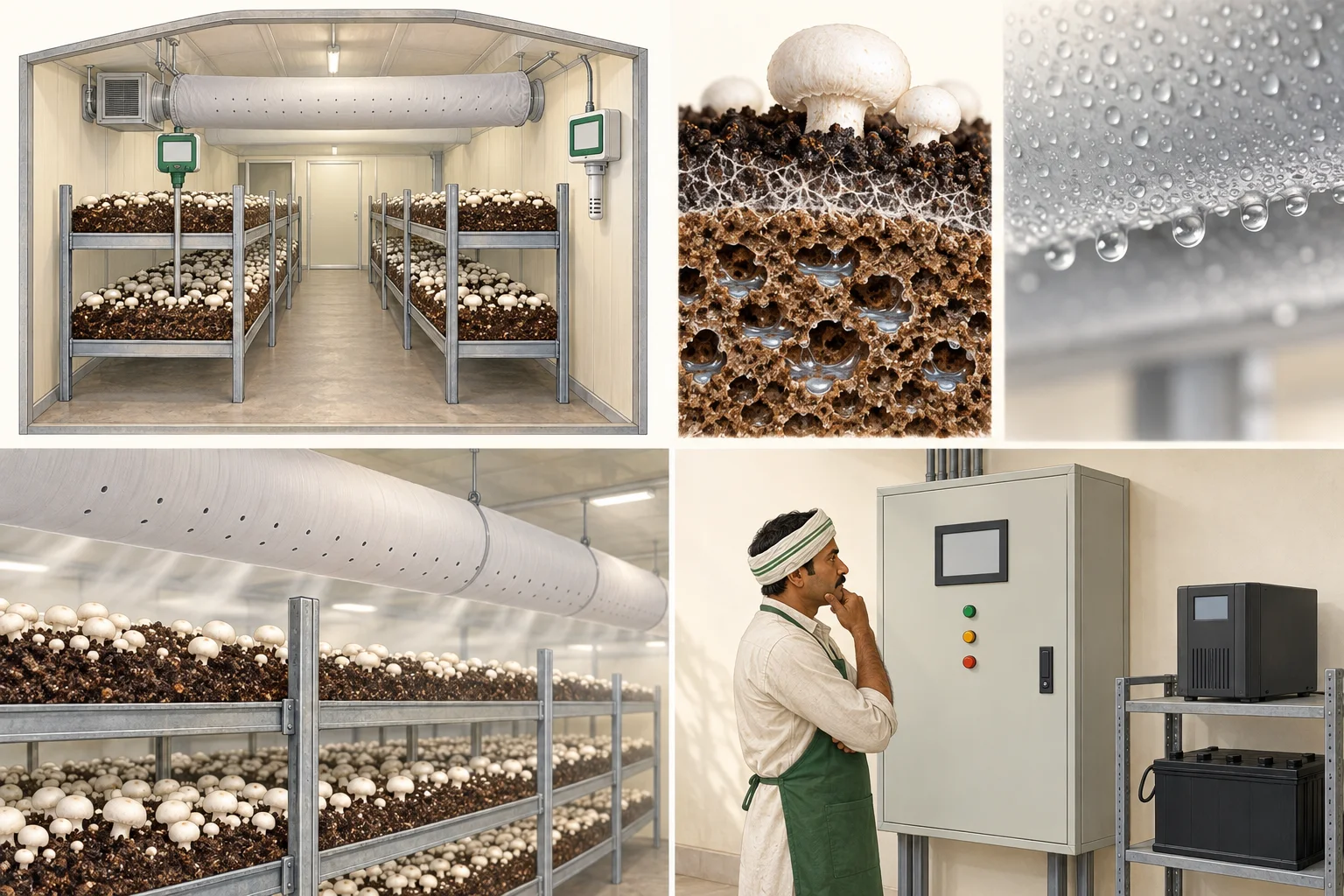
A sensor is a measurement system with a location, purpose, verification method and failure history.
SENSOR-AIR-TEMP-RHAir dry bulb and relative humidity
Does the point represent crop air rather than a wall, coil discharge or door plume?
- Installation
- Shield from radiant and wetting bias; Record height, rack, aisle and air path; Allow service access
- Verification
- Compare against a traceable reference; Verify time alignment and logging interval; Inspect drift after wet cleaning
- Failure modes
- Condensation on element; wall temperature bias; unrecorded replacement
SENSOR-COMPOST-TEMPCompost temperature
Are depth, bed position, rack level and insertion contact repeatable?
- Installation
- Define insertion depth; Map representative beds; Protect cable and connector
- Verification
- Cross-check probes; Record point identity; Review response time
- Failure modes
- shallow insertion; poor contact; single-point overconfidence
SENSOR-CO2Carbon-dioxide concentration
Can the placement reveal gradients rather than only return-air average?
- Installation
- Record height and air path; Avoid direct fresh-air jet; Provide calibration access
- Verification
- Zero/span method per instrument; Compare map points; Review pressure and cross-sensitivity limits
- Failure modes
- drift; condensation; blocked sample line; false representativeness
SENSOR-PRESSUREDifferential pressure
Are the reference zones, tube routes and door states defined?
- Installation
- Label high and low ports; Protect tubes from water; Locate reference away from local jets
- Verification
- Zero check; leak check; door-state test
- Failure modes
- reversed tubes; water in line; undefined reference
SENSOR-AIR-VELOCITYAir speed and direction
Is the instrument suitable for low-speed, directional mapping among racks?
- Installation
- Define orientation; use repeatable grid; record occupied crop state
- Verification
- instrument zero and calibration; repeat traverse; compare supply and return balance
- Failure modes
- orientation error; operator blockage; snapshot treated as permanent
Room mapping tool
Record one parameter across a repeatable grid. Add location, height, instrument and operating-mode details to the field sheet.
Enter at least one grid point to begin the map.
Technical diagrams
Original diagrams expose system boundaries, air paths, feedback and engineering handoffs.
Printable field sheets
Download a blank CSV, open it in a spreadsheet, and record the actual observations with units and references. These educational templates are not acceptance criteria or engineering certificates.
Evidence and review
Source type, applicability and limitations stay visible so older farm guidance is not mistaken for current engineering law.
foundational · biologyMushroom Cultivation, Marketing and Consumption
Indian Button Mushroom crop stages, environmental responses and cultivation vocabulary.
Published stage values remain source-specific and require strain, system and current-review context before approval.
Open primary sourcecurrent · biologyICAR-DMR Crop Advisory
Current India-season cultivation context and stage-specific environmental advisories.
An advisory is time, crop and context specific; it is not a universal equipment design basis.
Open primary source