


Quick orientation
Follow the validated technology protocol for the actual facility. Do not borrow timers or stage durations from a different system.
01
Simple explanation
Indoor Phase I uses forced aeration and defined transfers to improve process control.
02
What is happening
Enclosure and forced aeration change heat retention, moisture loss, gas movement and microbial selection compared with an outdoor pile.
03
Operator explanation
Follow the validated technology protocol for the actual facility. Do not borrow timers or stage durations from a different system.
04
What to observe
Observation should describe stage, location, pattern and change history before interpretation.
- Uniform wetting before fill
- air distribution
- temperature pattern
- transfer mixing
- odour and structure
05
What to measure
Measurement must retain method, unit, location, timing, calibration and sample identity.
- Batch timeline
- multi-point temperature
- fan state
- pressure
- water additions
- transfer mass
06
Equipment and process boundary
Equipment is useful only when its role in the biological process is explicit.
- Preparation area
- aerated bunkers
- loader
- floor cleaning
- Phase II tunnel
07
Variables that interact
Outdoor preparation, aerated Phase I, remixing or transfer and Phase II are linked but distinct operations.
08
What can go wrong
A symptom may have several mechanisms. Verify the cause before changing the process.
- Blind timer operation
- wrong protocol
- incomplete mixing at transfer
- capacity mismatch between bunkers and tunnels
09
What changes at commercial scale
Scaling changes geometry, repeatability, instrumentation, material flow and failure consequence.
- Mechanization improves repeatability only when loading, air and records are controlled
- Bottlenecks move between preparation, bunker, transfer and tunnel
10
Evidence boundary
Mapped evidence: Technologies Developed by ICAR-DMR for Commercial Use; Farm Design for White Button Mushroom Cultivation. Foundational, current operational, research and engineering sources retain their different roles.
Technical diagrams
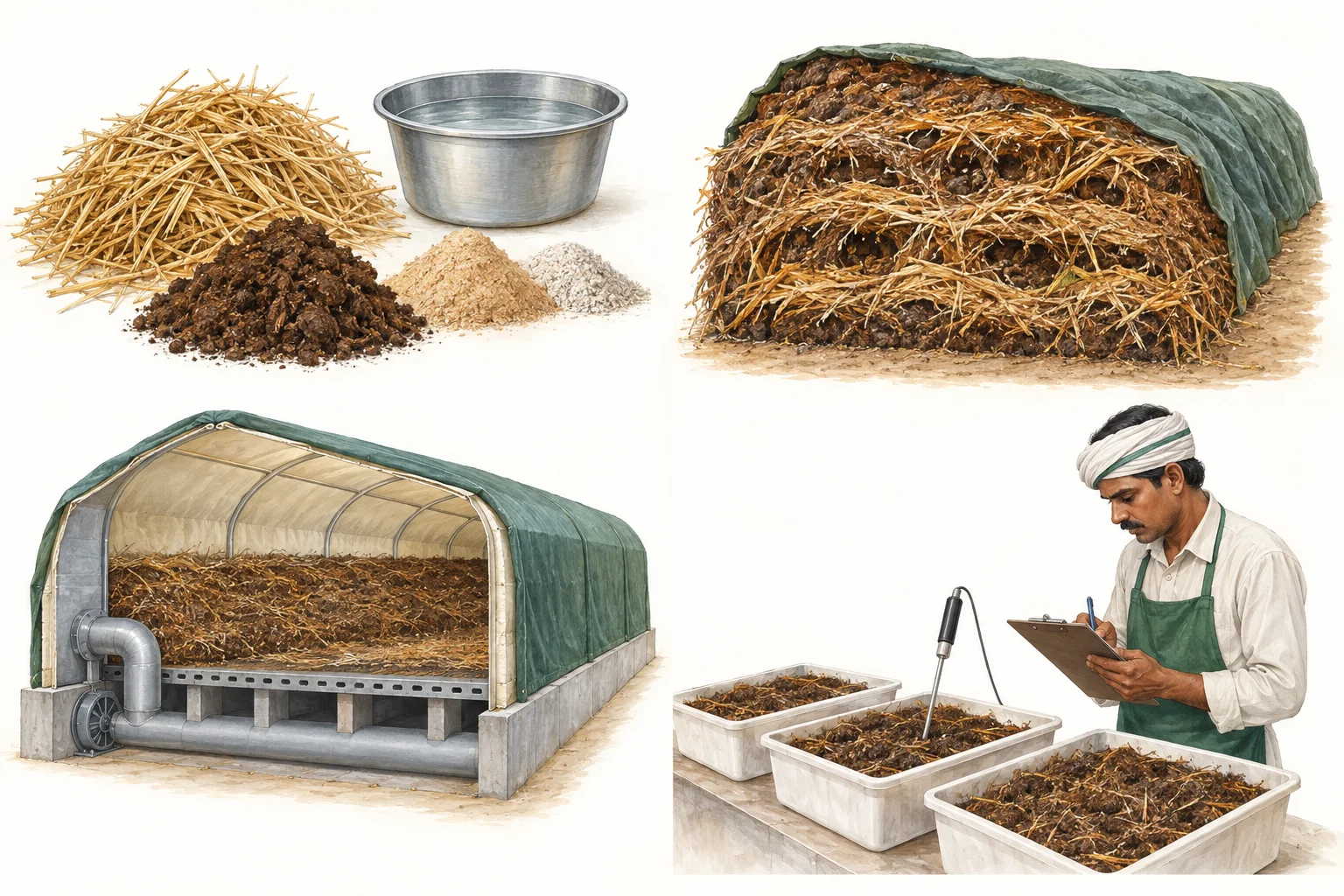
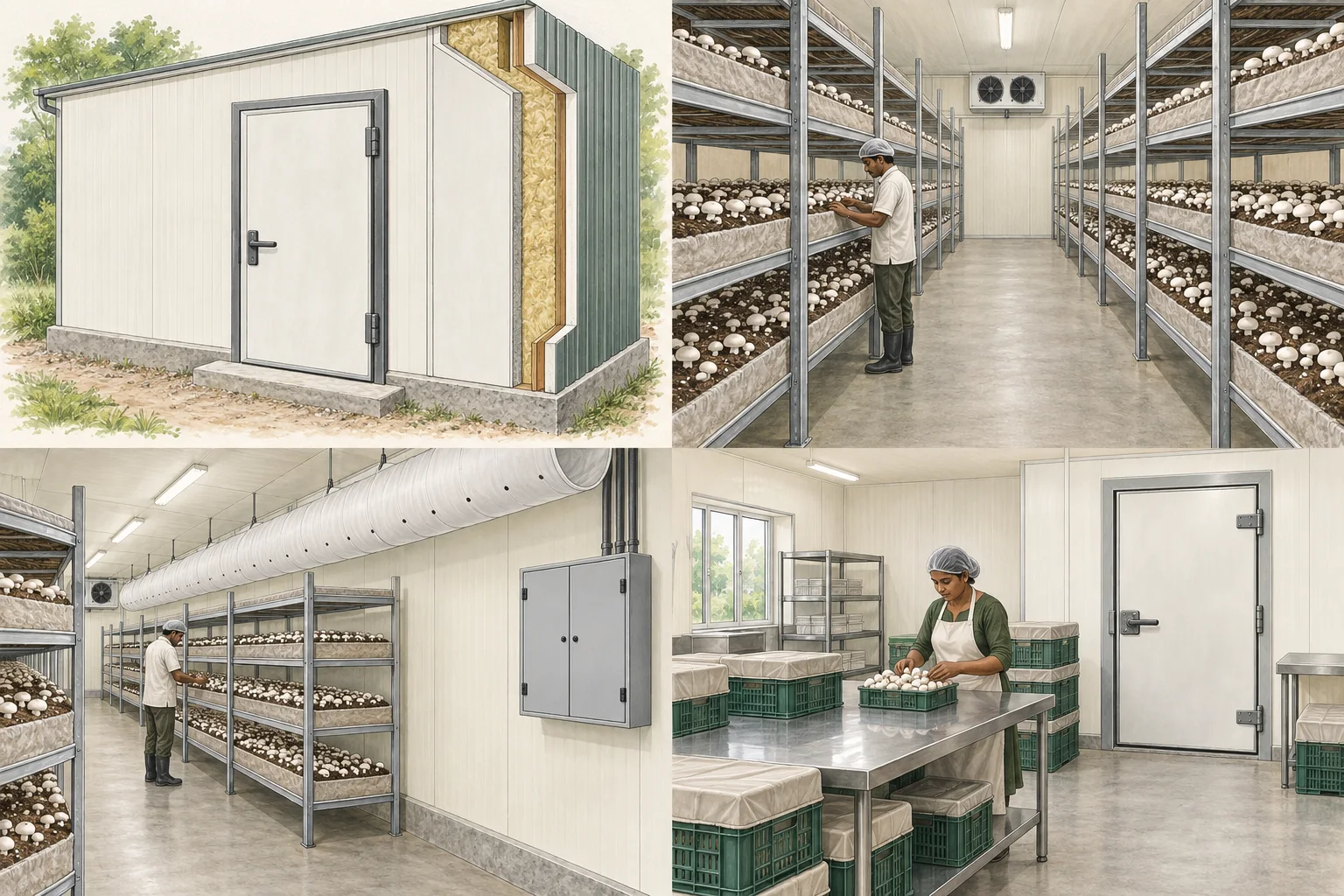
Original system diagrams separate air paths, material paths, measurements and biological transformations.
Progressive depth
Move from field observation to mechanism, engineering and evidence without losing the original question.
PracticalWhat the operator notices
- Indoor Phase I uses forced aeration and defined transfers to improve process control.
- Uniform wetting before fill
- air distribution
- temperature pattern
TechnicalHow process variables interact
- Outdoor preparation, aerated Phase I, remixing or transfer and Phase II are linked but distinct operations.
- Batch timeline
- multi-point temperature
- fan state
EngineeringHow the physical system serves the process
- Preparation area
- aerated bunkers
- loader
- Mechanization improves repeatability only when loading, air and records are controlled
- Bottlenecks move between preparation, bunker, transfer and tunnel
ResearchWhich evidence records govern this page
- COMPOST-SRC-DMR-TECHNOLOGIES
- COMPOST-SRC-DMR-FARM-DESIGN
The numbers for this step, with their source.
Process values are published from ICAR-DMR guidance with the stage and measuring point they apply to. A parameter still marked pending has no published Indian value yet.
Biological and process parameters
COMPOST.PHASE1.COMPOST_TEMPERATUREsource contextualPhase I heap temperature
65 to 70 °C- Stage
- Phase I
- Measurement context
- Core of the outdoor long-method heap
- Conditions
- The heap should reach 65 to 70 °C in the core (ICAR-DMR farmer folder); ICAR-DMR treats 80 °C as the upper safe core temperature; Probe depth, time since turning and weather change the reading
COMPOST.PHASE1.AMMONIAsource contextualAmmonia at the end of Phase I
800 to 1,000 ppm- Stage
- Phase I
- Measurement context
- Compost sample at the end of Phase I
- Conditions
- ICAR-DMR: 800 to 1,000 ppm ammonia after Phase I; Phase II must bring free ammonia below 10 ppm before spawning; Measurement method and pH change the reading
Engineering design metrics
COMPOST.AERATION.AIRFLOWpending technical verificationRequired airflow
Project value pending verification- Component
- Aeration system
- Design context
- Process stage and loaded compost resistance
- Method
- Project-specific engineering calculation required
COMPOST.FAN.DUTY_POINTpending technical verificationOperating duty point
Project value pending verification- Component
- Fan or blower
- Design context
- Intersection of verified fan and system curves
- Method
- Project-specific engineering calculation required
Evidence, applicability and review2 mapped sources
Sources support mechanisms and architecture. Technical and engineering values publish only through their separate governed registries.
Technologies Developed by ICAR-DMR for Commercial Use
Documents distinct Indian composting methods, including aerated indoor Phase I and ZEPT concepts.
- Publisher
- ICAR-Directorate of Mushroom Research
- Accessed
- 2026-08-22
Farm Design for White Button Mushroom Cultivation
Indian farm workflow, compost-unit components, tunnel and controlled-farm engineering vocabulary.
- Publisher
- ICAR-Directorate of Mushroom Research
- Accessed
- 2026-08-22