


Quick orientation
Advance by verified mass condition and process objective, not because one air sensor reached a number.
01
Simple explanation
Phase II is controlled thermal and biological processing. It is not only heating.
02
What is happening
Thermal treatment, microbial selection, physicochemical nitrogen transformations, ammonia removal, gas exchange and compost maturation continue inside a controlled air circuit.
03
Operator explanation
Advance by verified mass condition and process objective, not because one air sensor reached a number.
04
What to observe
Observation should describe stage, location, pattern and change history before interpretation.
- Fill uniformity
- air-compost temperature relationship
- cold and hot spots
- ammonia trend
- pressure and fan response
05
What to measure
Measurement must retain method, unit, location, timing, calibration and sample identity.
- Multi-point compost temperature
- supply and return air
- pressure
- fan and damper state
- safe ammonia evidence
06
Equipment and process boundary
Equipment is useful only when its role in the biological process is explicit.
- Insulated tunnel
- plenum
- air floor
- fan
- dampers
- sensors
- controller
- drainage
07
Variables that interact
Tunnel envelope, floor, plenum, fan, dampers, fresh air, return air, exhaust, sensors and drainage form one process system.
08
What can go wrong
A symptom may have several mechanisms. Verify the cause before changing the process.
- One-probe certification
- uneven filling
- air bypass
- persistent ammonia
- rapid uncontrolled cooling
- dirty unloading
09
What changes at commercial scale
Scaling changes geometry, repeatability, instrumentation, material flow and failure consequence.
- Small peak-heating rooms and bulk tunnels may use different architecture
- Commercial tunnels require commissioned distribution and traceable curves
10
Evidence boundary
Mapped evidence: Mushroom Cultivation, Marketing and Consumption; Farm Design for White Button Mushroom Cultivation; Dynamics of microbial community and enzyme activities during Agaricus bisporus compost preparation. Foundational, current operational, research and engineering sources retain their different roles.
Technical diagrams
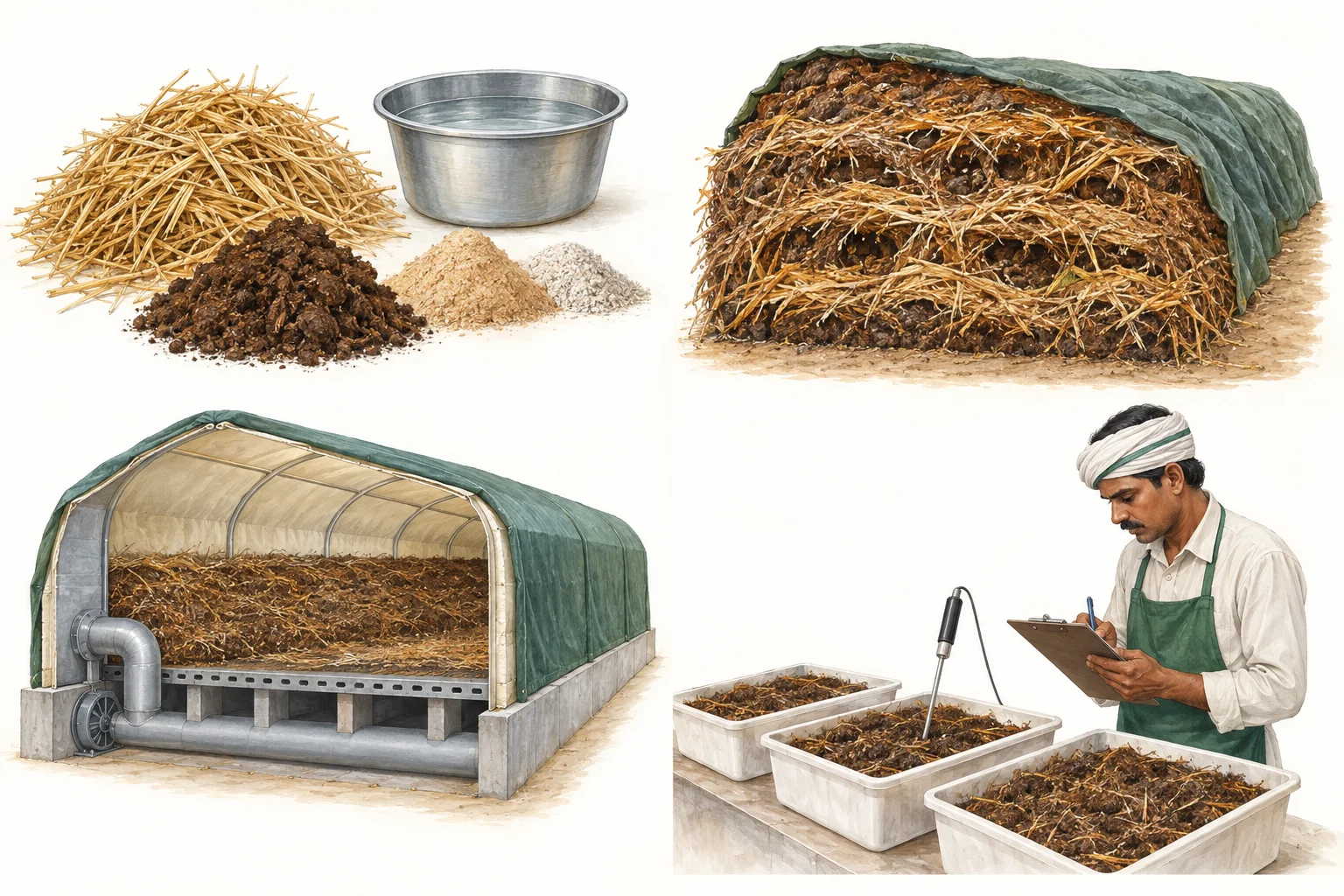
Original system diagrams separate air paths, material paths, measurements and biological transformations.
Progressive depth
Move from field observation to mechanism, engineering and evidence without losing the original question.
PracticalWhat the operator notices
- Phase II is controlled thermal and biological processing. It is not only heating.
- Fill uniformity
- air-compost temperature relationship
- cold and hot spots
TechnicalHow process variables interact
- Tunnel envelope, floor, plenum, fan, dampers, fresh air, return air, exhaust, sensors and drainage form one process system.
- Multi-point compost temperature
- supply and return air
- pressure
EngineeringHow the physical system serves the process
- Insulated tunnel
- plenum
- air floor
- Small peak-heating rooms and bulk tunnels may use different architecture
- Commercial tunnels require commissioned distribution and traceable curves
ResearchWhich evidence records govern this page
- COMPOST-SRC-DMR-MANUAL
- COMPOST-SRC-DMR-FARM-DESIGN
- COMPOST-SRC-ISME-MICROBIAL
The numbers for this step, with their source.
Process values are published from ICAR-DMR guidance with the stage and measuring point they apply to. A parameter still marked pending has no published Indian value yet.
Biological and process parameters
COMPOST.PHASE2.AIR_TEMPERATUREpending technical verificationPhase II process-air temperature
Technical value pending verification- Stage
- Phase II
- Measurement context
- Defined supply, return or room-air position
- Conditions
- Phase objective; sensor placement; fan state
COMPOST.PHASE2.COMPOST_TEMPERATUREsource contextualPhase II compost temperature envelope
45 to 59 °C- Stage
- Phase II
- Measurement context
- Mapped points through the compost mass
- Conditions
- Conditioning at 45 to 52 °C before and after pasteurisation; Pasteurisation at 58 to 59 °C for 4 to 6 hours, never above 60 °C; Rise about 1 °C per hour, cool about 1.5 °C per hour
COMPOST.PHASE2.PASTEURIZATION_PROFILEsource contextualDMR bulk-tunnel pasteurization compost temperature
58 to 59 °C- Stage
- Pasteurization
- Measurement context
- Coldest validated mapped compost point
- Conditions
- Hold 4–6 hours after the mapped compost mass satisfies the cited band; DMR-described bulk-tunnel method; not universal across all systems; The cited method warns against compost temperature above 60°C
COMPOST.PHASE2.CONDITIONING_PROFILEsource contextualDMR Phase II conditioning compost temperature
45 to 52 °C- Stage
- PPC and POPC
- Measurement context
- Multiple mapped compost points with oxygen and ammonia history
- Conditions
- PPC: approximately 45–52°C for about two days in the cited >15 t tunnel description; POPC: approximately 45–48°C, commonly 3–4 days, until ammonia is below 10 ppm; Maintain oxygen above 10% during biological conditioning
Engineering design metrics
COMPOST.TUNNEL.USABLE_VOLUMEpending technical verificationUsable compost volume
Project value pending verification- Component
- Phase II tunnel
- Design context
- Declared internal loading envelope
- Method
- Project-specific engineering calculation required
COMPOST.PLENUM.PRESSUREpending technical verificationPlenum pressure
Project value pending verification- Component
- Phase II plenum
- Design context
- Measured under the loaded floor
- Method
- Project-specific engineering calculation required
COMPOST.FAN.DUTY_POINTpending technical verificationOperating duty point
Project value pending verification- Component
- Fan or blower
- Design context
- Intersection of verified fan and system curves
- Method
- Project-specific engineering calculation required
Phase II Process Record
Record actual observations and measured values. No unsourced setpoint is prefilled.
Evidence, applicability and review3 mapped sources
Sources support mechanisms and architecture. Technical and engineering values publish only through their separate governed registries.
Mushroom Cultivation, Marketing and Consumption
Indian Button Mushroom compost methods, cultivation context, Phase I and Phase II process vocabulary.
- Publisher
- ICAR-Directorate of Mushroom Research
- Accessed
- 2026-08-22
Farm Design for White Button Mushroom Cultivation
Indian farm workflow, compost-unit components, tunnel and controlled-farm engineering vocabulary.
- Publisher
- ICAR-Directorate of Mushroom Research
- Accessed
- 2026-08-22
Dynamics of microbial community and enzyme activities during Agaricus bisporus compost preparation
Microbial succession, thermophilic communities, lignocellulose transformation and conditioning mechanisms.
- Publisher
- ISME Communications
- Accessed
- 2026-08-22