


Quick orientation
Record source batch, fill pattern, depth, sensor positions and visible nonuniformity before the process starts.
01
Simple explanation
How compost is loaded changes how air moves through it.
02
What is happening
Compression and particle distribution change pressure drop, pore continuity and local heat and mass transfer.
03
Operator explanation
Record source batch, fill pattern, depth, sensor positions and visible nonuniformity before the process starts.
04
What to observe
Observation should describe stage, location, pattern and change history before interpretation.
- Depth variation
- compressed tracks
- material segregation
- damaged or blocked floor outlets
- probe placement
05
What to measure
Measurement must retain method, unit, location, timing, calibration and sample identity.
- Depth map
- mass by declared stage
- contextual density if used
- sensor identity and location
06
Equipment and process boundary
Equipment is useful only when its role in the biological process is explicit.
- Loader or conveyor
- floor protection
- depth reference
- probes
- batch identification
07
Variables that interact
Transfer mixing, loader or conveyor, floor protection, tunnel capacity and sensor placement meet at filling.
08
What can go wrong
A symptom may have several mechanisms. Verify the cause before changing the process.
- Overfilling
- uneven compaction
- segregation
- unmapped sensors
- mixing dirty and clean movement
09
What changes at commercial scale
Scaling changes geometry, repeatability, instrumentation, material flow and failure consequence.
- Manual filling produces operator-dependent compaction
- Mechanized filling needs distribution checks and capacity reconciliation
10
Evidence boundary
Mapped evidence: Farm Design for White Button Mushroom Cultivation; Mushroom Cultivation, Marketing and Consumption. Foundational, current operational, research and engineering sources retain their different roles.
Technical diagrams
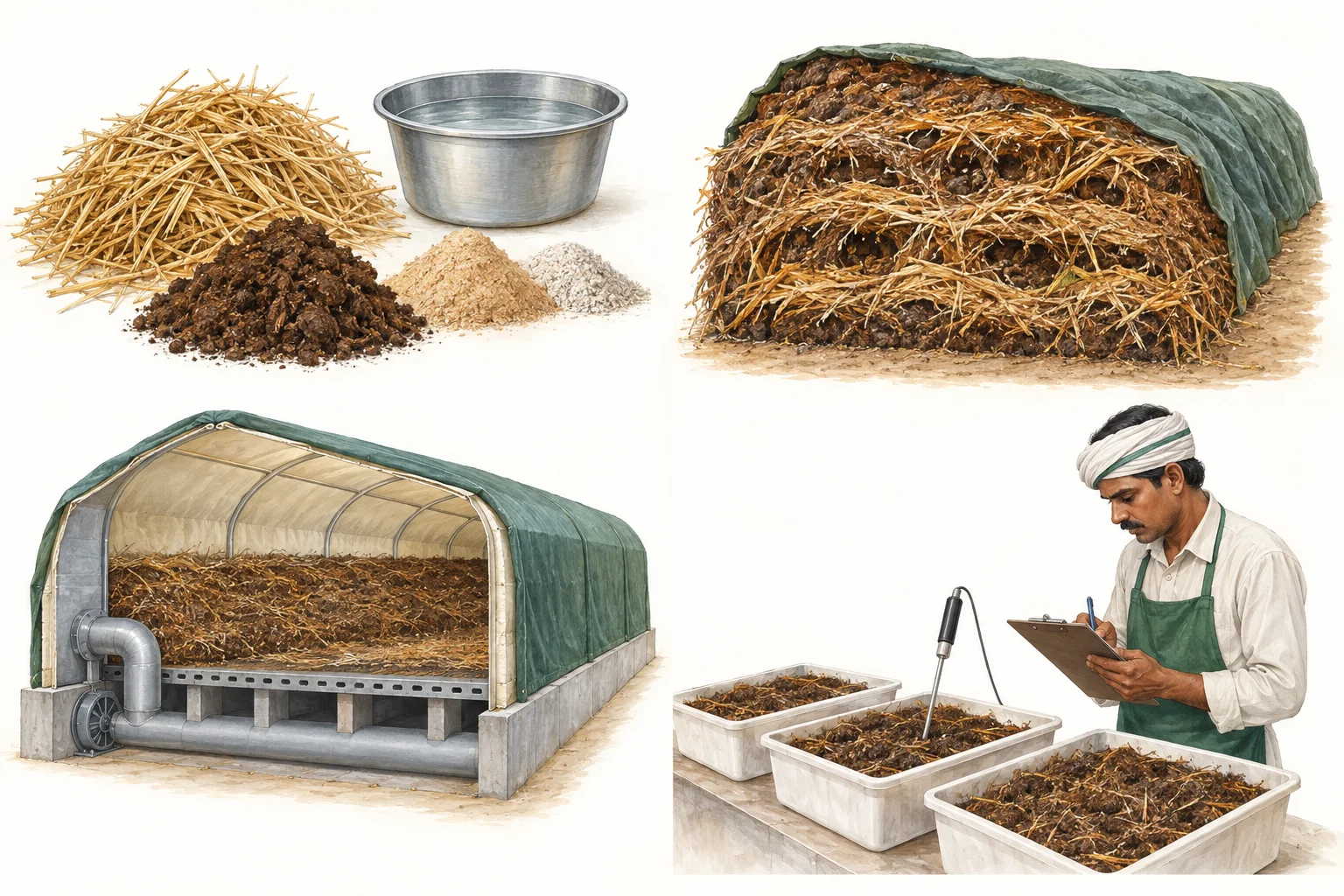
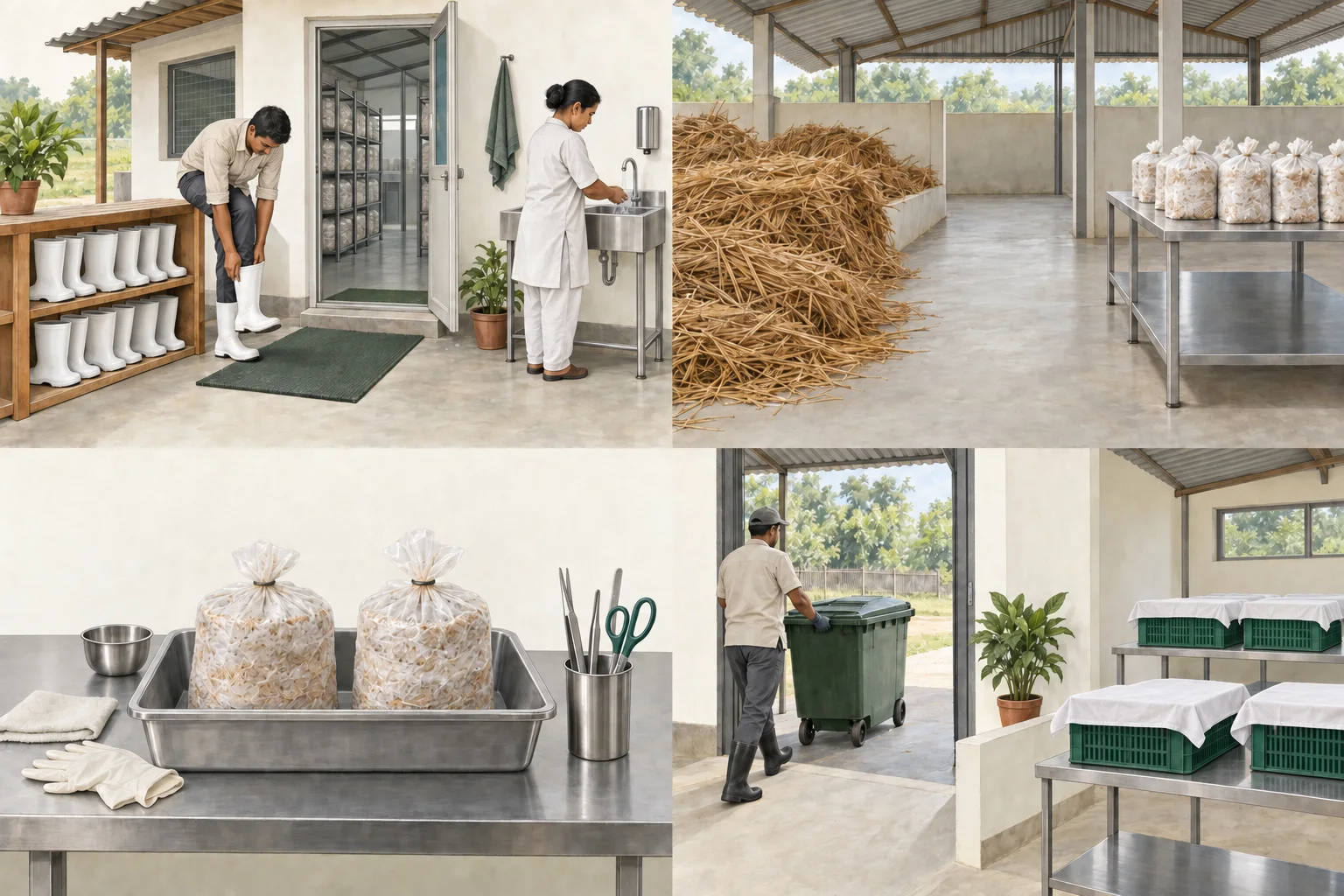
Original system diagrams separate air paths, material paths, measurements and biological transformations.
Progressive depth
Move from field observation to mechanism, engineering and evidence without losing the original question.
PracticalWhat the operator notices
- How compost is loaded changes how air moves through it.
- Depth variation
- compressed tracks
- material segregation
TechnicalHow process variables interact
- Transfer mixing, loader or conveyor, floor protection, tunnel capacity and sensor placement meet at filling.
- Depth map
- mass by declared stage
- contextual density if used
EngineeringHow the physical system serves the process
- Loader or conveyor
- floor protection
- depth reference
- Manual filling produces operator-dependent compaction
- Mechanized filling needs distribution checks and capacity reconciliation
ResearchWhich evidence records govern this page
- COMPOST-SRC-DMR-FARM-DESIGN
- COMPOST-SRC-DMR-MANUAL
The numbers for this step, with their source.
Process values are published from ICAR-DMR guidance with the stage and measuring point they apply to. A parameter still marked pending has no published Indian value yet.
Biological and process parameters
COMPOST.PHYSICS.BULK_DENSITYpending technical verificationContextual bulk density
Technical value pending verification- Stage
- Loading and capacity planning
- Measurement context
- Representative material at stated compaction and moisture
- Conditions
- Process stage; moisture; compaction; particle structure
COMPOST.PHYSICS.FILL_DEPTHsource contextualBulk tunnel fill height
2 to 2.2 m- Stage
- Bunker or tunnel filling
- Measurement context
- Mapped depth across the loaded floor
- Conditions
- ICAR-DMR bulk tunnel: fill height 2 to 2.2 m; About 900 to 1,000 kg compost per square metre of floor; Loading uniformity and density change the effective depth
Engineering design metrics
COMPOST.TUNNEL.USABLE_VOLUMEpending technical verificationUsable compost volume
Project value pending verification- Component
- Phase II tunnel
- Design context
- Declared internal loading envelope
- Method
- Project-specific engineering calculation required
COMPOST.SENSOR.TEMPERATURE_COUNTpending technical verificationTemperature measurement points
Project value pending verification- Component
- Monitoring system
- Design context
- Spatial coverage of the compost mass
- Method
- Project-specific engineering calculation required
Auditable calculation framework
Every equation exposes inputs, units, assumptions, output and validation rules.
COMPOST.FORMULA.INDICATIVE_MASSConvert gross volume to indicative mass using contextual user-provided bulk density.
M = V × ρ- V: Gross compost volume
- m³. calculated or user input
- ρ: Contextual bulk density
- kg/m³. verified or user-provided input; no default
Assumptions and validation
Assumptions
- Density represents the same process stage, moisture and compaction as the volume
Validation tests
- Do not calculate mass without density
- reject nonpositive density
- verify kilogram output
Tunnel Filling
Record actual observations and measured values. No unsourced setpoint is prefilled.
Evidence, applicability and review2 mapped sources
Sources support mechanisms and architecture. Technical and engineering values publish only through their separate governed registries.
Farm Design for White Button Mushroom Cultivation
Indian farm workflow, compost-unit components, tunnel and controlled-farm engineering vocabulary.
- Publisher
- ICAR-Directorate of Mushroom Research
- Accessed
- 2026-08-22
Mushroom Cultivation, Marketing and Consumption
Indian Button Mushroom compost methods, cultivation context, Phase I and Phase II process vocabulary.
- Publisher
- ICAR-Directorate of Mushroom Research
- Accessed
- 2026-08-22