


Quick orientation
Wet uniformly, meter additions where practical, observe runoff and protect the air structure of the material.
01
Simple explanation
Water added is not the same as water retained inside the compost.
02
What is happening
Water supports transport and metabolism, but water films occupy pore space, alter heat transfer and can raise resistance when structure collapses.
03
Operator explanation
Wet uniformly, meter additions where practical, observe runoff and protect the air structure of the material.
04
What to observe
Observation should describe stage, location, pattern and change history before interpretation.
- Dry cores in fibre
- surface runoff
- leachate
- wet clumps
- weather exposure
- uneven absorption
05
What to measure
Measurement must retain method, unit, location, timing, calibration and sample identity.
- Incoming water
- addition events
- representative moisture
- leachate where safely measurable
- water quality as required
06
Equipment and process boundary
Equipment is useful only when its role in the biological process is explicit.
- Metered supply
- uniform applicator
- drainage
- leachate containment
- cleanable storage
07
Variables that interact
Source quality, pre-wetting, weather, drainage, leachate, evaporation and reuse decisions belong to one water balance.
08
What can go wrong
A symptom may have several mechanisms. Verify the cause before changing the process.
- Flooding faster than absorption
- assuming squeeze feel is laboratory moisture
- automatic leachate reuse
- ignoring salinity or contamination
09
What changes at commercial scale
Scaling changes geometry, repeatability, instrumentation, material flow and failure consequence.
- Manual wetting requires frequent spatial checks
- Commercial wetting needs metering, drainage design and water-accounting boundaries
10
Evidence boundary
Mapped evidence: Mushroom Cultivation, Marketing and Consumption; Farm Design for White Button Mushroom Cultivation. Foundational, current operational, research and engineering sources retain their different roles.
Technical diagrams
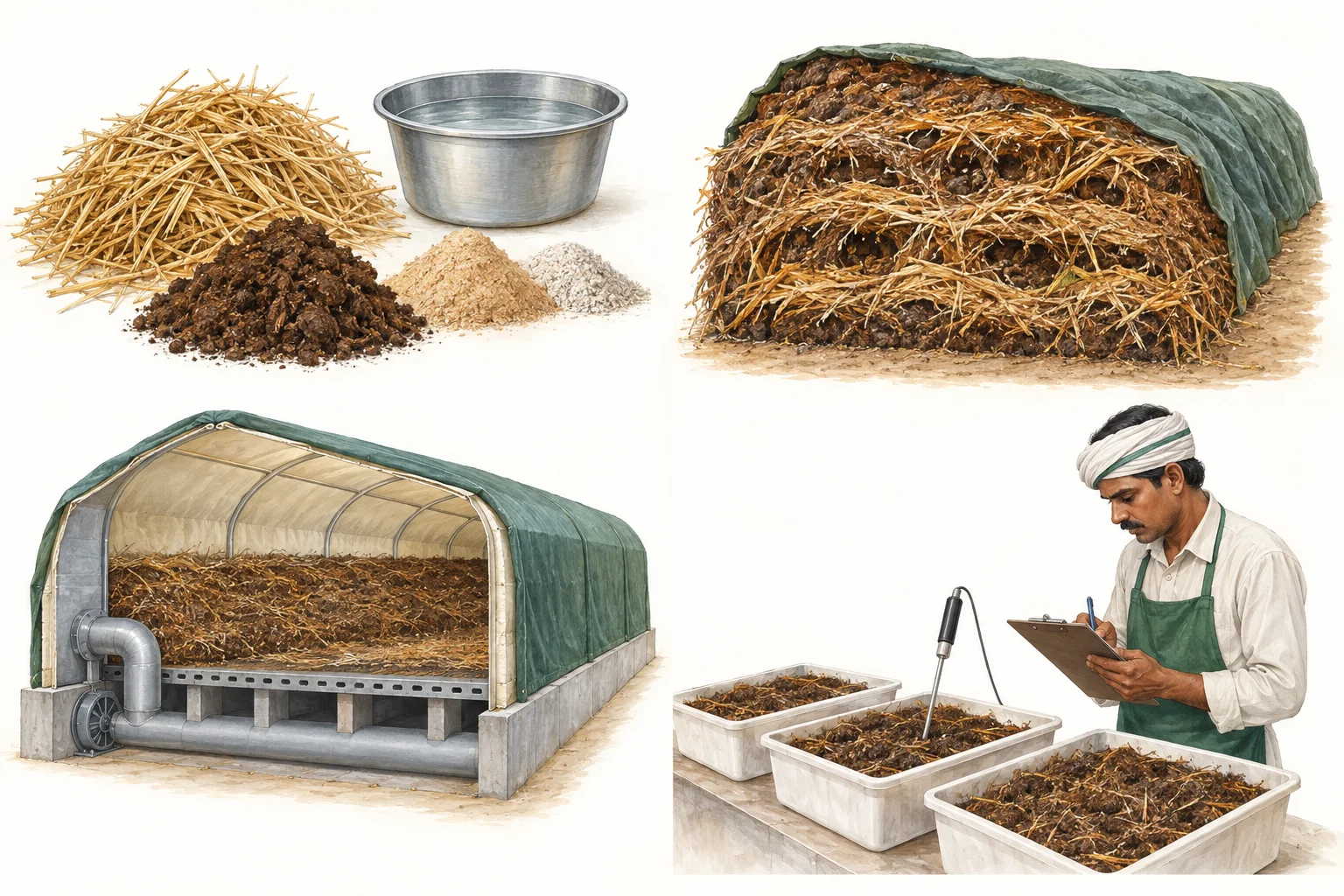
Original system diagrams separate air paths, material paths, measurements and biological transformations.
Progressive depth
Move from field observation to mechanism, engineering and evidence without losing the original question.
PracticalWhat the operator notices
- Water added is not the same as water retained inside the compost.
- Dry cores in fibre
- surface runoff
- leachate
TechnicalHow process variables interact
- Source quality, pre-wetting, weather, drainage, leachate, evaporation and reuse decisions belong to one water balance.
- Incoming water
- addition events
- representative moisture
EngineeringHow the physical system serves the process
- Metered supply
- uniform applicator
- drainage
- Manual wetting requires frequent spatial checks
- Commercial wetting needs metering, drainage design and water-accounting boundaries
ResearchWhich evidence records govern this page
- COMPOST-SRC-DMR-MANUAL
- COMPOST-SRC-DMR-FARM-DESIGN
The numbers for this step, with their source.
Process values are published from ICAR-DMR guidance with the stage and measuring point they apply to. A parameter still marked pending has no published Indian value yet.
Biological and process parameters
COMPOST.RAW.WATER_QUALITYpending technical verificationProcess-water quality
Technical value pending verification- Stage
- Pre-wetting and process
- Measurement context
- Defined water source and sampling point
- Conditions
- Analytical method; source variability; reuse history
COMPOST.MOISTURE.COMPOSTsource contextualFinished compost moisture
64 to 72 %- Stage
- Finished compost
- Measurement context
- Squeeze test or oven sample at spawning
- Conditions
- Synthetic compost 68 to 72 percent at spawning; natural horse-manure compost 65 to 67 percent; After tunnel Phase II ICAR-DMR reports 64 to 66 percent; Never spawn above 72 percent moisture
Engineering design metrics
COMPOST.WATER.BATCHpending technical verificationBatch water balance
Project value pending verification- Component
- Water monitoring
- Design context
- Declared incoming, process, cleaning and leachate boundary
- Method
- Project-specific engineering calculation required
Auditable calculation framework
Every equation exposes inputs, units, assumptions, output and validation rules.
COMPOST.FORMULA.WATER_BALANCEReconcile declared incoming, process, cleaning and leachate water records.
Recorded outflow and retained water = incoming water + approved reuse - measured discharge and losses- Wi: Incoming water
- L or m³. metered input
- Wr: Approved reuse
- same volume unit. separate user record
- Wo: Measured outflow
- same volume unit. metered or estimated with method
Assumptions and validation
Assumptions
- All terms share one batch and one unit
- rainfall and evaporation are declared when material
Validation tests
- Reject mixed units without conversion
- reject negative inputs
- flag incomplete boundary
Evidence, applicability and review2 mapped sources
Sources support mechanisms and architecture. Technical and engineering values publish only through their separate governed registries.
Mushroom Cultivation, Marketing and Consumption
Indian Button Mushroom compost methods, cultivation context, Phase I and Phase II process vocabulary.
- Publisher
- ICAR-Directorate of Mushroom Research
- Accessed
- 2026-08-22
Farm Design for White Button Mushroom Cultivation
Indian farm workflow, compost-unit components, tunnel and controlled-farm engineering vocabulary.
- Publisher
- ICAR-Directorate of Mushroom Research
- Accessed
- 2026-08-22