


Quick orientation
Record the actual lots, measurement basis, water context, source method and every substitution before mixing.
01
Simple explanation
Formulation balances materials for a particular composting method, location, scale and batch basis.
02
What is happening
Theoretical carbon and nitrogen balances are limited by ingredient variability, analytical basis and what becomes biologically available during processing.
03
Operator explanation
Record the actual lots, measurement basis, water context, source method and every substitution before mixing.
04
What to observe
Observation should describe stage, location, pattern and change history before interpretation.
- Ingredient distribution
- unexpected fines or clumps
- lot substitutions
- dry and wet basis ambiguity
05
What to measure
Measurement must retain method, unit, location, timing, calibration and sample identity.
- Declared quantity basis
- ingredient analyses where required
- water additions
- batch mass by named stage
06
Equipment and process boundary
Equipment is useful only when its role in the biological process is explicit.
- Calibrated weighing
- mixer or turning method
- water metering
- batch record
07
Variables that interact
A formulation only makes sense together with its wetting, Phase I and Phase II process.
08
What can go wrong
A symptom may have several mechanisms. Verify the cause before changing the process.
- Calling a sourced formula the best formula
- mixing wet and dry bases
- silent substitution
- ignoring process capability
09
What changes at commercial scale
Scaling changes geometry, repeatability, instrumentation, material flow and failure consequence.
- Manual formulations depend on distribution skill
- Mechanized plants need calibration, lot traceability and mass-balance reconciliation
10
Evidence boundary
Mapped evidence: Mushroom Cultivation, Marketing and Consumption; Technologies Developed by ICAR-DMR for Commercial Use; Physico-chemical properties and thermophilic flora in Button Mushroom compost using spent substrate. Foundational, current operational, research and engineering sources retain their different roles.
Formulation comparison
Compare method and limits without promoting a best formula.
| Record | Method and scale | Raw-material context | Validation | Limitations |
|---|---|---|---|---|
ICAR-DMR documented short-method formulation familyCOMPOST-FORMULATION-DMR-SHORT-METHOD | Short method with distinct Phase I and Phase IISeasonal or controlled units with suitable Phase II infrastructure | Wheat straw; documented nitrogen inputs; conditioner; waterSource record retained; quantities withheld from comparison until basis and current review are complete. | source recorded | Not a universal recipe; ingredient composition varies; requires matching process infrastructure |
ICAR-DMR indoor aerated composting methodCOMPOST-FORMULATION-DMR-INDOOR | Aerated Phase I bunker and Phase II tunnelMechanized compost unit | Documented formulation inputs; water; conditionerProtocol source recorded; values quarantined from generic pages. | source recorded | Requires bunker and tunnel capability; fan timer or schedule is not generalized; facility commissioning remains project-specific |
ICAR-DMR ZEPT method contextCOMPOST-FORMULATION-DMR-ZEPT | Zero Energy Polytunnel rapid compostingTechnology-specific application | Documented formulation inputsProtocol source recorded; no universal quantities shown. | source recorded | Not equivalent to a conventional tunnel; technology transfer context required; climate and operating boundary must remain attached |
Spent-substrate supplementation research formulationsCOMPOST-FORMULATION-SMS-RESEARCH | Experimental short-method compostingExperimental | Wheat straw; poultry manure; concentrates; conditioner; spent substrateStudy treatment basis. Not reproduced as a farm recommendation. | source recorded | Experimental finding; requires source-level treatment review; not established universal practice |
Technical diagrams
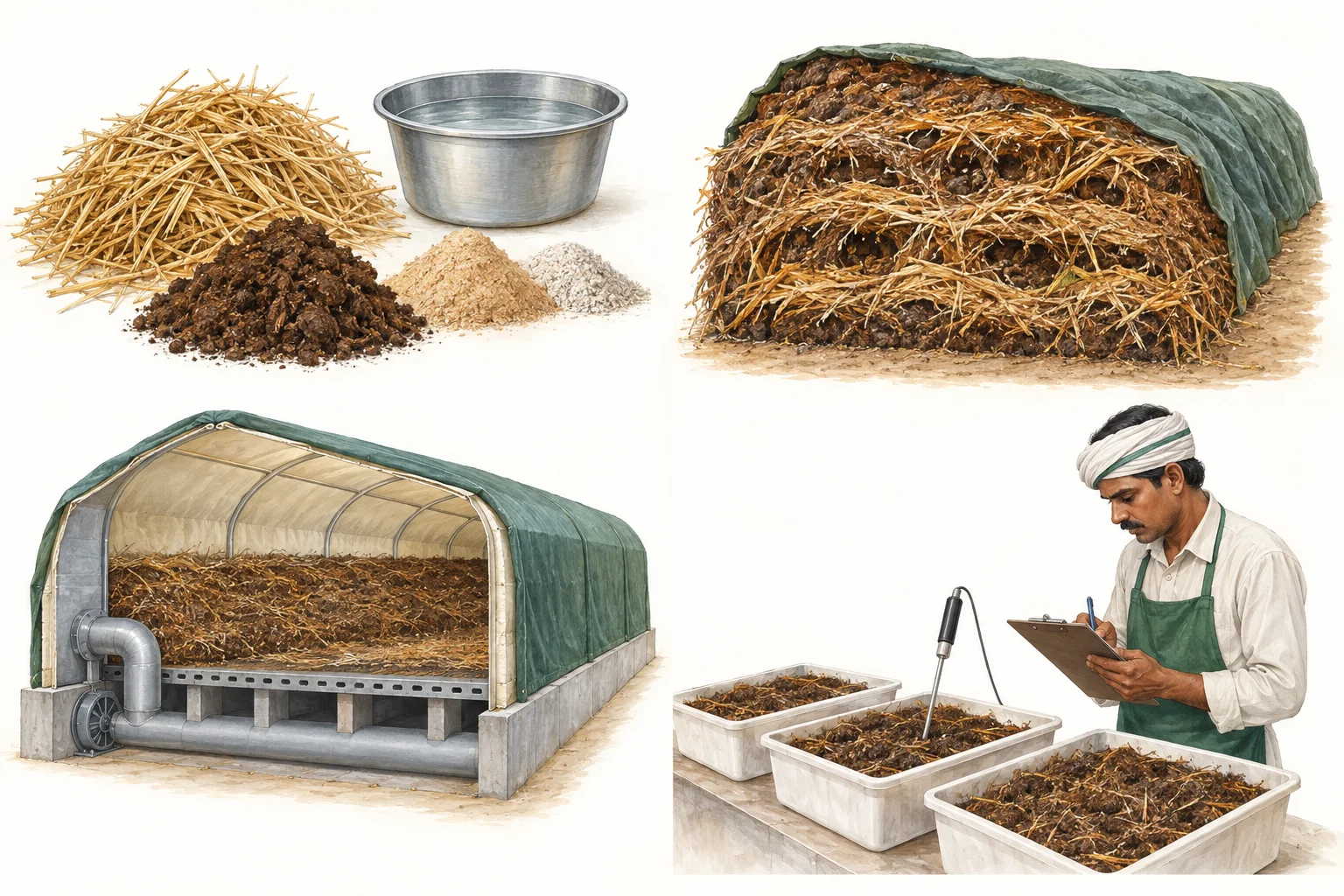
Original system diagrams separate air paths, material paths, measurements and biological transformations.
Progressive depth
Move from field observation to mechanism, engineering and evidence without losing the original question.
PracticalWhat the operator notices
- Formulation balances materials for a particular composting method, location, scale and batch basis.
- Ingredient distribution
- unexpected fines or clumps
- lot substitutions
TechnicalHow process variables interact
- A formulation only makes sense together with its wetting, Phase I and Phase II process.
- Declared quantity basis
- ingredient analyses where required
- water additions
EngineeringHow the physical system serves the process
- Calibrated weighing
- mixer or turning method
- water metering
- Manual formulations depend on distribution skill
- Mechanized plants need calibration, lot traceability and mass-balance reconciliation
ResearchWhich evidence records govern this page
- COMPOST-SRC-DMR-MANUAL
- COMPOST-SRC-DMR-TECHNOLOGIES
- COMPOST-SRC-ICAR-THERMOPHILES
The numbers for this step, with their source.
Process values are published from ICAR-DMR guidance with the stage and measuring point they apply to. A parameter still marked pending has no published Indian value yet.
Biological and process parameters
COMPOST.FORMULATION.C_Nsource contextualCarbon-to-nitrogen ratio at stacking
25 to 30 C:N- Stage
- Formulation
- Measurement context
- Compounding mixture on a dry-weight basis
- Conditions
- ICAR-DMR: C:N of 25 to 30 in the compounding mixture at stacking; Dry-weight basis; Ingredient analyses set the exact figure
COMPOST.FORMULATION.NITROGENsource contextualFormulation nitrogen at stacking
1.5 to 1.75 % N, dry weight- Stage
- Formulation
- Measurement context
- Compounding mixture on a dry-weight basis
- Conditions
- ICAR-DMR: 1.5 to 1.75 percent nitrogen at stacking; Target minerals also include P2O5 1.2 to 1.5 percent and K2O 2.0 to 2.3 percent; Dry-weight basis
COMPOST.RAW.MATERIAL_MOISTUREpending technical verificationRaw-material moisture
Technical value pending verification- Stage
- Receipt and formulation
- Measurement context
- Representative material lot sample
- Conditions
- Material identity; sampling method; storage exposure
Evidence, applicability and review3 mapped sources
Sources support mechanisms and architecture. Technical and engineering values publish only through their separate governed registries.
Mushroom Cultivation, Marketing and Consumption
Indian Button Mushroom compost methods, cultivation context, Phase I and Phase II process vocabulary.
- Publisher
- ICAR-Directorate of Mushroom Research
- Accessed
- 2026-08-22
Technologies Developed by ICAR-DMR for Commercial Use
Documents distinct Indian composting methods, including aerated indoor Phase I and ZEPT concepts.
- Publisher
- ICAR-Directorate of Mushroom Research
- Accessed
- 2026-08-22
Physico-chemical properties and thermophilic flora in Button Mushroom compost using spent substrate
Thermophilic fungi, ammonia reduction and experimental raw-material substitution context.
- Publisher
- Mushroom Research, ICAR
- Accessed
- 2026-08-22