


A practical guide to growing mushrooms in IndiaA joint educational initiative by MushroomWale & DMR Solan
MushroomFarming.in

A joint educational initiative by

MushroomWale.com
ICAR–Directorate of Mushroom Research, Solan logoICAR–DMRSolan

MushroomFarming / guide

Compost Physics

Bridge particle structure, density, porosity, water films, compression, heat transfer and air resistance.

Practical explanation + detailed referenceSources & review ↓
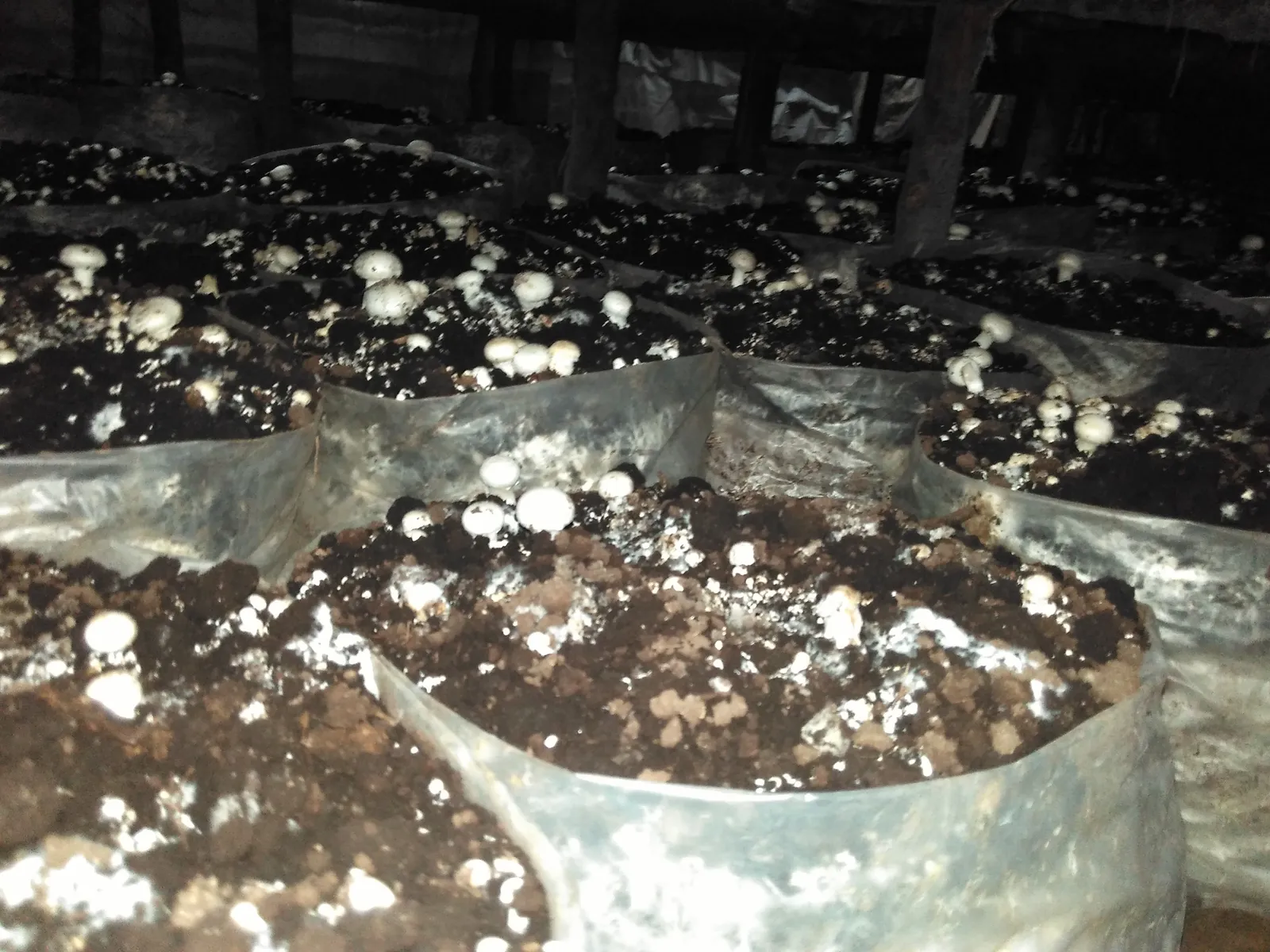
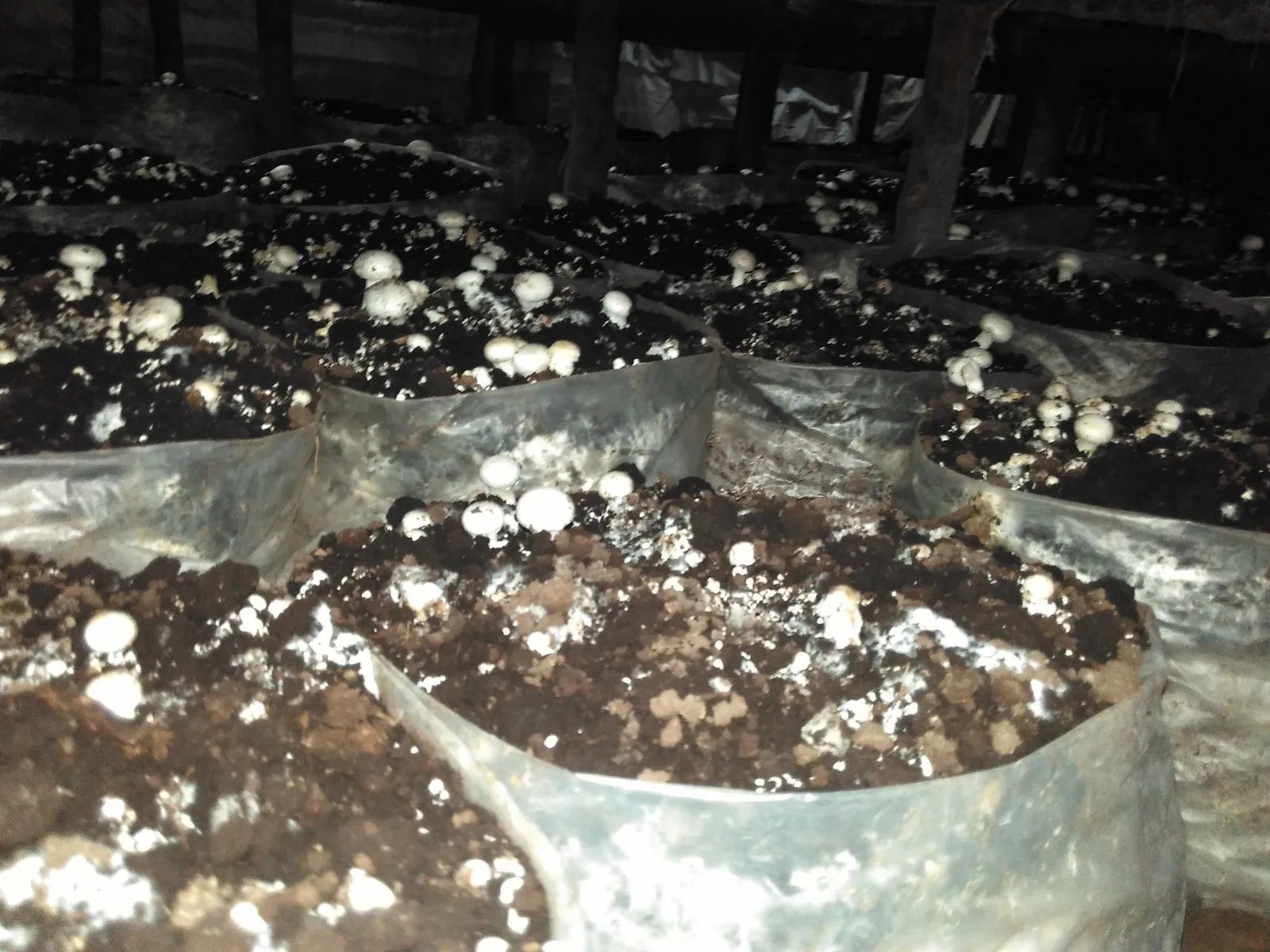
Polythene compost bags topped with dark casing soil and emerging button-mushroom pinheads in a dim cropping room, Tamil Nadu (uploader is a TNAU student; Tamil caption 'mushroom cultivation method').
Real cultivation photograph. Read its source for location and context; it is not a universal operating specification.Rahumath nisha · CC BY-SA 4.0View full photograph ↗
On this pageChoose a section, or keep reading below

Read this in the full guide: Understand and document a compost batch

Understand the topic

Start with the explanation.

Loading, watering and turning change the same physical mass that the fan or natural convection must serve.

Part 01

Simple explanation

Compost is a porous material. Air and water must move through connected spaces between particles.

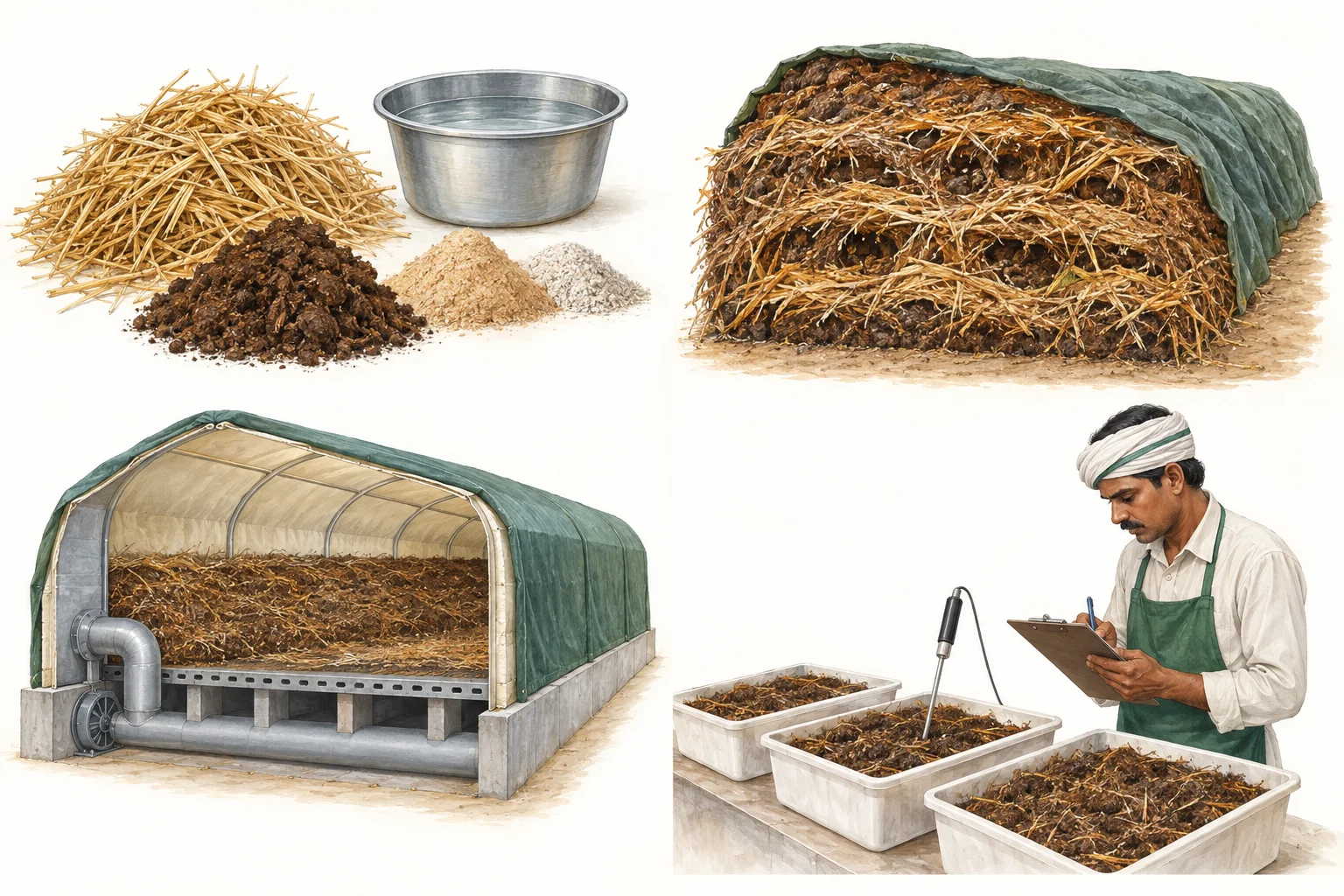
Conceptual compost heap cutaway showing straw structure and internal spaces.
AI teaching illustrationStructure and air

The heap has structure, depth and internal variation. One central reading does not describe every part of the material.

Conceptual explanation—not a real farm photograph, diagnostic finding or construction specification.
Part 02

What is happening

Bulk density, free air space, particle size and compression govern pressure drop, channeling, heat transfer and mass transfer.

Part 03

Operator explanation

Loading, watering and turning change the same physical mass that the fan or natural convection must serve.

Part 04

What to look for

Observation should describe stage, location, pattern and change history before interpretation.

  • Compaction
  • particle breakdown
  • uneven depth
  • water films
  • channeling
  • air bypass
Part 05

What to measure

Measurement must retain method, unit, location, timing, calibration and sample identity.

  • Contextual bulk density
  • fill depth map
  • pressure difference
  • free air space where method is available
  • moisture
Part 06

Equipment and process boundary

Equipment is useful only when its role in the biological process is explicit.

  • Known-volume sampler
  • depth map
  • pressure instrument
  • airflow verification
  • loading equipment
Part 07

Variables that interact

Physics connects raw-material structure to bunker capacity, tunnel loading, fan duty and anaerobic risk.

Part 08

What can go wrong

A symptom may have several mechanisms. Verify the cause before changing the process.

  • Using one density for every stage
  • equating motor power with airflow
  • ignoring floor loss
  • compressing wet material
Part 09

What changes at commercial scale

Scaling changes geometry, repeatability, instrumentation, material flow and failure consequence.

  • Small piles exchange more at edges
  • Large bunkers and tunnels develop stronger pressure and distribution consequences
Part 10

What the evidence can tell you

Mapped evidence: Farm Design for White Button Mushroom Cultivation; Straightening Out Fan Curves; Dynamics of microbial community and enzyme activities during Agaricus bisporus compost preparation. Foundational, current operational, research and engineering sources retain their different roles.

Illustration of an operator recording a compost probe reading beside material samples.
AI teaching illustrationRelease with evidence

The batch record brings measurements and observations together. The calendar alone cannot prove compost is ready for spawning.

Conceptual explanation—not a real farm photograph, diagnostic finding or construction specification.

Go deeper

Technical reference, records and tools.

Detailed crop-stage information, parameters, diagrams and specialist tools are kept together below. This material retains its source conditions and review limits.

Open the complete technical reference

Compost system · science guide

Compost Physics

Bridge particle structure, density, porosity, water films, compression, heat transfer and air resistance.

Crop context
Agaricus bisporus
Publication
Public editorial page
External review
Not yet recorded · needed from Button Mushroom compost technical reviewer
Evidence records
3
Polythene compost bags topped with dark casing soil and emerging button-mushroom pinheads in a dim cropping room, Tamil Nadu (uploader is a TNAU student; Tamil caption 'mushroom cultivation method').
Button mushroom compost bags with pinheads in a dark grow room. Photo: Rahumath nisha, CC BY-SA 4.0. Source

Compost temperature from day 0 to spawning

Long-method heap 65 to 70 °C with turnings, then pasteurisation at 58 to 59 °C for 4 to 6 hours, conditioning at 45 to 52 °C, cooling to 25 to 30 °C for spawning. Source: ICAR-DMR manual 2011.

30°40°50°60°70°80°turnturnturnPhase I: outdoor heap, 65 to 70 °CPhase II: 58 °C, then 45 to 52 °Cspawn at 25 to 30 °Cday 0day 22
Phase I heapPhase II tunnelPasteurisation band
Picture → explanation → field task

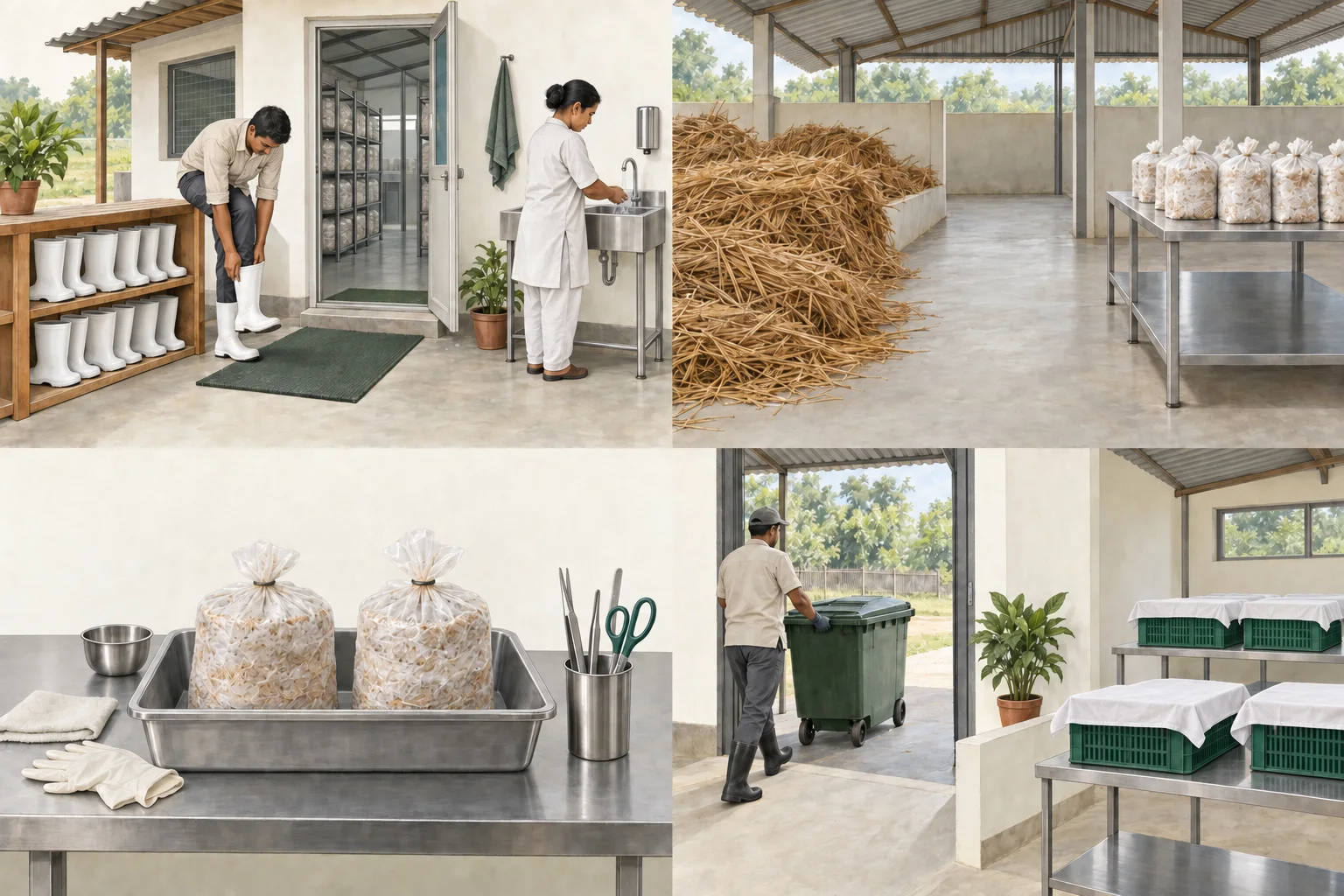
Keep clean and suspect work separate

AI-generated educational illustrations. Not actual farm photographs, diagnostic evidence or construction specifications.

Generated illustration of raw straw separated from closed cultivation bags on a different bench.
02

Protect prepared material

Raw inputs and protected prepared material are separated. Treatment does not protect a substrate indefinitely. Handling afterwards can introduce contamination.

Try this on your farm

Keep work areas, tools and movement routes separated. Label batches so a later problem can be traced to its preparation history.

Generated illustration of a covered waste tub leaving a separate area away from covered harvest crates.
04

Plan the spent-material route

Used material and saleable harvest follow different handling paths. A disposal route can undo clean-work separation if it crosses incoming materials or harvest handling.

Try this on your farm

Map the exit route and cleaning responsibility. Check the actual workflow during a busy room turnaround, not only on a drawing.

Quick orientation

Loading, watering and turning change the same physical mass that the fan or natural convection must serve.

01

Simple explanation

Compost is a porous material. Air and water must move through connected spaces between particles.

02

What is happening

Bulk density, free air space, particle size and compression govern pressure drop, channeling, heat transfer and mass transfer.

03

Operator explanation

Loading, watering and turning change the same physical mass that the fan or natural convection must serve.

04

What to observe

Observation should describe stage, location, pattern and change history before interpretation.

  • Compaction
  • particle breakdown
  • uneven depth
  • water films
  • channeling
  • air bypass

05

What to measure

Measurement must retain method, unit, location, timing, calibration and sample identity.

  • Contextual bulk density
  • fill depth map
  • pressure difference
  • free air space where method is available
  • moisture

06

Equipment and process boundary

Equipment is useful only when its role in the biological process is explicit.

  • Known-volume sampler
  • depth map
  • pressure instrument
  • airflow verification
  • loading equipment

07

Variables that interact

Physics connects raw-material structure to bunker capacity, tunnel loading, fan duty and anaerobic risk.

08

What can go wrong

A symptom may have several mechanisms. Verify the cause before changing the process.

  • Using one density for every stage
  • equating motor power with airflow
  • ignoring floor loss
  • compressing wet material

09

What changes at commercial scale

Scaling changes geometry, repeatability, instrumentation, material flow and failure consequence.

  • Small piles exchange more at edges
  • Large bunkers and tunnels develop stronger pressure and distribution consequences

10

Evidence boundary

Mapped evidence: Farm Design for White Button Mushroom Cultivation; Straightening Out Fan Curves; Dynamics of microbial community and enzyme activities during Agaricus bisporus compost preparation. Foundational, current operational, research and engineering sources retain their different roles.

What happens when one variable changes?

Explore defensible directional relationships, with their uncertainty still attached.

Increase retained moisture

  1. 1Water films may occupy pore pathways
  2. 2Free air space may decrease
  3. 3Air resistance may increase
  4. 4Anaerobic risk may rise
  5. 5Heat and microbial patterns may change

Direction depends on starting moisture, structure, particle form and distribution.

Progressive depth

Move from field observation to mechanism, engineering and evidence without losing the original question.

PracticalWhat the operator notices
  • Compost is a porous material. Air and water must move through connected spaces between particles.
  • Compaction
  • particle breakdown
  • uneven depth
TechnicalHow process variables interact
  • Physics connects raw-material structure to bunker capacity, tunnel loading, fan duty and anaerobic risk.
  • Contextual bulk density
  • fill depth map
  • pressure difference
EngineeringHow the physical system serves the process
  • Known-volume sampler
  • depth map
  • pressure instrument
  • Small piles exchange more at edges
  • Large bunkers and tunnels develop stronger pressure and distribution consequences
ResearchWhich evidence records govern this page
  • COMPOST-SRC-DMR-FARM-DESIGN
  • COMPOST-SRC-AMCA-FAN-CURVES
  • COMPOST-SRC-ISME-MICROBIAL

The numbers for this step, with their source.

Process values are published from ICAR-DMR guidance with the stage and measuring point they apply to. A parameter still marked pending has no published Indian value yet.

Biological and process parameters

COMPOST.PHYSICS.BULK_DENSITYpending technical verification

Contextual bulk density

Technical value pending verification
Stage
Loading and capacity planning
Measurement context
Representative material at stated compaction and moisture
Conditions
Process stage; moisture; compaction; particle structure
COMPOST.PHYSICS.FREE_AIR_SPACEpending technical verification

Free air space

Technical value pending verification
Stage
Phase I and Phase II
Measurement context
Representative compost mass using a declared method
Conditions
Method; compression; moisture; particle size
COMPOST.PHYSICS.FILL_DEPTHsource contextual

Bulk tunnel fill height

2 to 2.2 m
Stage
Bunker or tunnel filling
Measurement context
Mapped depth across the loaded floor
Conditions
ICAR-DMR bulk tunnel: fill height 2 to 2.2 m; About 900 to 1,000 kg compost per square metre of floor; Loading uniformity and density change the effective depth

Engineering design metrics

COMPOST.AERATION.AIRFLOWpending technical verification

Required airflow

Project value pending verification
Component
Aeration system
Design context
Process stage and loaded compost resistance
Method
Project-specific engineering calculation required
COMPOST.AERATION.STATIC_PRESSUREpending technical verification

Required static pressure

Project value pending verification
Component
Aeration system
Design context
Complete floor, duct and compost system
Method
Project-specific engineering calculation required
Evidence, applicability and review3 mapped sources

Sources support mechanisms and architecture. Technical and engineering values publish only through their separate governed registries.

Tier Afoundational

Farm Design for White Button Mushroom Cultivation

Indian farm workflow, compost-unit components, tunnel and controlled-farm engineering vocabulary.

Publisher
ICAR-Directorate of Mushroom Research
Accessed
2026-08-22
Open original source
Tier Dengineering

Straightening Out Fan Curves

Fan curve, system curve, airflow, static pressure, operating point and efficiency concepts.

Publisher
Air Movement and Control Association International
Accessed
2026-08-22
Open original source
Tier Cresearch

Dynamics of microbial community and enzyme activities during Agaricus bisporus compost preparation

Microbial succession, thermophilic communities, lignocellulose transformation and conditioning mechanisms.

Publisher
ISME Communications
Accessed
2026-08-22
Open original source

Read the evidence

Sources & review.

Editorial update: 2026-08-22. Independent technical review is not recorded for this entry.

  1. Farm Design for White Button Mushroom Cultivation

    ICAR-Directorate of Mushroom Research

  2. Straightening Out Fan Curves

    Air Movement and Control Association International · 2020

  3. Dynamics of microbial community and enzyme activities during Agaricus bisporus compost preparation

    ISME Communications · 2022

Reading a source is not the same as applying its instructions to every farm. Confirm species, strain, crop stage, system, region and publication date. Old chemical recommendations are not current-use instructions.

See something that needs correcting? Tell us →