


Quick orientation
Protect the platform, map edge and core conditions, turn with a purpose and distinguish rainwater from process water.
01
Simple explanation
Outdoor Phase I relies on pile geometry, microbial heat, turning and operator response under changing weather.
02
What is happening
Natural convection, diffusion, evaporation and edge heat loss create spatial differences that turning partially redistributes.
03
Operator explanation
Protect the platform, map edge and core conditions, turn with a purpose and distinguish rainwater from process water.
04
What to observe
Observation should describe stage, location, pattern and change history before interpretation.
- Weather exposure
- pile shape
- edge drying
- core condition
- runoff
- turning uniformity
05
What to measure
Measurement must retain method, unit, location, timing, calibration and sample identity.
- Temperature map
- water additions
- rain exposure
- moisture samples
- turning history
06
Equipment and process boundary
Equipment is useful only when its role in the biological process is explicit.
- Impermeable cleanable platform
- weather protection
- drainage
- turner or loader
- safe access
07
Variables that interact
Platform, roof, drainage, pile geometry, turning equipment and labour form the outdoor process system.
08
What can go wrong
A symptom may have several mechanisms. Verify the cause before changing the process.
- Rain-driven variability
- cold edges
- manual nonuniformity
- leachate loss
- anaerobic core
09
What changes at commercial scale
Scaling changes geometry, repeatability, instrumentation, material flow and failure consequence.
- Labour rises quickly with batch size
- Mechanization improves mixing but does not remove weather and sampling limits
10
Evidence boundary
Mapped evidence: Mushroom Cultivation, Marketing and Consumption; Influence of turning methods on temperature profile of Button Mushroom compost pile. Foundational, current operational, research and engineering sources retain their different roles.
Technical diagrams
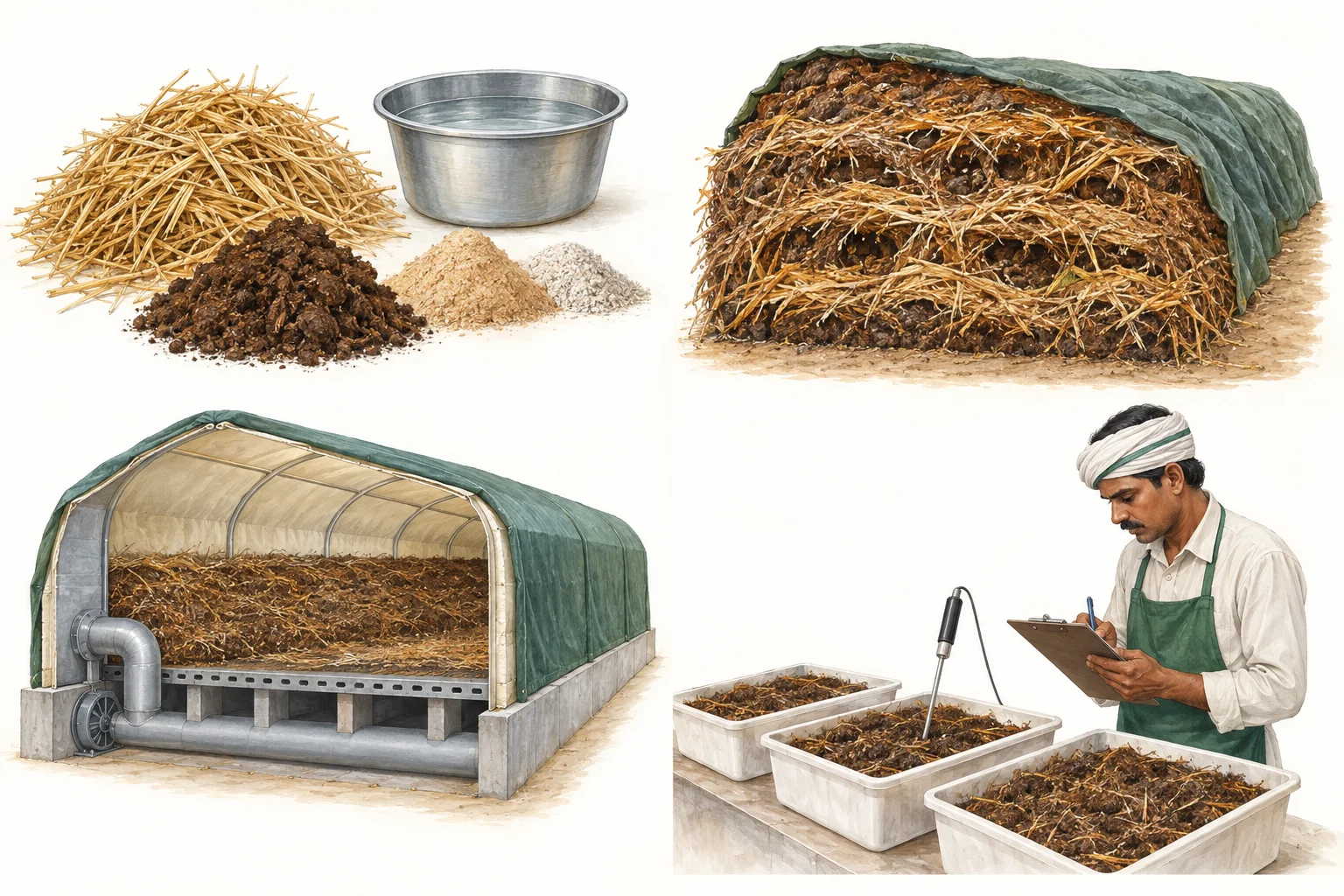
Original system diagrams separate air paths, material paths, measurements and biological transformations.
Progressive depth
Move from field observation to mechanism, engineering and evidence without losing the original question.
PracticalWhat the operator notices
- Outdoor Phase I relies on pile geometry, microbial heat, turning and operator response under changing weather.
- Weather exposure
- pile shape
- edge drying
TechnicalHow process variables interact
- Platform, roof, drainage, pile geometry, turning equipment and labour form the outdoor process system.
- Temperature map
- water additions
- rain exposure
EngineeringHow the physical system serves the process
- Impermeable cleanable platform
- weather protection
- drainage
- Labour rises quickly with batch size
- Mechanization improves mixing but does not remove weather and sampling limits
ResearchWhich evidence records govern this page
- COMPOST-SRC-DMR-MANUAL
- COMPOST-SRC-ICAR-TURNING
The numbers for this step, with their source.
Process values are published from ICAR-DMR guidance with the stage and measuring point they apply to. A parameter still marked pending has no published Indian value yet.
Biological and process parameters
COMPOST.PHASE1.COMPOST_TEMPERATUREsource contextualPhase I heap temperature
65 to 70 °C- Stage
- Phase I
- Measurement context
- Core of the outdoor long-method heap
- Conditions
- The heap should reach 65 to 70 °C in the core (ICAR-DMR farmer folder); ICAR-DMR treats 80 °C as the upper safe core temperature; Probe depth, time since turning and weather change the reading
COMPOST.MOISTURE.COMPOSTsource contextualFinished compost moisture
64 to 72 %- Stage
- Finished compost
- Measurement context
- Squeeze test or oven sample at spawning
- Conditions
- Synthetic compost 68 to 72 percent at spawning; natural horse-manure compost 65 to 67 percent; After tunnel Phase II ICAR-DMR reports 64 to 66 percent; Never spawn above 72 percent moisture
Evidence, applicability and review2 mapped sources
Sources support mechanisms and architecture. Technical and engineering values publish only through their separate governed registries.
Mushroom Cultivation, Marketing and Consumption
Indian Button Mushroom compost methods, cultivation context, Phase I and Phase II process vocabulary.
- Publisher
- ICAR-Directorate of Mushroom Research
- Accessed
- 2026-08-22
Influence of turning methods on temperature profile of Button Mushroom compost pile
Evidence that turning method, material and process system affect compost temperature behaviour.
- Publisher
- Mushroom Research, ICAR
- Accessed
- 2026-08-22