


Phase I
Phase I is the noisy, smelly, outdoor half of composting. Everything Phase II can do is decided by how well this half was run.
- By the end you can choose between the long, short and indoor routes.
- By the end you can build a stack of the right size for your region.
- By the end you can recognise the end of Phase I from its readings.
Compost temperature from day 0 to spawning
Long-method heap 65 to 70 °C with turnings, then pasteurisation at 58 to 59 °C for 4 to 6 hours, conditioning at 45 to 52 °C, cooling to 25 to 30 °C for spawning. Source: ICAR-DMR manual 2011.
Read numerical examples with their source, method and crop context. They are not universal operating instructions. Historical prices are not current quotations.
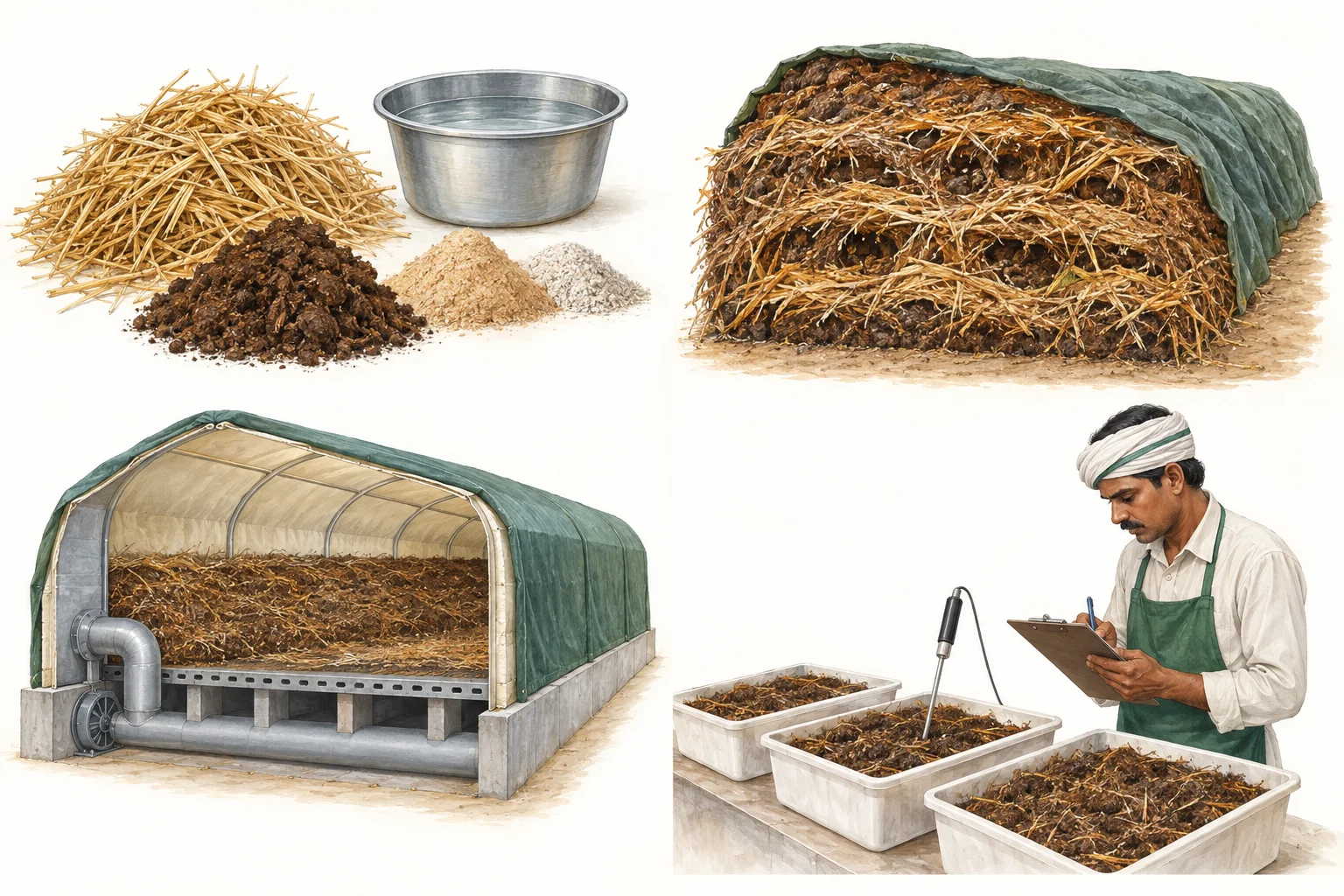
Structure and air
- Notice
- The heap has structure, depth and internal variation.
- Understand
- One central reading does not describe every part of the material.
- Try it
- Record representative readings and the actual preparation sequence.
01Three routes, three timetables
ICAR-DMR publishes three ways to make button mushroom compost. The long method takes 28 to 30 days with 7 to 8 turnings and needs no pasteurisation room. The short method takes 16 to 20 days in total, of which 10 to 12 days are outdoor Phase I. The indoor method runs 10 to 12 days in total, with only 6 to 8 days of Phase I inside an aerated bunker.
The route also changes what the straw gives back. DMR reports 1.75 to 2.0 tonnes of finished compost per tonne of straw by the long method, and 3.0 to 3.5 tonnes by the indoor method.
02Building the stack
Stack on a clean cemented yard so leachate can be collected and returned. Stack size is set by climate, not by convenience. In the plains DMR recommends a stack about 100 to 120 cm wide and around the same height. In the hills, where outside air may sit between 7 and 20 degrees Celsius, the stack is widened to 130 to 150 cm with a height of about 150 cm so heat is not lost.
Keep the sides vertical and the top flat, press the edges lightly, leave the core loose, and never stack less than 300 kg.
03Turning is the process
A turning mixes the hot core with the cool edges, lets fresh air in, and re-wets what has dried. The DMR long method schedule gives turnings on days 6, 10, 13, 16, 19, 22 and 25, with filling on day 28, and gypsum going in at the third turning. The Hindi farmer folder prints an eight turning version of the same ladder.
Both DMR documents also call for an insecticide at the last turning, and they differ from each other by a factor of ten on strength. Copy neither. Check what is approved for this use today and follow that label.
04Knowing Phase I is over
Phase I compost is not finished compost. DMR describes it as dark brown, smelling heavily of ammonia, holding 72 to 75 per cent moisture, with pH roughly 8.2 to 8.5, nitrogen between 1.5 and 2.0 per cent and free ammonia around 800 to 1000 ppm.
That ammonia is the point. It is exactly what Phase II has to convert, and compost handed over with too little of it has already lost nitrogen to the air. If the smell is weak and the pH low, look back at the formula rather than pushing on.
Write the turning calendar before you stack
- Pick the route and count days from stacking day zero.
- Write every turning date on a board in the yard.
- Mark the gypsum turning so it is not missed or doubled.
- Measure stack width and height after stacking and correct it.
- On the last day record pH, moisture and ammonia smell.
Write in your farm diary: Stacking date, route, stack dimensions, each turning date with core temperature before turning, and end readings.
Mistakes that cost a crop
- Skipping a turning because the heap looks fine; the edges never joined in.
- Stacking on bare soil, which loses leachate and invites pests.
- Copying an insecticide strength from a bulletin; two DMR documents differ tenfold.
Check yourself
Three questions, instant answersIn the DMR long method schedule, gypsum goes in at:
A hill farm at 10 degrees Celsius should build the stack:
A strong ammonia smell at the end of Phase I means:
An editorial self-check, not a certificate. Answers are not stored, not even on this device.
Words used in this lesson
- Phase I
- The outdoor or bunker fermentation that makes a hot, ammonia rich mass.
- Turning
- Breaking the stack down and rebuilding it to mix, aerate and re-wet.
- ppm
- Parts per million, a way of writing small gas concentrations.
References & further reading
A lesson cannot replace batch measurements or plant-specific procedures.
Open current reference