


Bunker Operation
A bunker turns Phase I from a weather problem into a machine problem. The machine only works if air actually gets through the compost.
- By the end you can describe the air path from fan to plenum to compost.
- By the end you can say how fill condition changes where air goes.
- By the end you can build a monitoring routine instead of trusting one probe.
Compost temperature from day 0 to spawning
Long-method heap 65 to 70 °C with turnings, then pasteurisation at 58 to 59 °C for 4 to 6 hours, conditioning at 45 to 52 °C, cooling to 25 to 30 °C for spawning. Source: ICAR-DMR manual 2011.
Read numerical examples with their source, method and crop context. They are not universal operating instructions. Historical prices are not current quotations.
Structure and air
- Notice
- The heap has structure, depth and internal variation.
- Understand
- One central reading does not describe every part of the material.
- Try it
- Record representative readings and the actual preparation sequence.
01What a bunker is
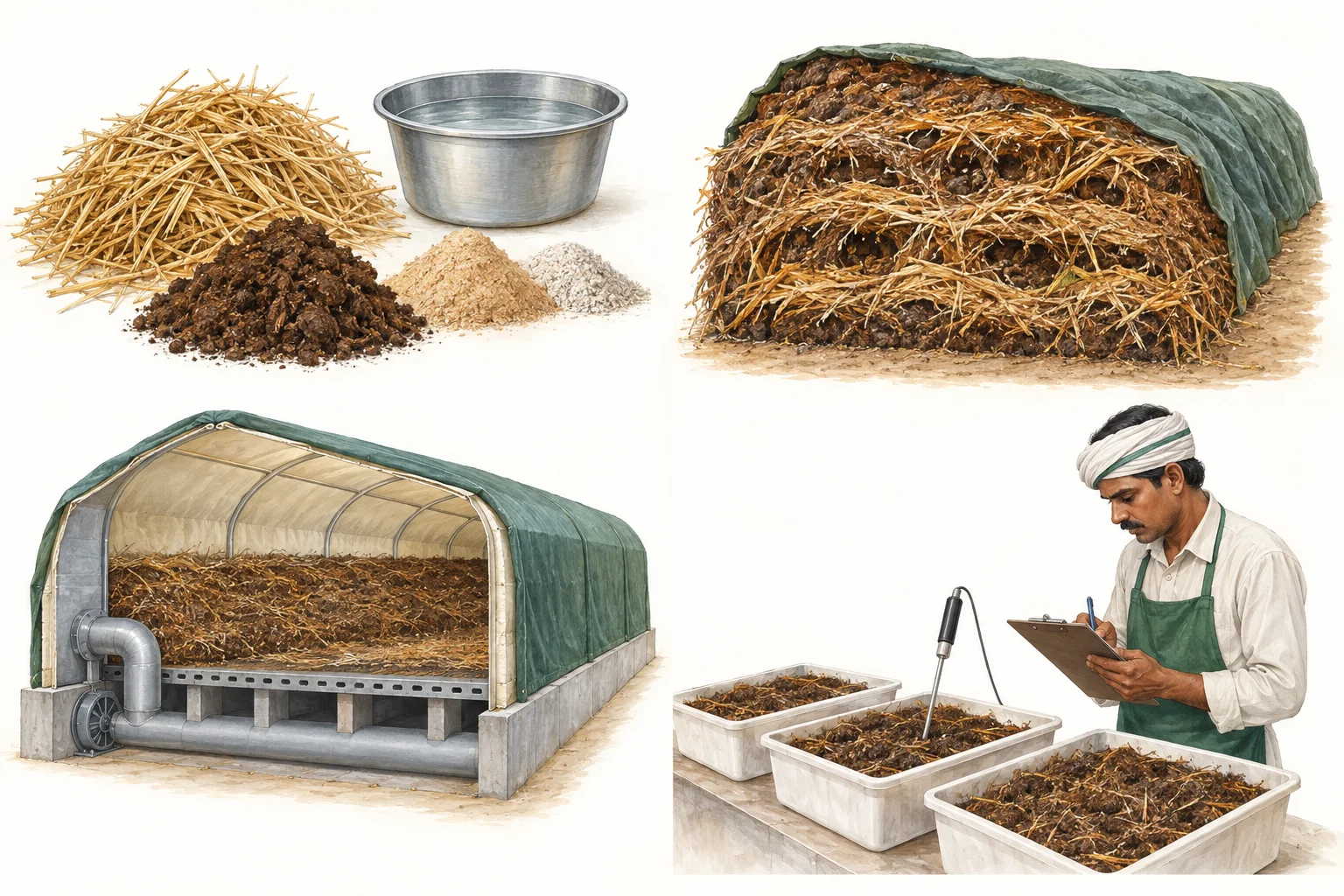
A Phase I bunker is a walled concrete box with an aerated floor. A fan pushes air into a space under the floor, called the plenum, and the air rises through slots into the compost above. A timer runs the fan in cycles so the mass stays aerobic without being cooled too far.
The gain is time and control. DMR completes Phase I in a bunker in 6 to 8 days against 10 to 12 outdoors, and the whole indoor route runs 10 to 12 days. MIDH treats the Phase I bunker as one line inside a compost making unit costed at 30 lakh rupees.
02Fill condition decides where air goes
Air is lazy. It leaves by whichever route has least resistance, so an uneven fill quietly starves part of the batch. A corner packed tight by a loader bucket stays cold and wet. A dip in the surface becomes a chimney, and air races out of it without touching the compost beside it.
Fill evenly, keep the surface level, and do not press the mass against the walls. Material wetter than planned will settle and compact on its own, so wet batches need more care with fill height, not more fan speed.
03Airflow, timers and what DMR specifies
The one airflow figure DMR gives for Phase I is 10 to 15 cubic metres of air per tonne of wet compost per hour through the stack. That is delivered air, not the number printed on the fan.
DMR does not publish a bunker fill height, a plenum pressure or a timer cycle for Indian bunkers, so those must be established on your own farm and written down. Start from the supplier's commissioning settings, change one thing at a time, and keep the batch record that lets you compare one run with the next.
04Monitoring, not spot checking
One probe in the middle tells you about the middle. Build a fixed grid instead: readings near each wall, in the centre, at two depths, taken at the same hours every day.
What you are looking for is spread, not a single value. A wide spread means air is not reaching everywhere, and the fix is usually the fill or a blocked floor slot rather than the fan. Use your nose as a second instrument: sharp ammonia is normal in Phase I, while a sour or rotten egg smell says a pocket has gone anaerobic.
Map the air path in your own bunker
- Draw the bunker: fan, plenum, floor slots, compost, exhaust.
- Mark six probe positions and number them permanently.
- Record all six at the same two hours daily.
- After emptying, clear every floor slot before refilling.
- Write down the fill height and timer cycle actually used.
Write in your farm diary: Batch number, fill height, timer cycle, six probe readings twice daily, slot condition and any smell.
Mistakes that cost a crop
- Raising fan speed to fix a cold corner instead of fixing the fill.
- Leaving floor slots blocked between batches, so the plenum feeds part of the floor.
- Trusting a single centre probe and recording it as the batch temperature.
Check yourself
Three questions, instant answersThe plenum in a bunker is:
One corner stays cold. The most likely cause is:
DMR gives Phase I airflow as:
An editorial self-check, not a certificate. Answers are not stored, not even on this device.
Words used in this lesson
- Bunker
- A walled concrete box with an aerated floor used for indoor Phase I.
- Plenum
- The sealed air space under the floor that feeds the slots evenly.
- Anaerobic pocket
- A part of the mass with no oxygen; it smells sour and spoils.
References & further reading
A lesson cannot replace batch measurements or plant-specific procedures.
Open current reference