


Aeration
The number on the fan plate is what the fan can do against nothing. What reaches your compost is a different number, and only one of them makes compost.
- By the end you can explain why rated fan capacity is not delivered air.
- By the end you can state the oxygen and airflow figures DMR publishes.
- By the end you can collect distribution evidence before changing equipment.
Checking delivered air: weigh the batch, compute the need, read the spread, then hunt the leak.
- Weigh the batchRecord the wet weight actually loaded.
- Compute the needTonnes times 10 to 15 cubic metres per hour.
- Read the probe gridCompare probes with each other, not the setpoint.
- Hunt the easy pathCompaction, surface dips, blocked slots, door seals.
Read numerical examples with their source, method and crop context. They are not universal operating instructions. Historical prices are not current quotations.
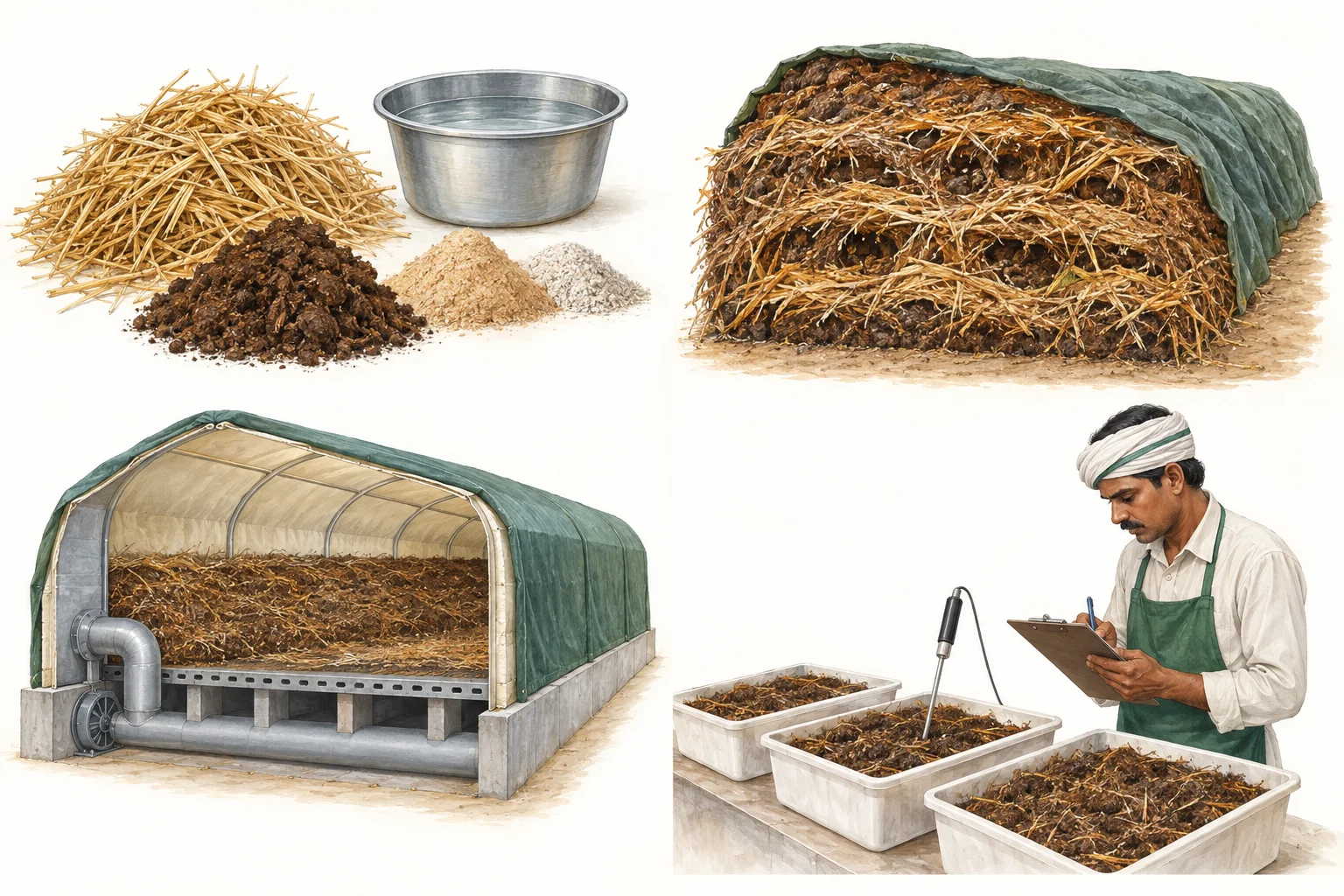
Structure and air
- Notice
- The heap has structure, depth and internal variation.
- Understand
- One central reading does not describe every part of the material.
- Try it
- Record representative readings and the actual preparation sequence.
01Rated air and delivered air
A fan is rated at a test condition with nothing in its way. In a real bunker or tunnel the air must pass through a plenum, a slotted floor and one to two metres of damp compost. Each of those adds resistance, and the fan moves less air as resistance rises.
The figure that matters is air passing through the stack. DMR states 10 to 15 cubic metres of air per tonne of wet compost per hour for aerated Phase I. Work out what your batch weighs, multiply, and compare that with what the system is actually delivering before blaming the compost.
02Oxygen is the real target
Air is the means; oxygen is the purpose. DMR asks for oxygen above 10 per cent by volume during Phase II conditioning so the mass stays fully aerobic, and notes demand can climb above 15 per cent of the total gaseous volume during post pasteurisation conditioning.
When oxygen falls the process does not simply slow, it changes. Anaerobic pockets make sour smelling compounds and kill the thermophilic flora. DMR links olive green mould directly to lack of aeration during compost preparation, especially during Phase II, alongside temperatures above 60 degrees.
03Evidence of distribution
Distribution is measured with temperature, because temperature follows the air. DMR sets the limit in a Phase II tunnel plainly: the difference between air above the compost, the compost itself and the plenum below should not exceed 3 degrees Celsius.
Use a grid of probes and compare readings against each other rather than against a setpoint.
- Steam rising evenly across the surface, not from two spots.
- No cold zone near the walls or the door end.
- Probe spread inside the limit at every reading hour.
- No sour smell anywhere along the surface.
04Acting on the evidence
When the spread is wide, the cause is usually mechanical and cheap to fix. Look first at compaction from the loader, then at a dip in the surface, then at floor slots blocked by old compost, then at air escaping round a door seal instead of going through the mass.
Raising fan speed on a leaking or compacted system simply moves more air along the easy path and dries the surface. Change one thing, run one batch, record what the spread did. A bigger fan bought without this evidence usually solves nothing.
Test distribution on the next batch
- Weigh the compost loaded and write the tonnage down.
- Place probes near both walls, both ends and centre.
- Log every probe at the same three hours daily.
- Walk the surface and note steam pattern and smell.
- List the widest spread and where it came from.
Write in your farm diary: Batch tonnage, computed air requirement, probe readings by position and hour, widest spread and its cause.
Mistakes that cost a crop
- Writing the fan plate figure in a batch record as though it were delivered air.
- Buying a larger blower before checking compaction, slots and door seals.
- Reading one probe, which hides the spread that would show the problem.
Check yourself
Three questions, instant answersA fan rated 8000 cubic metres per hour, loaded, delivers:
DMR limits the air, compost and plenum difference to:
Poor aeration in Phase II is linked by DMR to:
An editorial self-check, not a certificate. Answers are not stored, not even on this device.
Words used in this lesson
- Rated capacity
- Airflow a fan achieves on a test bench with nothing resisting it.
- Delivered air
- Air that actually passes through the compost in the working system.
- Short circuit
- Air escaping by an easy route without doing any work.
References & further reading
A lesson cannot replace batch measurements or plant-specific procedures.
Open current reference