

Mushroom disease library · Field companion
Prevent the next outbreak
Crop-stage biosecurity, process checks, monitoring, safe waste handling and a measured review of what changed.
- Clean inputs
Protect spawn and treated substrate.
- Crop work
Use identified tools and crop-stage routes.
- Contained waste
Keep exposed old material away from new production.
- Verified restart
Record sanitation and inspect before refill.
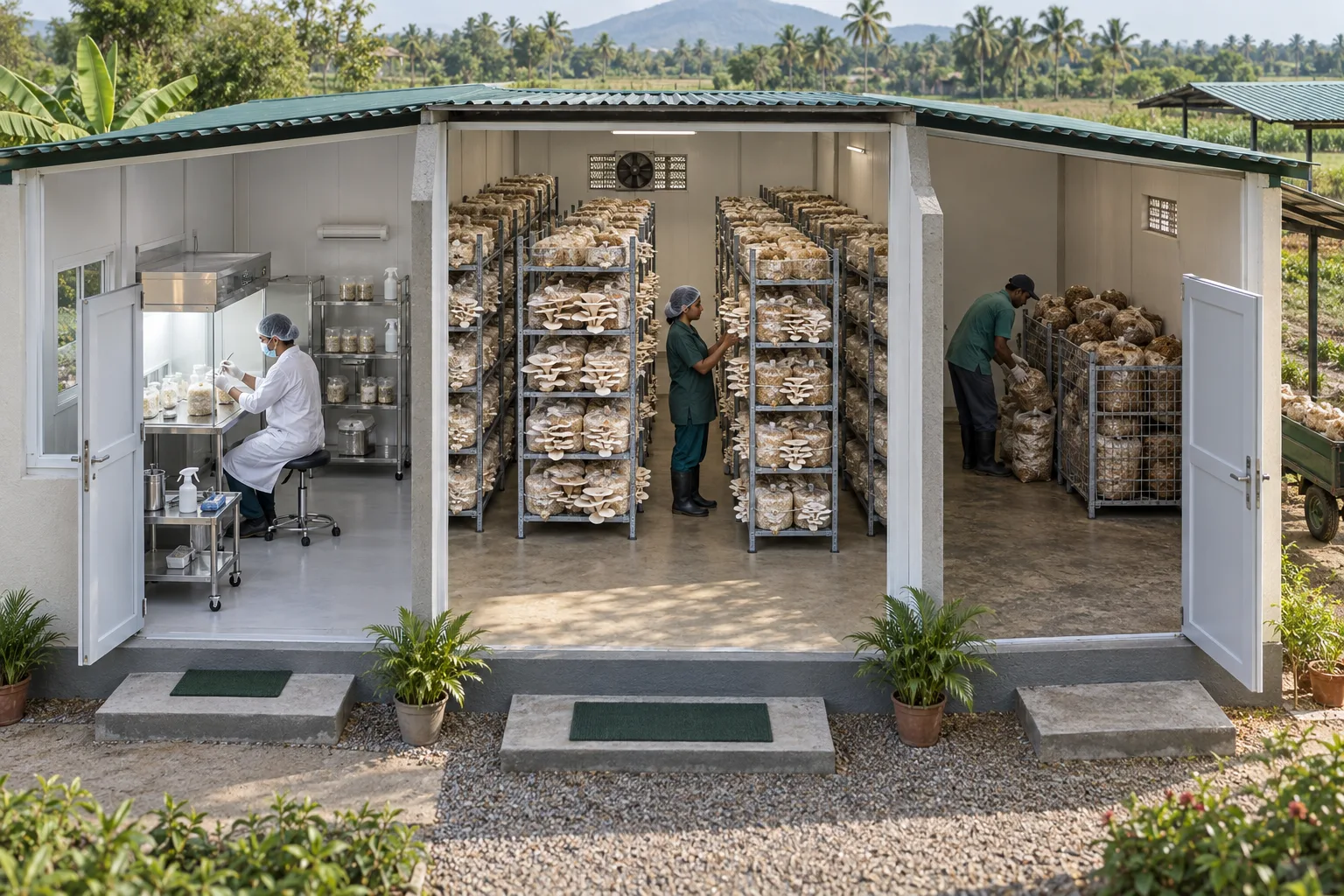
People, tools, air, water and material routes must work together. A painted “clean zone” is not effective if a waste trolley passes through it or air carries exposed spores into inoculation work.
Prevention through the crop cycle
| Stage | Decision | Practical check |
|---|---|---|
| Before buying inputs | Know the source and the lot. | Keep species/strain, supplier, production/receipt dates, storage conditions and any quality documents. Reject unexplained substitutions. A clean-looking spawn bag does not establish purity. |
| Substrate preparation | Validate the actual process. | Composted button substrate, pasteurised straw and sterilised supplemented wood are different systems. Record load, time/temperature at appropriate positions and handling after treatment. Do not copy one crop’s process into another. |
| Cooling and spawning | Protect the newly treated material. | Separate clean inoculation work from raw ingredients, crop waste and dusty traffic. Check bags, seals and filters; cooling exposed material can undo an otherwise adequate preparation step. |
| Incubation | Watch the batch, not just one bag. | Inspect through intact containers. Record substrate heat, growth pattern and contamination by position and lot. Arrange contained removal when indicated; never open a dusty bag among healthy units. |
| Casing and induction | Respect the host and stage. | For cased crops, protect casing storage and application equipment. Confirm crop readiness and a crop-specific transition. Uncased crops do not need a casing-disease routine simply because button mushrooms do. |
| Fruiting and watering | Inspect before the routine. | Look for new patches, cap wetness, pest activity and uneven growth before watering or picking. A change in air temperature can alter surface condensation even if the humidity reading looks familiar. |
| Harvest and packing | Keep the chain traceable. | Separate affected material, maintain clean food-contact surfaces and use suitable packaging. Record crop lot, harvest time and handling conditions. Farm appearance does not certify absence of foodborne pathogens. |
| Crop end and restart | Remove the reservoir safely. | Plan contained waste movement, cleaning, authorised disinfection where appropriate, maintenance and verification before refill. Thermal sanitation needs an engineered, monitored procedure; there is no universal room cook-out recipe here. |
Use a monitoring routine you can repeat
Assign who checks each room and when. Use the same mapped positions and record crop stage, inspected units, new affected units, pest observations and environmental events. Record zero observations too, so missing data are not mistaken for a clean crop.
- Traps: label location and date; compare counts over equal exposure periods. A generic internet threshold is not a validated trigger for your farm.
- Rooms: compare door/inlet/outlet zones and rack levels. Shared air readings can hide a local problem.
- Batches: retain input and process links so a supplier or treatment-load pattern can be found.
- Actions: record what was changed, by whom and when. If several things change together, cause and effect become hard to interpret.
Containment is not the same as cleaning
Containment limits spread now. Cleaning removes soil and organic debris. Disinfection, where appropriate, is a separately specified step with a suitable authorised product, concentration, contact time, surface condition and worker protection. Neither a pleasant smell nor disappearance of visible mould verifies success.
Keep dirty equipment out of clean storage. Do not dry-sweep spores or use compressed air to clean contaminated areas. Plan waste transport and disposal with local requirements; do not dump exposed affected substrate beside air intakes, water supplies or incoming material.
For fixed beds or large compost loads, do not improvise removal or a heat-treatment schedule. Ask a qualified production and engineering team to assess the crop, room and exposure risks.
Why this library does not give a spray chart
Many accessible manuals and papers contain historical, foreign or experimental chemical rates. Publication in a paper is not permission to use a product on an edible mushroom crop in India.
- Confirm the diagnosis and whether a chemical intervention is justified.
- Check the current Indian registration and label for the actual crop, target and use. A recommendation for another crop, country or room surface is not transferable.
- Follow the label’s use restrictions, application method, protective measures, re-entry and harvest requirements with a qualified adviser.
- Record the product and lot, operator, date, reason and verification. Do not mix products or apply antibiotics, household cleaners or experimental biological agents to rescue a crop.
Resistance and residue risks are additional reasons to avoid repeated speculative spraying. No recovery percentage, “zero residue” claim or guaranteed cure is offered here.
Close the loop after a problem
Compare the next crop with a documented baseline: new affected units, pest trends, yield/quality observations and recurrence by location. Agree restart criteria with the responsible adviser. If the same failure returns, reopen the diagnosis and traceability investigation rather than merely repeating treatment.
- Basic IPM: What is Integrated Pest Management? ↗
Penn State Extension · 8 July 2021
Used for: Monitoring, identification, prevention and evaluation.
Limit: US organic approvals and economic thresholds do not automatically apply in India.
- IPM in Mushroom Production: Exclusion Techniques for Pest Control ↗
Penn State Extension · Undated page
Used for: Separation of clean and older crops, tools and material routes.
Limit: Adapt the workflow to actual building, worker safety and ventilation needs.
- Sciarid Fly in Commercial Mushroom Production ↗
Penn State Extension · Undated page
Used for: Larval feeding, adult transport and monitoring clues.
Limit: Life-cycle timing and pest species differ with conditions; no universal trap threshold is supplied.
- Control of Fungal Diseases in Mushroom Crops while Dealing with Fungicide Resistance: A Review ↗
Gea et al., Microorganisms 9:585 · 2021
Used for: Dry bubble, wet bubble, cobweb and green mould; Figure 1 reference photographs.
Limit: Review, not a local diagnosis. Fungicide approvals and resistance vary by country. Photographs retained with CC BY attribution.
- Controlling exposure to dust and bioaerosols on farms growing common commercial mushrooms ↗
UK Health and Safety Executive / HDC · 2011
Used for: Worker exposure controls and respiratory-risk assessment.
Limit: Agaricus-focused occupational guidance, not diagnosis or treatment of a person.
- Seven Stages of Cultivation ↗
Cornell Small Farms · Undated guide
Used for: Indoor cultivation stages, ventilation, moisture and crop-specific conditions.
Limit: Environmental needs depend on species and strain; no single climate setpoint fits all crops.