Describe the change
Often no reliable visible sign.
 MushroomFarming.in
A joint educational initiative by

 ICAR–DMRSolan
Food & worker safety
A healthy-looking mushroom is not proof of food safety. A crop-disease photo guide cannot detect Listeria, Salmonella or unacceptable residues.
Organism / cause: Human pathogens and chemical contamination require food-safety controls
Where this evidence applies: All edible-mushroom food chains; enoki outbreak evidence is a specific example, not a claim about every crop.
Picture → observation → next check
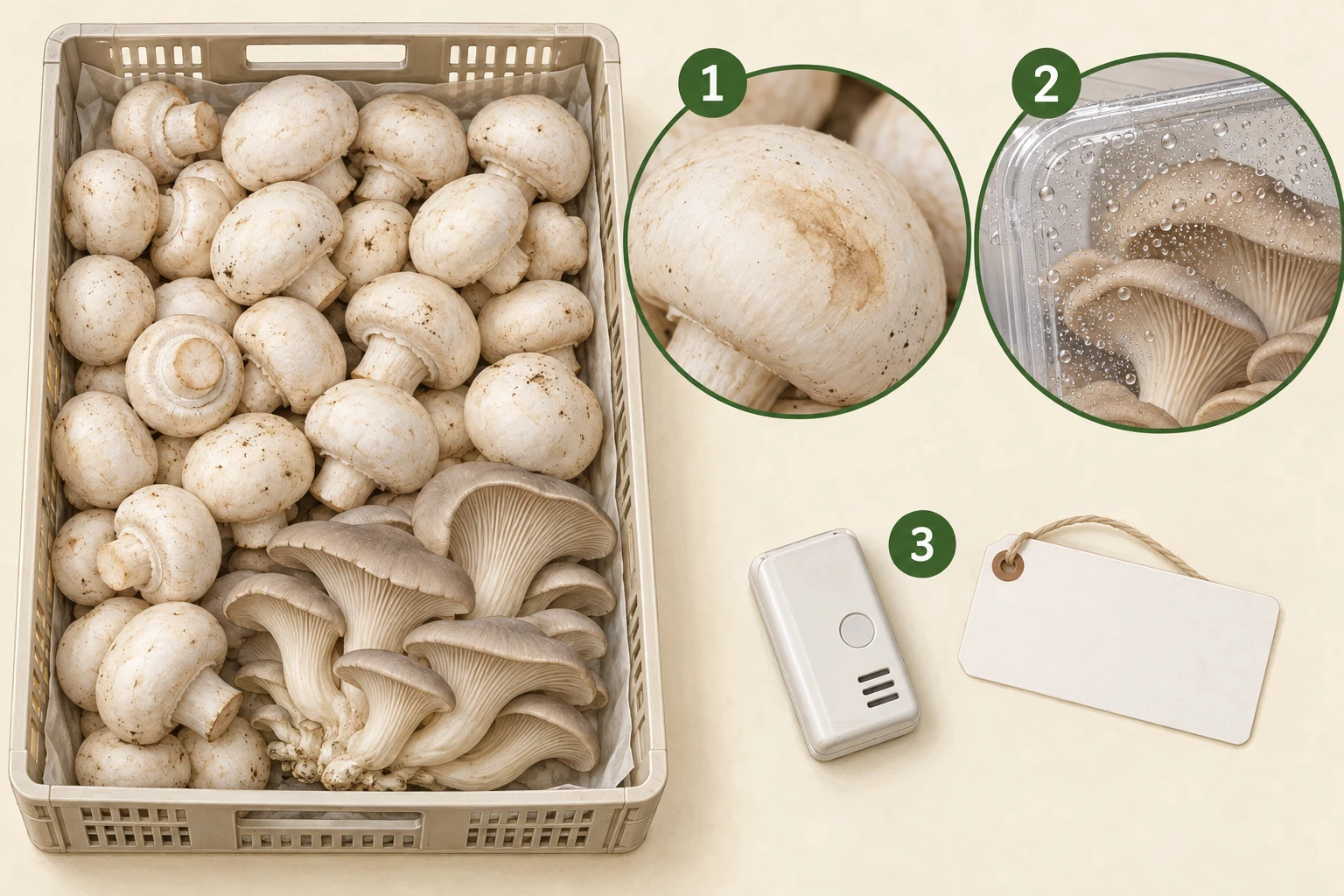
Ask whether it appeared before picking, during handling or in storage. A brown area is not automatically bacterial blotch.
Record condensation, temperature changes and elapsed time. Do not use a visual match to release a suspect lot.
Link harvest, packing and transport records so affected produce can be traced and assessed.
Often no reliable visible sign.
Visible spoilage is a different warning; absence of spoilage is not clearance.
Keep supplier, crop, packing and dispatch lots connected.
A visual match is only a starting point. Appropriate validated testing and professional interpretation are needed. A photograph or ordinary crop-pathogen test is not enough.
01 · Observe
No verified reusable diagnostic photograph is included for this entry. The illustration above explains observation context, not a confirmed disease specimen. Consult the original source figures where available.
02 · Compare
Contaminated food, equipment and preparation surfaces can transfer human pathogens. Cross-contamination matters even when a product is later cooked.
03 · Check
What confirmation needs: Appropriate validated testing and professional interpretation are needed. A photograph or ordinary crop-pathogen test is not enough.
Use the field record and sampling checklist →04 · Respond
These are investigation and containment steps, not a guaranteed cure. Do not eat, sell or distribute suspect material on the strength of a visual match. Do not culture unknown contaminants or experiment with pesticides in a growing room.
05 · Learn
After intervention, compare new affected units, crop condition and inspection results against the same recorded baseline. A lack of visible growth does not, by itself, verify decontamination or food safety.
Read the stage-by-stage prevention plan →Historical CDC enoki outbreak illustrates invisible food-safety risk; it is not a current outbreak alert.
US CDC · Updated 30 January 2025; outbreak ended
Used for: Human food-safety contamination, cross-contamination and cooking advice.
Limit: Historical outbreak, not a claim that the reader’s crop or all Indian enoki are contaminated.
Food & worker safety
Separate when damage started from when someone noticed it. That distinction prevents a storage problem being mislabelled as a growing-room disease.
Harvest, packing, transport and storage; a crop can deteriorate after leaving a healthy room.
Signs, checks & response →Environmental disorders
Unexpected forms or lesions after cleaning, spraying or nearby fuel use need an exposure history as well as a disease differential.
Rosecomb is classically described in Agaricus; broader crop filters cover exposure investigation, not identical symptoms.
Signs, checks & response →Pests & vectors
Missing tissue is not necessarily disease. Feeding, physical damage and contamination by animals require different responses.
Outdoor/log cultivation and entry into protected farms; exact risks vary with location.
Signs, checks & response →