Describe the change
Softening, slime, mould, discolouration or leaking packs.
 MushroomFarming.in
A joint educational initiative by

 ICAR–DMRSolan
Food & worker safety
Separate when damage started from when someone noticed it. That distinction prevents a storage problem being mislabelled as a growing-room disease.
Organism / cause: Handling damage, physiological change and/or microorganisms
Where this evidence applies: Harvest, packing, transport and storage; a crop can deteriorate after leaving a healthy room.
Picture → observation → next check
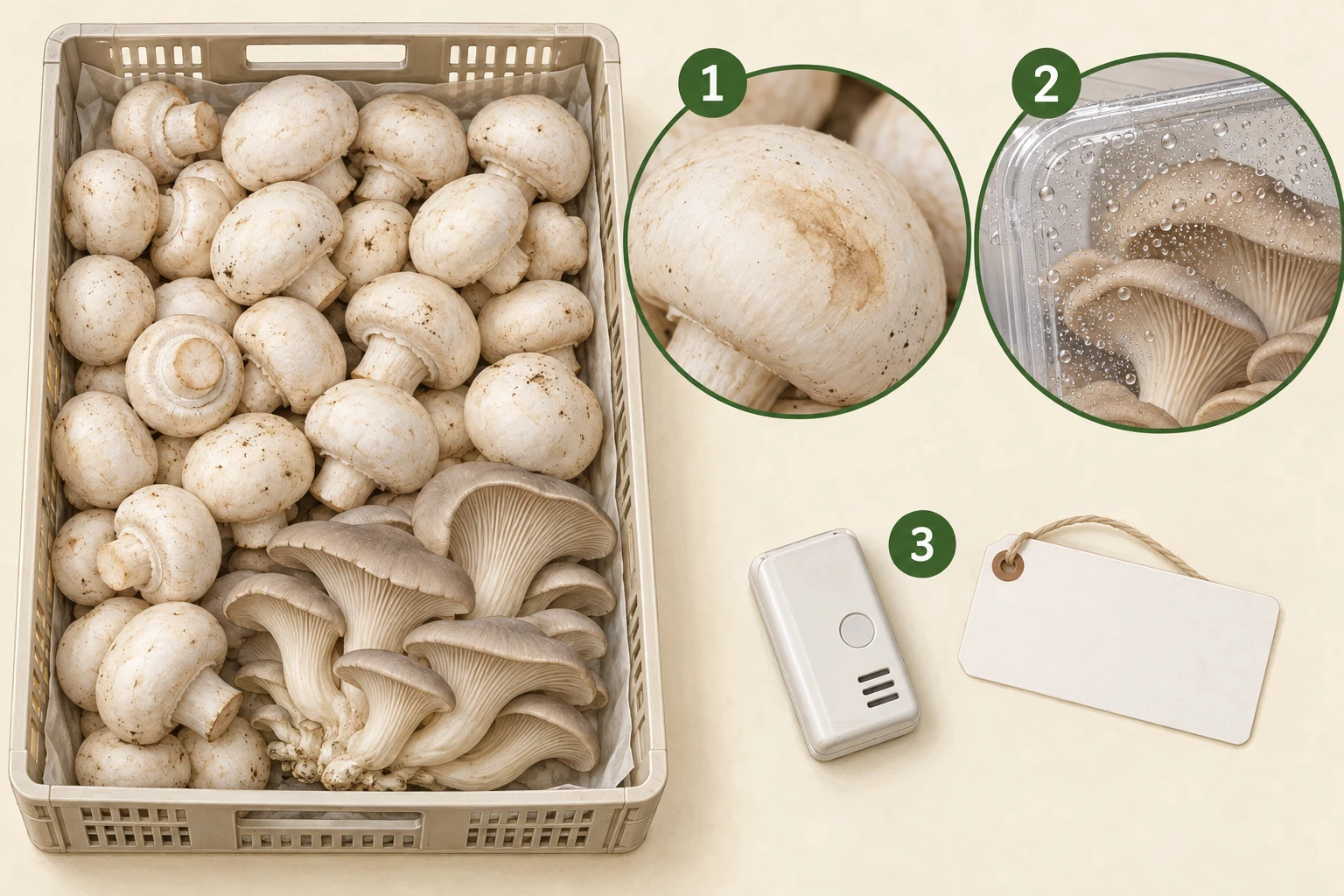
Ask whether it appeared before picking, during handling or in storage. A brown area is not automatically bacterial blotch.
Record condensation, temperature changes and elapsed time. Do not use a visual match to release a suspect lot.
Link harvest, packing and transport records so affected produce can be traced and assessed.
Softening, slime, mould, discolouration or leaking packs.
Preharvest blotch, internal necrosis and normal strain colour.
Reconstruct harvest time, packing, storage and delivery conditions.
A visual match is only a starting point. Quality defects and invisible foodborne pathogens need different assessments; appearance cannot certify safety.
01 · Observe
No verified reusable diagnostic photograph is included for this entry. The illustration above explains observation context, not a confirmed disease specimen. Consult the original source figures where available.
02 · Compare
Contact surfaces, mixed lots, damaged tissue and unsuitable storage can contribute; some defects are physical rather than infectious.
03 · Check
What confirmation needs: Quality defects and invisible foodborne pathogens need different assessments; appearance cannot certify safety.
Use the field record and sampling checklist →04 · Respond
These are investigation and containment steps, not a guaranteed cure. Do not eat, sell or distribute suspect material on the strength of a visual match. Do not culture unknown contaminants or experiment with pesticides in a growing room.
05 · Learn
After intervention, compare new affected units, crop condition and inspection results against the same recorded baseline. A lack of visible growth does not, by itself, verify decontamination or food safety.
Read the stage-by-stage prevention plan →Crop-deterioration differential supported by disease and food-safety references, not a shelf-life guarantee.
Research review, PMC · 2008
Used for: Bacterial soft rot and yellowing; Burkholderia gladioli pv. agaricicola in Agaricus bitorquis.
Limit: Research taxonomy and mechanism, not evidence that all soft rot is this organism.
Penn State Extension · 8 July 2021
Used for: Hairlike growth, cap damage and postharvest occurrence.
Limit: Do not identify Syzygites from a fuzzy photograph alone.
US CDC · Updated 30 January 2025; outbreak ended
Used for: Human food-safety contamination, cross-contamination and cooking advice.
Limit: Historical outbreak, not a claim that the reader’s crop or all Indian enoki are contaminated.
ICAR–DMR Solan · Historical technical bulletin
Used for: Volvariella cultivation, competitors and crop-specific handling.
Limit: Do not transfer button-mushroom climate, cold-storage or chemical recipes to this warm-growing species.
Food & worker safety
A healthy-looking mushroom is not proof of food safety. A crop-disease photo guide cannot detect Listeria, Salmonella or unacceptable residues.
All edible-mushroom food chains; enoki outbreak evidence is a specific example, not a claim about every crop.
Signs, checks & response →Bacterial diseases
A mushroom can look relatively normal outside while its stem is damaged internally. Internal quality checks can reveal a different problem from cap blotch.
Reported in cultivated Agaricus; stem browning has multiple possible causes.
Signs, checks & response →Environmental disorders
A room-air reading can miss a hot substrate core. Equally, a cold chain suitable for button mushrooms must not be assumed suitable for paddy straw.
Substrate, crop and storage temperatures must be interpreted separately for each species.
Signs, checks & response →