Describe the change
Stalled colonisation, crop stress or tissue deterioration after an excursion.
 MushroomFarming.in
A joint educational initiative by

 ICAR–DMRSolan
Environmental disorders
A room-air reading can miss a hot substrate core. Equally, a cold chain suitable for button mushrooms must not be assumed suitable for paddy straw.
Organism / cause: Temperature history and metabolic heat
Where this evidence applies: Substrate, crop and storage temperatures must be interpreted separately for each species.
Picture → observation → next check
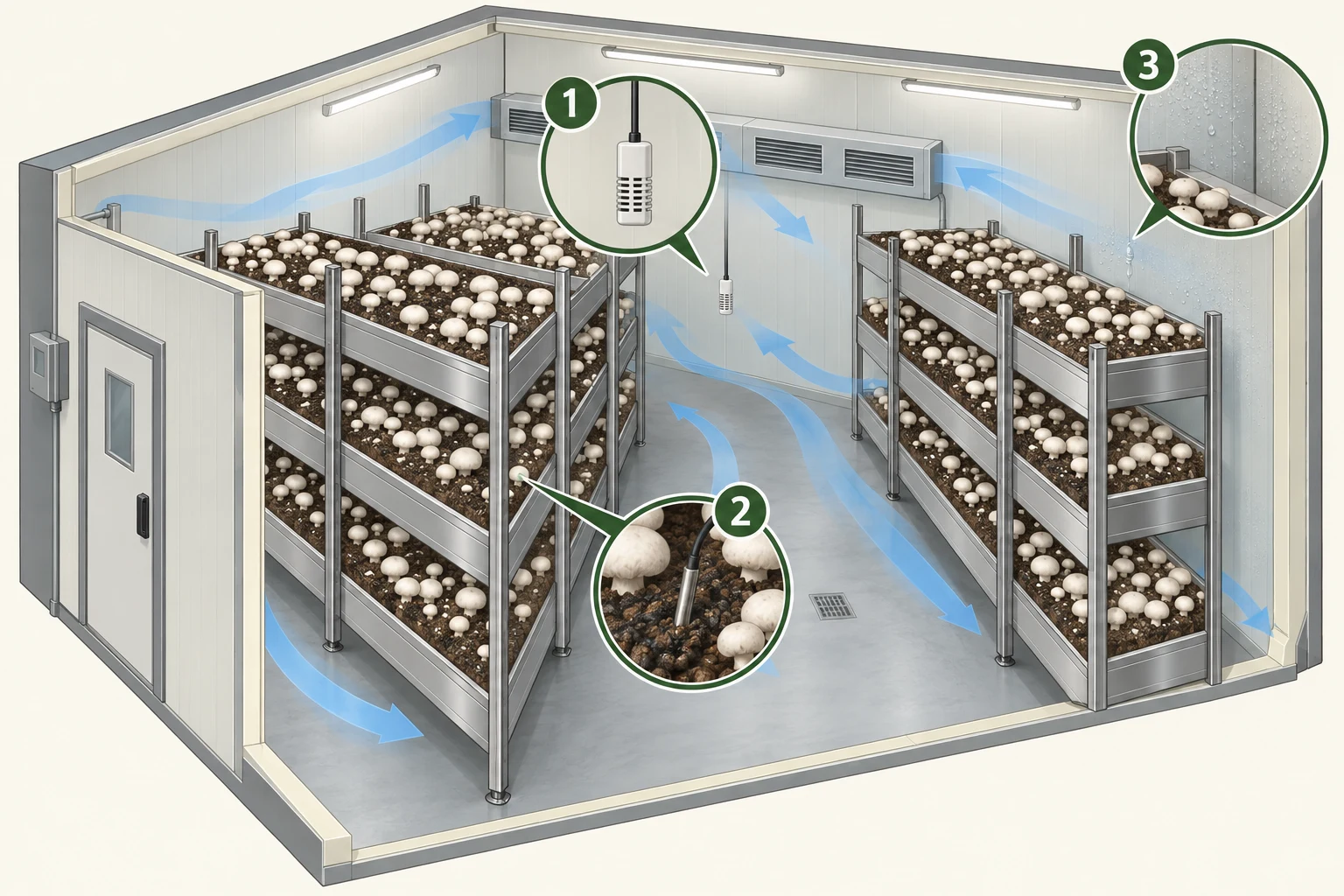
Use time-stamped readings at representative positions. One sensor can miss a rack-level or doorway difference.
Record substrate temperature separately from room air using the farm’s appropriate hygienic measurement procedure.
Map condensation, leaks and wet crop zones. Compare the pattern with watering and temperature changes.
Stalled colonisation, crop stress or tissue deterioration after an excursion.
Contamination, weak spawn, water stress and poor ventilation.
Review substrate-core measurements and peak history, not only current room air.
A visual match is only a starting point. Documented exposure supports the diagnosis; later microbial decay can complicate the picture.
01 · Observe
No verified reusable diagnostic photograph is included for this entry. The illustration above explains observation context, not a confirmed disease specimen. Consult the original source figures where available.
02 · Compare
Several units may be affected by the same load or storage event without contagious disease.
03 · Check
What confirmation needs: Documented exposure supports the diagnosis; later microbial decay can complicate the picture.
Use the field record and sampling checklist →04 · Respond
These are investigation and containment steps, not a guaranteed cure. Do not eat, sell or distribute suspect material on the strength of a visual match. Do not culture unknown contaminants or experiment with pesticides in a growing room.
05 · Learn
After intervention, compare new affected units, crop condition and inspection results against the same recorded baseline. A lack of visible growth does not, by itself, verify decontamination or food safety.
Read the stage-by-stage prevention plan →Agaricus spawn-run and paddy-straw institutional guidance; not an all-species storage recipe.
Penn State Extension · 23 December 2025
Used for: Spawn run, substrate heat, moisture and mummy-risk context.
Limit: Agaricus substrate management is not a sterilisation protocol for supplemented sawdust bags.
ICAR–DMR Solan · Historical technical bulletin
Used for: Volvariella cultivation, competitors and crop-specific handling.
Limit: Do not transfer button-mushroom climate, cold-storage or chemical recipes to this warm-growing species.
Cornell Small Farms · Undated guide
Used for: Indoor cultivation stages, ventilation, moisture and crop-specific conditions.
Limit: Environmental needs depend on species and strain; no single climate setpoint fits all crops.
Environmental disorders
Poorly colonised substrate can be a process failure before a competitor arrives. Treating the visible late mould may miss the original cause.
Ammonia/conditioning is especially relevant to button compost. Bag substrates use different preparation systems.
Signs, checks & response →Food & worker safety
Separate when damage started from when someone noticed it. That distinction prevents a storage problem being mislabelled as a growing-room disease.
Harvest, packing, transport and storage; a crop can deteriorate after leaving a healthy room.
Signs, checks & response →