Describe the change
Slow or absent colonisation across a batch.
 MushroomFarming.in
A joint educational initiative by

 ICAR–DMRSolan
Environmental disorders
Poorly colonised substrate can be a process failure before a competitor arrives. Treating the visible late mould may miss the original cause.
Organism / cause: Process or substrate condition; not necessarily a pathogen
Where this evidence applies: Ammonia/conditioning is especially relevant to button compost. Bag substrates use different preparation systems.
Picture → observation → next check
For crops that use casing, trace storage, handling and the casing lot separately from the compost.
Compare the compost lot and preparation history. White growth is not, by itself, proof of either purity or contamination.
Record treatment, cooling, spawning and the first affected position through the intact bag.
Check the filter, seal and batch history without opening suspect material. Normal block appearance depends on crop and stage.
Slow or absent colonisation across a batch.
Contaminated spawn, Trichoderma and bacterial deterioration.
Compare the substrate recipe, loading, treatment, cooling and spawning records.
A visual match is only a starting point. Process measurements and laboratory substrate testing can separate chemical/physical failure from infection.
01 · Observe
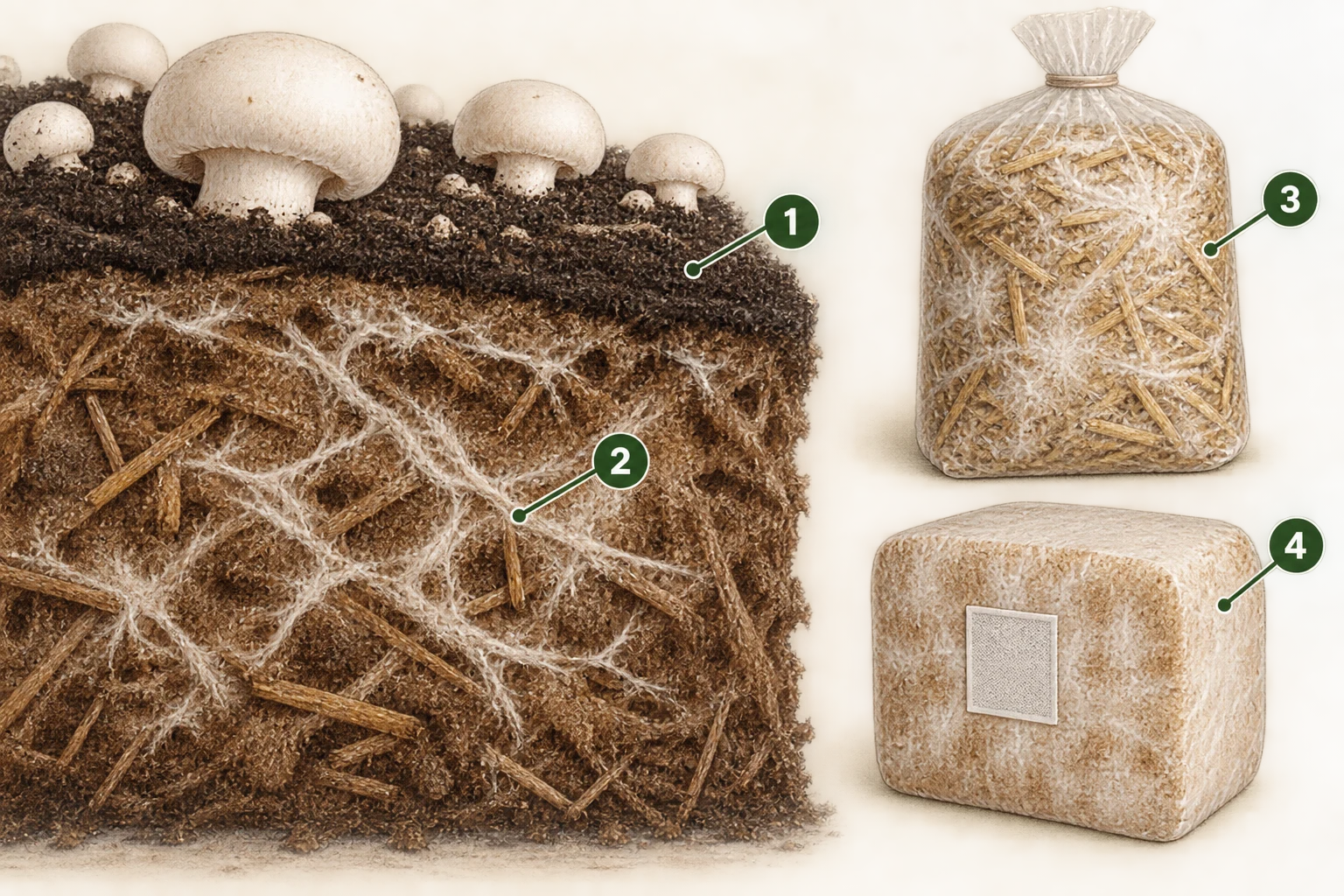
No verified reusable diagnostic photograph is included for this entry. The illustration above explains observation context, not a confirmed disease specimen. Consult the original source figures where available.
02 · Compare
The problem can follow a recipe, treatment load or compost batch rather than spread between bags.
03 · Check
What confirmation needs: Process measurements and laboratory substrate testing can separate chemical/physical failure from infection.
Use the field record and sampling checklist →04 · Respond
These are investigation and containment steps, not a guaranteed cure. Do not eat, sell or distribute suspect material on the strength of a visual match. Do not culture unknown contaminants or experiment with pesticides in a growing room.
05 · Learn
After intervention, compare new affected units, crop condition and inspection results against the same recorded baseline. A lack of visible growth does not, by itself, verify decontamination or food safety.
Read the stage-by-stage prevention plan →Agaricus substrate guidance with explicit limits on transfer to other crops.
Penn State Extension · 23 December 2025
Used for: Spawn run, substrate heat, moisture and mummy-risk context.
Limit: Agaricus substrate management is not a sterilisation protocol for supplemented sawdust bags.
Cornell Small Farms · Undated guide
Used for: Indoor cultivation stages, ventilation, moisture and crop-specific conditions.
Limit: Environmental needs depend on species and strain; no single climate setpoint fits all crops.
Viruses & culture health
Separate three questions: was the spawn viable, was the substrate suitable, and was the inoculation/handling process sound?
Applies from grain spawn to compost, straw and supplemented wood substrates.
Signs, checks & response →Fungal diseases
A competitive or pathogenic fungus can occupy compost that should be colonised by the mushroom. Green spores may appear after an initially white phase.
Composted Agaricus substrate. Not every green colony is the aggressive epidemic organism.
Signs, checks & response →Bacterial diseases
Mummy describes a recognisable crop syndrome, but the label should not hide uncertainty about cause.
Agaricus production syndrome.
Signs, checks & response →