Describe the change
White growth followed by green sporulation in compost or casing.
 MushroomFarming.in
A joint educational initiative by

 ICAR–DMRSolan
Fungal diseases
A competitive or pathogenic fungus can occupy compost that should be colonised by the mushroom. Green spores may appear after an initially white phase.
Organism / cause: Trichoderma aggressivum and other Trichoderma species
Where this evidence applies: Composted Agaricus substrate. Not every green colony is the aggressive epidemic organism.
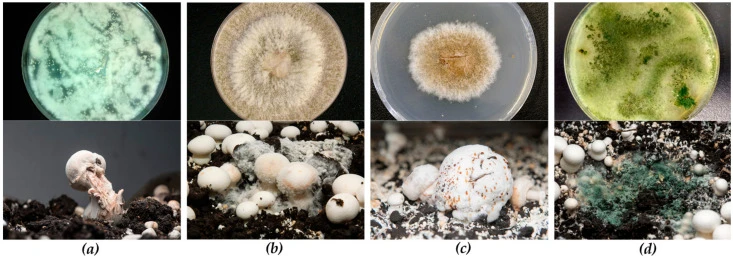
Reference image only. These are published study examples, not photographs of your crop or claims about an Indian outbreak.
Picture → observation → next check
White growth followed by green sporulation in compost or casing.
Penicillium, Aspergillus and other green-sporing contaminants.
Compare compost, spawn and filling dates between affected and unaffected rooms.
A visual match is only a starting point. Laboratory identification is needed for species attribution. Green colour alone cannot diagnose T. aggressivum.
01 · Observe
02 · Compare
Contaminated substrate, equipment and operations around spawning can introduce or distribute the organism; later handling moves spores.
03 · Check
What confirmation needs: Laboratory identification is needed for species attribution. Green colour alone cannot diagnose T. aggressivum.
Use the field record and sampling checklist →04 · Respond
These are investigation and containment steps, not a guaranteed cure. Do not eat, sell or distribute suspect material on the strength of a visual match. Do not culture unknown contaminants or experiment with pesticides in a growing room.
05 · Learn
After intervention, compare new affected units, crop condition and inspection results against the same recorded baseline. A lack of visible growth does not, by itself, verify decontamination or food safety.
Read the stage-by-stage prevention plan →Established production problem; organism-level conclusions require testing.
Penn State Extension · Updated 23 December 2025
Used for: Green mould in commercial Agaricus production.
Limit: US production context. Green colour does not identify Trichoderma species.
Biology · 2023
Used for: Detection limits and reported hosts including milky, paddy straw and Ganoderma.
Limit: Host reports do not show prevalence in every Indian region; molecular identification needs qualified interpretation.
Fungal diseases
A bag can contain competing mould before green colour is visible. Oyster-associated Trichoderma species differ from the main button-mushroom epidemic species.
Detailed pathogen evidence exists for Pleurotus; the other listed crops have published green-mould host reports, not a shared diagnosis.
Signs, checks & response →Competitor moulds
Green, blue-green or dark growth is not automatically Trichoderma. Neither harmlessness nor toxin production can be established from its colour.
Raw-material, spawn, substrate and storage contamination differential across production systems.
Signs, checks & response →Environmental disorders
Poorly colonised substrate can be a process failure before a competitor arrives. Treating the visible late mould may miss the original cause.
Ammonia/conditioning is especially relevant to button compost. Bag substrates use different preparation systems.
Signs, checks & response →