Describe the change
Gill-like tissue on an unusual cap surface in a rosecomb-type form.
 MushroomFarming.in
A joint educational initiative by

 ICAR–DMRSolan
Environmental disorders
Unexpected forms or lesions after cleaning, spraying or nearby fuel use need an exposure history as well as a disease differential.
Organism / cause: Potential exposure injury; not a proven cause from appearance alone
Where this evidence applies: Rosecomb is classically described in Agaricus; broader crop filters cover exposure investigation, not identical symptoms.
Picture → observation → next check
Record a local spot versus whole-cap colour, and whether it was present before picking.
Separate normal maturity-related pigmentation from unusual wetness, exudate or deterioration.
Internal changes can differ from the outside. Obtain sampling instructions before cutting suspect material.
Note whether the change starts in the fruit body, the casing surface or the substrate below.
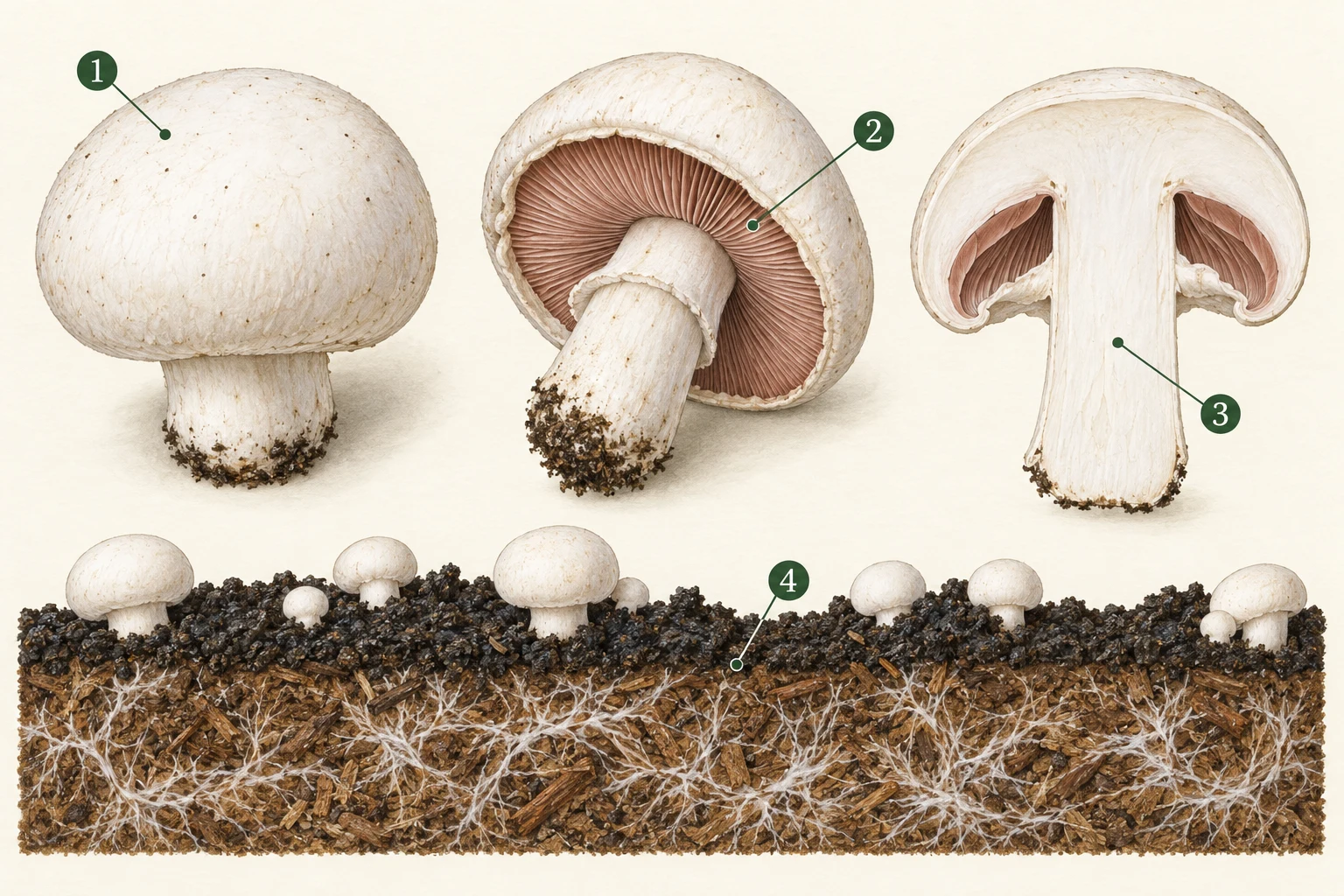
Gill-like tissue on an unusual cap surface in a rosecomb-type form.
Developmental variation, disease lesions and mechanical injury.
List products, dates, dilution records and entry of fumes.
A visual match is only a starting point. Exposure history and suitable testing are needed; the appearance cannot prove a specific chemical.
01 · Observe
No verified reusable diagnostic photograph is included for this entry. The illustration above explains observation context, not a confirmed disease specimen. Consult the original source figures where available.
02 · Compare
A shared exposure may affect several trays at once; it is not contagious merely because it is widespread.
03 · Check
What confirmation needs: Exposure history and suitable testing are needed; the appearance cannot prove a specific chemical.
Use the field record and sampling checklist →04 · Respond
These are investigation and containment steps, not a guaranteed cure. Do not eat, sell or distribute suspect material on the strength of a visual match. Do not culture unknown contaminants or experiment with pesticides in a growing room.
05 · Learn
After intervention, compare new affected units, crop condition and inspection results against the same recorded baseline. A lack of visible growth does not, by itself, verify decontamination or food safety.
Read the stage-by-stage prevention plan →Historical rosecomb association is a clue, not proof of cause or product safety.
ICAR–National Research Centre for Mushroom, Solan (now DMR) · 2007
Used for: Historical Indian register of competitor names and abiotic disorders; printed pages 2–43 and 65–69.
Limit: Older names and treatments. Used as a coverage checklist, not a current pesticide label or an image-reuse licence.
Penn State Extension · 8 July 2021
Used for: Monitoring, identification, prevention and evaluation.
Limit: US organic approvals and economic thresholds do not automatically apply in India.
Bacterial diseases
Persistent surface wetness can favour bacterial blotch. Managing cap drying means balancing the crop environment, not simply drying the entire room.
Agaricus caps; a brown spot does not establish bacterial identity.
Signs, checks & response →Food & worker safety
A healthy-looking mushroom is not proof of food safety. A crop-disease photo guide cannot detect Listeria, Salmonella or unacceptable residues.
All edible-mushroom food chains; enoki outbreak evidence is a specific example, not a claim about every crop.
Signs, checks & response →Environmental disorders
Counting days is not the same as checking readiness. Poor fruiting can follow immature substrate, an unsuitable transition, culture quality or infection.
Species-specific induction and fruiting systems, including cased and uncased crops.
Signs, checks & response →