Describe the change
Tan to brown cap lesions, sometimes becoming darker or sunken.
 MushroomFarming.in
A joint educational initiative by

 ICAR–DMRSolan
Bacterial diseases
Persistent surface wetness can favour bacterial blotch. Managing cap drying means balancing the crop environment, not simply drying the entire room.
Organism / cause: Pseudomonas tolaasii and a wider blotch-associated bacterial complex
Where this evidence applies: Agaricus caps; a brown spot does not establish bacterial identity.
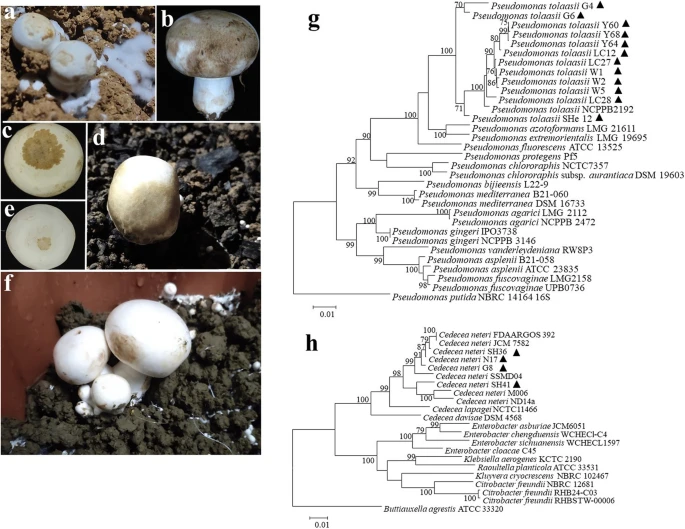
Reference image only. These are published study examples, not photographs of your crop or claims about an Indian outbreak.
Picture → observation → next check
Tan to brown cap lesions, sometimes becoming darker or sunken.
Bruising after handling, fungal lesions and chemical injury.
Compare cap wetness with watering time, temperature change and air distribution.
A visual match is only a starting point. A laboratory distinguishes bacterial blotch from noninfectious spots and can investigate the organism involved.
01 · Observe
02 · Compare
Bacteria can be distributed by water and handling; a long-lived film of water on caps helps disease develop.
03 · Check
What confirmation needs: A laboratory distinguishes bacterial blotch from noninfectious spots and can investigate the organism involved.
Use the field record and sampling checklist →04 · Respond
These are investigation and containment steps, not a guaranteed cure. Do not eat, sell or distribute suspect material on the strength of a visual match. Do not culture unknown contaminants or experiment with pesticides in a growing room.
05 · Learn
After intervention, compare new affected units, crop condition and inspection results against the same recorded baseline. A lack of visible growth does not, by itself, verify decontamination or food safety.
Read the stage-by-stage prevention plan →Established disease; modern research shows more bacterial diversity than the single name in many manuals.
Penn State Extension · Updated 23 December 2025
Used for: Wet caps, condensation, symptom patterns and prevention.
Limit: Foreign water-treatment or crop-protection rates are not Indian recommendations.
Research article indexed in PubMed · 2020
Used for: Blotch can involve several Pseudomonas species; molecular and pathogenicity testing.
Limit: Abstract and figure captions reviewed. Cap colour cannot distinguish the organisms.
Bacterial diseases
“Ginger blotch” and “yellow blotch” describe appearances, not a dependable field identification of one bacterium.
Blotch-associated isolates from Agaricus in Western European research.
Signs, checks & response →Environmental disorders
Room humidity does not tell the whole water story. A crop can have wet caps in one rack zone and drying injury in another.
All production systems, with different crop-specific tolerances.
Signs, checks & response →Fungal diseases
An infection whose appearance changes with the age of the mushroom when it is attacked. A distorted pin and a spotted mature cap can belong to the same disease.
Principally cultivated Agaricus; do not transfer the diagnosis to every malformed mushroom.
Signs, checks & response →