Describe the change
Undifferentiated dry masses when young tissue is affected.
 MushroomFarming.in
A joint educational initiative by

 ICAR–DMRSolan
Fungal diseases
An infection whose appearance changes with the age of the mushroom when it is attacked. A distorted pin and a spotted mature cap can belong to the same disease.
Organism / cause: Lecanicillium fungicola; older literature: Verticillium fungicola
Where this evidence applies: Principally cultivated Agaricus; do not transfer the diagnosis to every malformed mushroom.
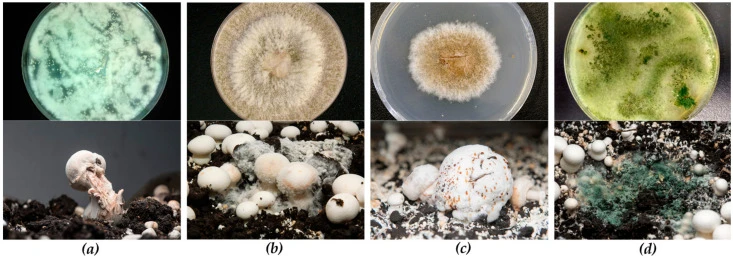
Reference image only. These are published study examples, not photographs of your crop or claims about an Indian outbreak.
Picture → observation → next check
Undifferentiated dry masses when young tissue is affected.
Wet bubble, which can also distort developing mushrooms.
Map the first patch against the casing lot and watering route.
A visual match is only a starting point. A specialist distinguishes the symptom pattern and examines an appropriate sample; a picture alone does not identify the fungus.
01 · Observe
02 · Compare
Spores can move with splashed water, contaminated equipment, people and insects; contaminated casing is an important investigation point.
03 · Check
What confirmation needs: A specialist distinguishes the symptom pattern and examines an appropriate sample; a picture alone does not identify the fungus.
Use the field record and sampling checklist →04 · Respond
These are investigation and containment steps, not a guaranteed cure. Do not eat, sell or distribute suspect material on the strength of a visual match. Do not culture unknown contaminants or experiment with pesticides in a growing room.
05 · Learn
After intervention, compare new affected units, crop condition and inspection results against the same recorded baseline. A lack of visible growth does not, by itself, verify decontamination or food safety.
Read the stage-by-stage prevention plan →Established Agaricus disease; archived extension instructions supplement the fungal-disease review.
AHDB archive · Undated archived guidance
Used for: Symptom forms, handling risks and containment principles.
Limit: Archived UK guidance; not current Indian product authorisation.
Gea et al., Microorganisms 9:585 · 2021
Used for: Dry bubble, wet bubble, cobweb and green mould; Figure 1 reference photographs.
Limit: Review, not a local diagnosis. Fungicide approvals and resistance vary by country. Photographs retained with CC BY attribution.
Fungal diseases
A disease of developing mushroom tissue, often producing swollen, disorganised masses rather than a normal cap and stem.
Agaricus disease; the two names occur in different publications.
Signs, checks & response →Fungal diseases
Spreading surface growth can overrun casing and fruit bodies. The important clue is progression across the crop, not simply white colour.
Strong Agaricus evidence; additional cultivated hosts are documented in Korean studies. Susceptibility varies with isolate and host.
Signs, checks & response →Bacterial diseases
Persistent surface wetness can favour bacterial blotch. Managing cap drying means balancing the crop environment, not simply drying the entire room.
Agaricus caps; a brown spot does not establish bacterial identity.
Signs, checks & response →