Describe the change
Irregular fleshy growth with white surface growth early in development.
 MushroomFarming.in
A joint educational initiative by

 ICAR–DMRSolan
Fungal diseases
A disease of developing mushroom tissue, often producing swollen, disorganised masses rather than a normal cap and stem.
Organism / cause: Mycogone perniciosa / Hypomyces perniciosus
Where this evidence applies: Agaricus disease; the two names occur in different publications.
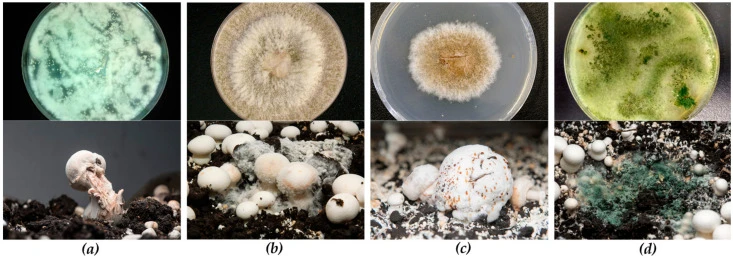
Reference image only. These are published study examples, not photographs of your crop or claims about an Indian outbreak.
Picture → observation → next check
Irregular fleshy growth with white surface growth early in development.
Dry bubble; early distorted tissue is not reliably separated by a casual photograph.
Trace the casing batch and where it was stored or handled.
A visual match is only a starting point. Request specialist examination to distinguish wet bubble from dry bubble before selecting a removal method.
01 · Observe
02 · Compare
Soil or casing contamination and movement of infected material are key pathways; splashing can distribute contamination.
03 · Check
What confirmation needs: Request specialist examination to distinguish wet bubble from dry bubble before selecting a removal method.
Use the field record and sampling checklist →04 · Respond
These are investigation and containment steps, not a guaranteed cure. Do not eat, sell or distribute suspect material on the strength of a visual match. Do not culture unknown contaminants or experiment with pesticides in a growing room.
05 · Learn
After intervention, compare new affected units, crop condition and inspection results against the same recorded baseline. A lack of visible growth does not, by itself, verify decontamination or food safety.
Read the stage-by-stage prevention plan →Established disease described in institutional guidance and reviews; no chemical rates reproduced.
AHDB archive · Undated archived guidance
Used for: Bubble recognition and distinction from dry bubble.
Limit: Removal advice requires correct identification and a trained supervisor; UK treatment labels are not transferable.
Gea et al., Microorganisms 9:585 · 2021
Used for: Dry bubble, wet bubble, cobweb and green mould; Figure 1 reference photographs.
Limit: Review, not a local diagnosis. Fungicide approvals and resistance vary by country. Photographs retained with CC BY attribution.
Fungal diseases
An infection whose appearance changes with the age of the mushroom when it is attacked. A distorted pin and a spotted mature cap can belong to the same disease.
Principally cultivated Agaricus; do not transfer the diagnosis to every malformed mushroom.
Signs, checks & response →Fungal diseases
Spreading surface growth can overrun casing and fruit bodies. The important clue is progression across the crop, not simply white colour.
Strong Agaricus evidence; additional cultivated hosts are documented in Korean studies. Susceptibility varies with isolate and host.
Signs, checks & response →