Describe the change
Expanding wispy or cottony patches crossing casing and mushroom surfaces.
 MushroomFarming.in
A joint educational initiative by

 ICAR–DMRSolan
Fungal diseases
Spreading surface growth can overrun casing and fruit bodies. The important clue is progression across the crop, not simply white colour.
Organism / cause: Cladobotryum species, including C. mycophilum and C. dendroides
Where this evidence applies: Strong Agaricus evidence; additional cultivated hosts are documented in Korean studies. Susceptibility varies with isolate and host.
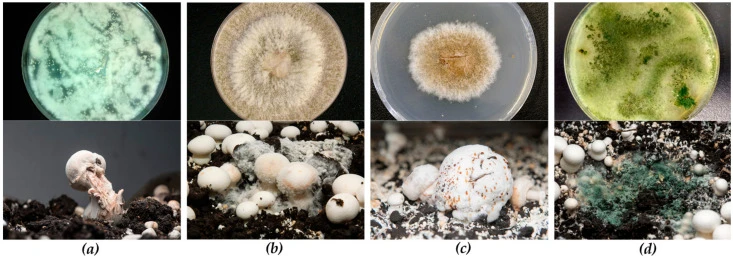
Reference image only. These are published study examples, not photographs of your crop or claims about an Indian outbreak.
Picture → observation → next check
Expanding wispy or cottony patches crossing casing and mushroom surfaces.
Normal crop mycelium, Mucor-like growth and Syzygites.
Record patch boundaries and changes without brushing the growth.
A visual match is only a starting point. Microscopy and, where needed, molecular identification distinguish Cladobotryum from other surface fungi.
01 · Observe
02 · Compare
Disturbance, air movement, watering and contaminated handling can disperse spores from established patches.
03 · Check
What confirmation needs: Microscopy and, where needed, molecular identification distinguish Cladobotryum from other surface fungi.
Use the field record and sampling checklist →04 · Respond
These are investigation and containment steps, not a guaranteed cure. Do not eat, sell or distribute suspect material on the strength of a visual match. Do not culture unknown contaminants or experiment with pesticides in a growing room.
05 · Learn
After intervention, compare new affected units, crop condition and inspection results against the same recorded baseline. A lack of visible growth does not, by itself, verify decontamination or food safety.
Read the stage-by-stage prevention plan →Established button disease; cross-host evidence is regional and does not establish Indian prevalence.
AHDB archive · Undated archived guidance
Used for: Spore dispersal and careful containment.
Limit: Historical extension guidance; no universal spray recipe is supplied.
Mycobiology · 2012
Used for: Button, king oyster, enoki and shimeji isolates and host-dependent pathogenicity.
Limit: A Korean study, not an all-host or India-wide prevalence estimate. No figures copied under its non-commercial licence.
Gea et al., Microorganisms 9:585 · 2021
Used for: Dry bubble, wet bubble, cobweb and green mould; Figure 1 reference photographs.
Limit: Review, not a local diagnosis. Fungicide approvals and resistance vary by country. Photographs retained with CC BY attribution.
Fungal diseases
Hairlike growth on mushrooms can be mistaken for cobweb. The cap tissue and the stage at which the growth appeared both matter.
Reported in Agaricus crops and after harvest.
Signs, checks & response →Competitor moulds
Upright fuzzy growth with tiny dark heads is an observation to record, not a reliable species identification.
Generic contamination differential, not a proven host disease on all crops.
Signs, checks & response →Environmental disorders
A dense surface mat is not automatically a contaminant. Separate crop mycelium from advancing foreign growth and review the stage transition.
Cased crops; do not apply casing-based terminology to uncased oyster bags.
Signs, checks & response →