Describe the change
Coarse, hairlike fungal growth on caps.
 MushroomFarming.in
A joint educational initiative by

 ICAR–DMRSolan
Fungal diseases
Hairlike growth on mushrooms can be mistaken for cobweb. The cap tissue and the stage at which the growth appeared both matter.
Organism / cause: Syzygites megalocarpus
Where this evidence applies: Reported in Agaricus crops and after harvest.
Picture → observation → next check
Record a local spot versus whole-cap colour, and whether it was present before picking.
Separate normal maturity-related pigmentation from unusual wetness, exudate or deterioration.
Internal changes can differ from the outside. Obtain sampling instructions before cutting suspect material.
Note whether the change starts in the fruit body, the casing surface or the substrate below.
Coarse, hairlike fungal growth on caps.
Cobweb, Mucor/Rhizopus and normal surface mycelium.
Establish whether symptoms began before harvest, in packing or during storage.
A visual match is only a starting point. Specialist microscopy distinguishes this fungus from superficially similar growth.
01 · Observe
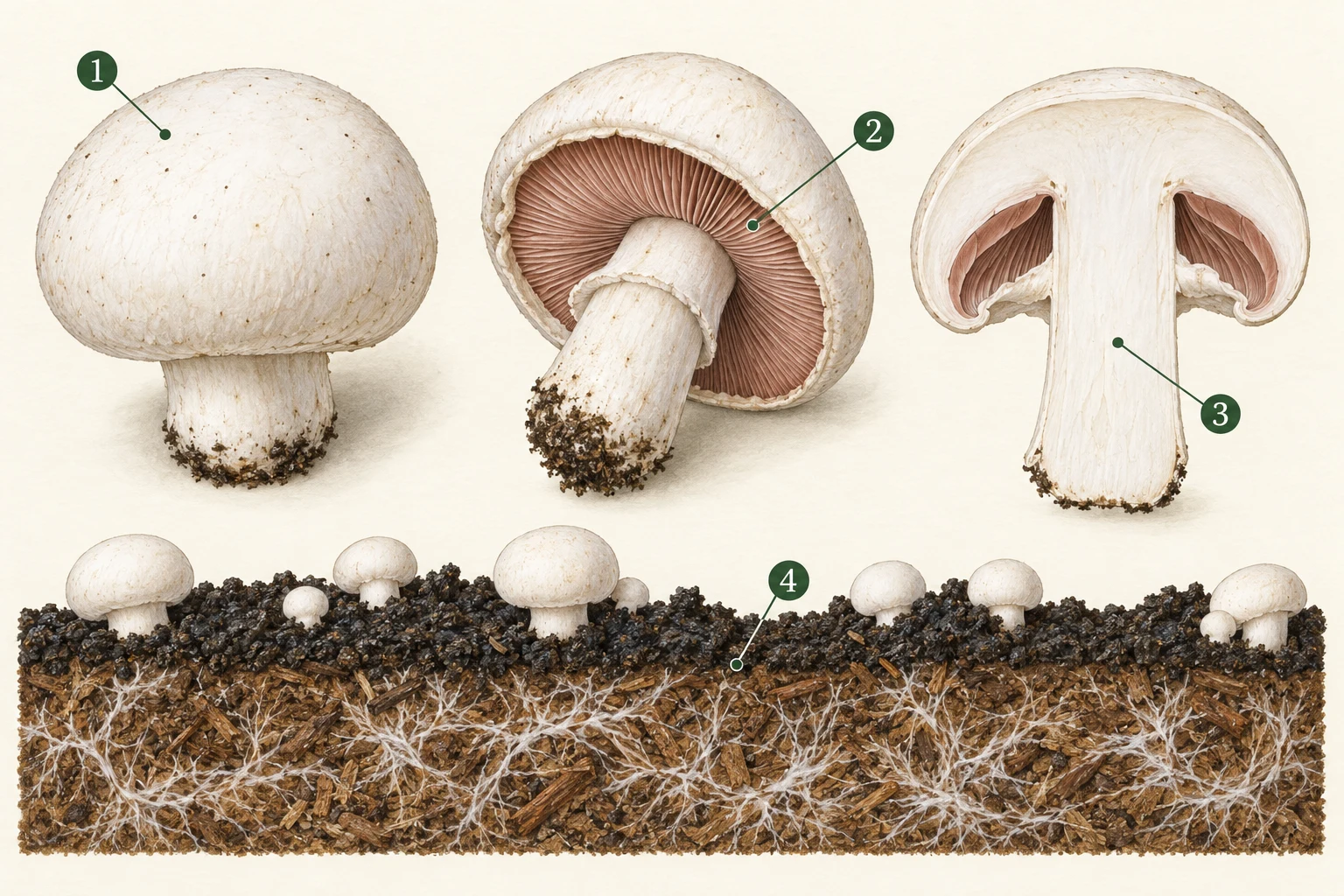
No verified reusable diagnostic photograph is included for this entry. The illustration above explains observation context, not a confirmed disease specimen. Consult the original source figures where available.
02 · Compare
Affected mushrooms and contaminated crop debris can support further fungal growth; handling can carry material between locations.
03 · Check
What confirmation needs: Specialist microscopy distinguishes this fungus from superficially similar growth.
Use the field record and sampling checklist →04 · Respond
These are investigation and containment steps, not a guaranteed cure. Do not eat, sell or distribute suspect material on the strength of a visual match. Do not culture unknown contaminants or experiment with pesticides in a growing room.
05 · Learn
After intervention, compare new affected units, crop condition and inspection results against the same recorded baseline. A lack of visible growth does not, by itself, verify decontamination or food safety.
Read the stage-by-stage prevention plan →Extension disease account; photographs alone are not confirmation.
Penn State Extension · 8 July 2021
Used for: Hairlike growth, cap damage and postharvest occurrence.
Limit: Do not identify Syzygites from a fuzzy photograph alone.
Fungal diseases
Spreading surface growth can overrun casing and fruit bodies. The important clue is progression across the crop, not simply white colour.
Strong Agaricus evidence; additional cultivated hosts are documented in Korean studies. Susceptibility varies with isolate and host.
Signs, checks & response →Competitor moulds
Upright fuzzy growth with tiny dark heads is an observation to record, not a reliable species identification.
Generic contamination differential, not a proven host disease on all crops.
Signs, checks & response →Food & worker safety
Separate when damage started from when someone noticed it. That distinction prevents a storage problem being mislabelled as a growing-room disease.
Harvest, packing, transport and storage; a crop can deteriorate after leaving a healthy room.
Signs, checks & response →