Describe the change
Dense mycelial surface growth or unusually distinct growth sectors.
 MushroomFarming.in
A joint educational initiative by

 ICAR–DMRSolan
Environmental disorders
A dense surface mat is not automatically a contaminant. Separate crop mycelium from advancing foreign growth and review the stage transition.
Organism / cause: Crop mycelial behaviour; strain and environment require investigation
Where this evidence applies: Cased crops; do not apply casing-based terminology to uncased oyster bags.
Picture → observation → next check
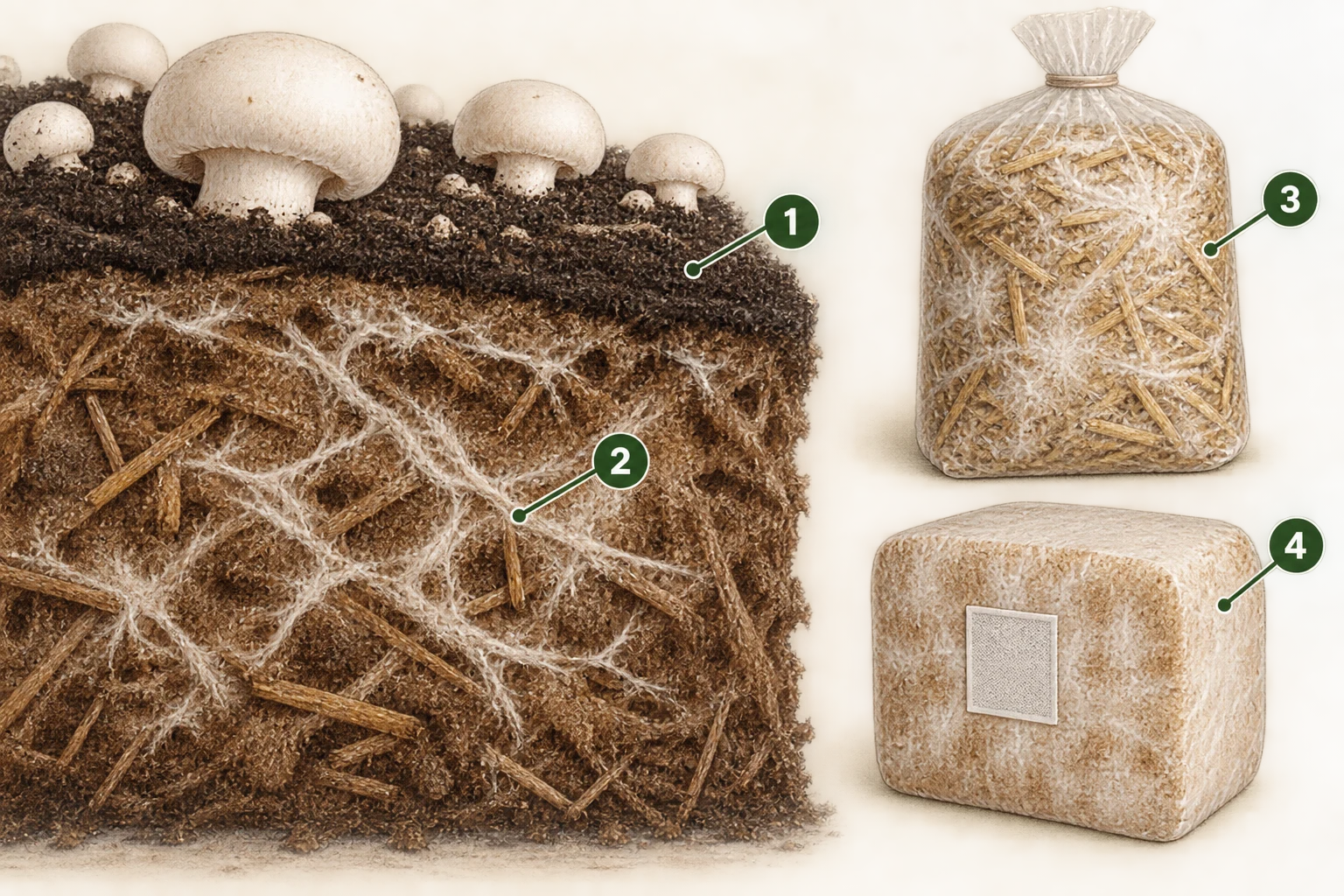
For crops that use casing, trace storage, handling and the casing lot separately from the compost.
Compare the compost lot and preparation history. White growth is not, by itself, proof of either purity or contamination.
Record treatment, cooling, spawning and the first affected position through the intact bag.
Check the filter, seal and batch history without opening suspect material. Normal block appearance depends on crop and stage.
Dense mycelial surface growth or unusually distinct growth sectors.
Cobweb, other white fungi and normal case run.
Record the casing material, moisture, stage and crop-specific induction changes.
A visual match is only a starting point. Examination and crop history distinguish crop mycelium from a competitor; strain-related behaviour may need a comparison trial.
01 · Observe
No verified reusable diagnostic photograph is included for this entry. The illustration above explains observation context, not a confirmed disease specimen. Consult the original source figures where available.
02 · Compare
A strain or shared casing/environment condition can produce a pattern without infection.
03 · Check
What confirmation needs: Examination and crop history distinguish crop mycelium from a competitor; strain-related behaviour may need a comparison trial.
Use the field record and sampling checklist →04 · Respond
These are investigation and containment steps, not a guaranteed cure. Do not eat, sell or distribute suspect material on the strength of a visual match. Do not culture unknown contaminants or experiment with pesticides in a growing room.
05 · Learn
After intervention, compare new affected units, crop condition and inspection results against the same recorded baseline. A lack of visible growth does not, by itself, verify decontamination or food safety.
Read the stage-by-stage prevention plan →Historical abiotic terminology; milky crop association is a casing-process differential.
ICAR–National Research Centre for Mushroom, Solan (now DMR) · 2007
Used for: Historical Indian register of competitor names and abiotic disorders; printed pages 2–43 and 65–69.
Limit: Older names and treatments. Used as a coverage checklist, not a current pesticide label or an image-reuse licence.
Tamil Nadu Agricultural University Agritech Portal · Undated guide
Used for: Milky mushroom bed, casing and routine pest inspection.
Limit: Historic product rates and promised yields are not reproduced.
Fungal diseases
Spreading surface growth can overrun casing and fruit bodies. The important clue is progression across the crop, not simply white colour.
Strong Agaricus evidence; additional cultivated hosts are documented in Korean studies. Susceptibility varies with isolate and host.
Signs, checks & response →Environmental disorders
Counting days is not the same as checking readiness. Poor fruiting can follow immature substrate, an unsuitable transition, culture quality or infection.
Species-specific induction and fruiting systems, including cased and uncased crops.
Signs, checks & response →Competitor moulds
A competitor recorded in Indian mushroom research. Unusual compact fungal bodies in compost deserve identification rather than a “mushroom” label.
Historical Agaricus problem; this is not an edible truffle crop.
Signs, checks & response →