Describe the change
Abnormal compact fungal structures in substrate.
 MushroomFarming.in
A joint educational initiative by

 ICAR–DMRSolan
Competitor moulds
A competitor recorded in Indian mushroom research. Unusual compact fungal bodies in compost deserve identification rather than a “mushroom” label.
Organism / cause: Diehliomyces microsporus
Where this evidence applies: Historical Agaricus problem; this is not an edible truffle crop.
Picture → observation → next check
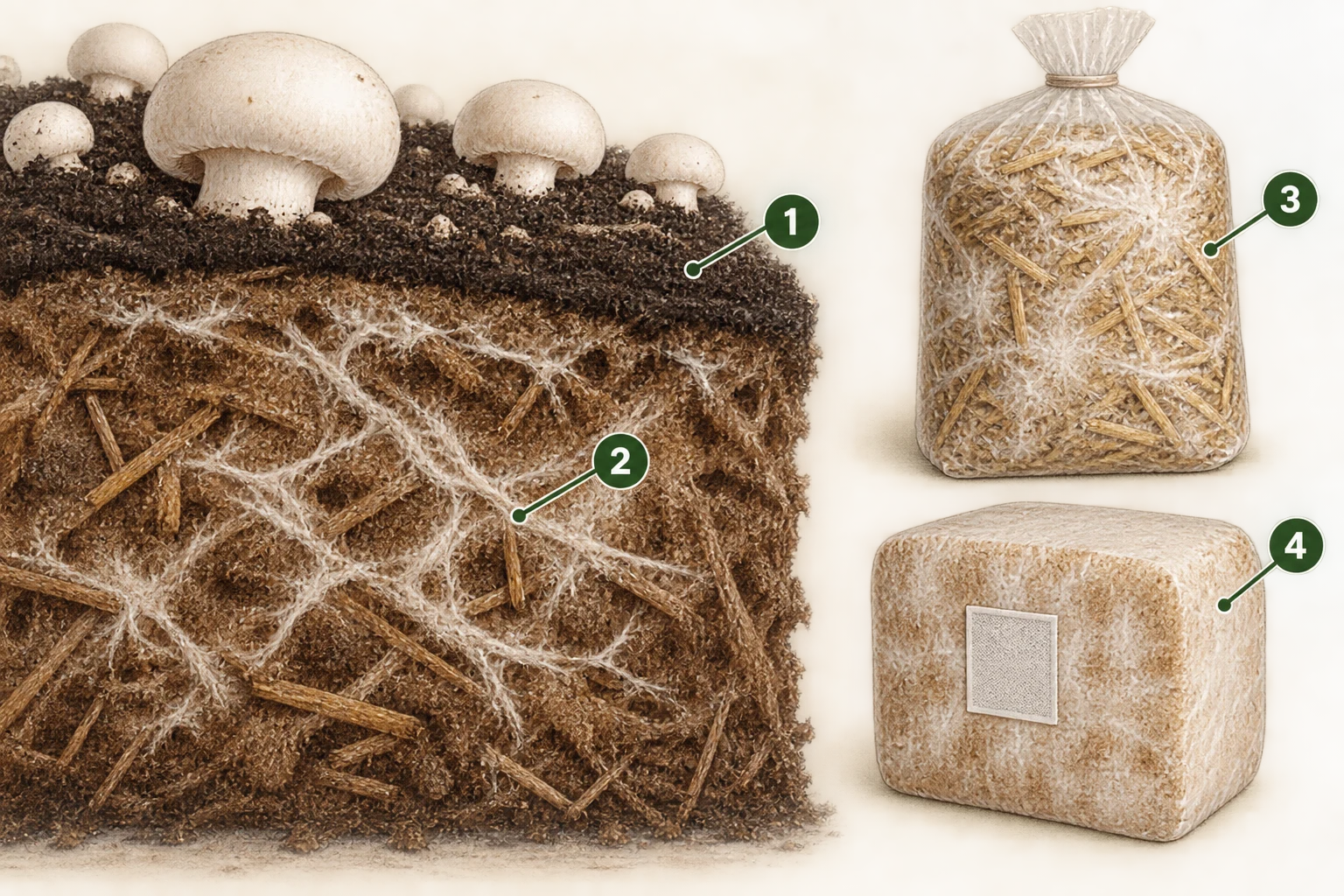
For crops that use casing, trace storage, handling and the casing lot separately from the compost.
Compare the compost lot and preparation history. White growth is not, by itself, proof of either purity or contamination.
Record treatment, cooling, spawning and the first affected position through the intact bag.
Check the filter, seal and batch history without opening suspect material. Normal block appearance depends on crop and stage.
Abnormal compact fungal structures in substrate.
Compost aggregates, mycelial mats and malformed crop tissue.
Photograph the intact structure beside a scale.
A visual match is only a starting point. Specialist examination is required; the historical research title is not enough to diagnose a new case.
01 · Observe
No verified reusable diagnostic photograph is included for this entry. The illustration above explains observation context, not a confirmed disease specimen. Consult the original source figures where available.
02 · Compare
Investigate the origin and handling of compost and casing; the cited bibliographic record alone does not establish a farm-specific transmission route.
03 · Check
What confirmation needs: Specialist examination is required; the historical research title is not enough to diagnose a new case.
Use the field record and sampling checklist →04 · Respond
These are investigation and containment steps, not a guaranteed cure. Do not eat, sell or distribute suspect material on the strength of a visual match. Do not culture unknown contaminants or experiment with pesticides in a growing room.
05 · Learn
After intervention, compare new affected units, crop condition and inspection results against the same recorded baseline. A lack of visible growth does not, by itself, verify decontamination or food safety.
Read the stage-by-stage prevention plan →Historical Indian bibliographic record; this profile deliberately does not invent a treatment from an inaccessible full paper.
Mushroom Research / ICAR journal platform · 1998 issue; digitised 2015
Used for: Historical Indian research record for Diehliomyces in Agaricus cultivation.
Limit: Bibliographic record only; operational management is not inferred from an inaccessible abstract.
ICAR–National Research Centre for Mushroom, Solan (now DMR) · 2007
Used for: Historical Indian register of competitor names and abiotic disorders; printed pages 2–43 and 65–69.
Limit: Older names and treatments. Used as a coverage checklist, not a current pesticide label or an image-reuse licence.
Environmental disorders
A dense surface mat is not automatically a contaminant. Separate crop mycelium from advancing foreign growth and review the stage transition.
Cased crops; do not apply casing-based terminology to uncased oyster bags.
Signs, checks & response →Fungal diseases
A competitive or pathogenic fungus can occupy compost that should be colonised by the mushroom. Green spores may appear after an initially white phase.
Composted Agaricus substrate. Not every green colony is the aggressive epidemic organism.
Signs, checks & response →