Describe the change
Unexpected brown fruit bodies among a normally white crop.
 MushroomFarming.in
A joint educational initiative by

 ICAR–DMRSolan
Viruses & culture health
Virus detection is not automatically proof that the detected virus caused the symptoms. Mixed infections complicate interpretation.
Organism / cause: Multiple Agaricus-associated viruses; interactions matter
Where this evidence applies: Unexpected browning in a normally white strain and associated crop disorders; normal brown strains are not this disease.
Picture → observation → next check
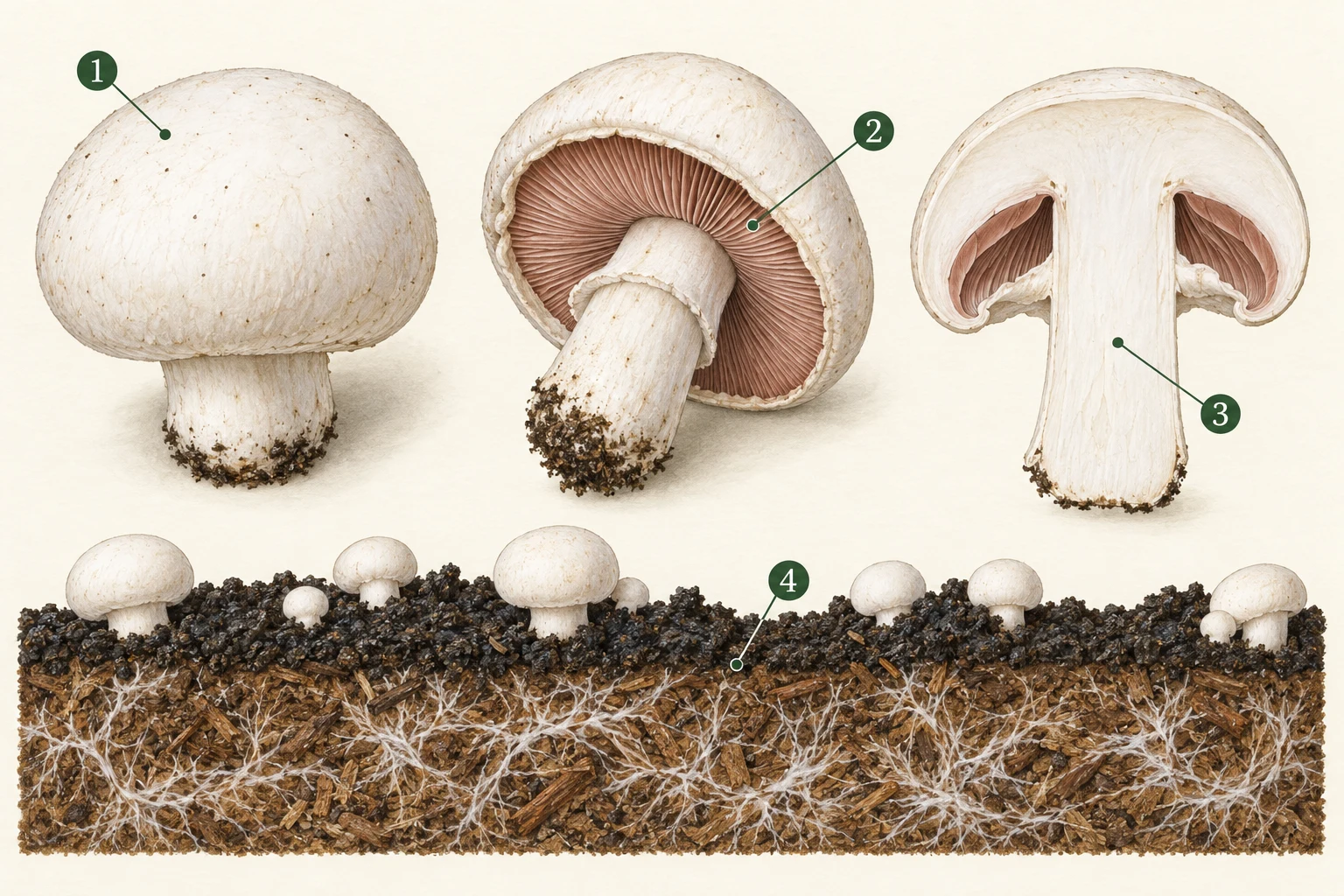
Record a local spot versus whole-cap colour, and whether it was present before picking.
Separate normal maturity-related pigmentation from unusual wetness, exudate or deterioration.
Internal changes can differ from the outside. Obtain sampling instructions before cutting suspect material.
Note whether the change starts in the fruit body, the casing surface or the substrate below.
Unexpected brown fruit bodies among a normally white crop.
A brown strain, cap blotch, bruising and uneven environmental stress.
Confirm cultivar identity before calling a brown mushroom abnormal.
A visual match is only a starting point. Specialist molecular analysis must be interpreted with symptoms, controls and the viruses included in the test.
01 · Observe
No verified reusable diagnostic photograph is included for this entry. The illustration above explains observation context, not a confirmed disease specimen. Consult the original source figures where available.
02 · Compare
Infected fungal material is an exclusion concern; room and spawn history help interpret the pattern.
03 · Check
What confirmation needs: Specialist molecular analysis must be interpreted with symptoms, controls and the viruses included in the test.
Use the field record and sampling checklist →04 · Respond
These are investigation and containment steps, not a guaranteed cure. Do not eat, sell or distribute suspect material on the strength of a visual match. Do not culture unknown contaminants or experiment with pesticides in a growing room.
05 · Learn
After intervention, compare new affected units, crop condition and inspection results against the same recorded baseline. A lack of visible growth does not, by itself, verify decontamination or food safety.
Read the stage-by-stage prevention plan →2015 and 2021 research distinguish symptom associations and complex viral interactions.
mBio · 2021
Used for: Multiple viruses, cap colour and the difference between detection and disease.
Limit: Virus abundance and interactions require molecular evidence. A positive result alone is not a crop-loss forecast.
Applied and Environmental Microbiology · 2015
Used for: Brown-cap disease in white Agaricus strains, distinct from La France.
Limit: Not all browning is viral and symptom-free mushrooms can occur beside affected ones.
Viruses & culture health
Poor cropping and malformed mushrooms can justify virus testing, but neither an image nor a low yield confirms a virus.
Agaricus virus investigation; symptoms are not specific.
Signs, checks & response →Bacterial diseases
Persistent surface wetness can favour bacterial blotch. Managing cap drying means balancing the crop environment, not simply drying the entire room.
Agaricus caps; a brown spot does not establish bacterial identity.
Signs, checks & response →Viruses & culture health
A clean-looking culture can lose desirable fruiting behaviour. Conversely, a failed crop does not prove that the strain has genetically degenerated.
Detailed research cited for Cordyceps militaris; other crop filters indicate a culture-quality investigation, not the same mechanism.
Signs, checks & response →