Describe the change
Loss of expected fruiting or altered culture characteristics.
 MushroomFarming.in
A joint educational initiative by

 ICAR–DMRSolan
Viruses & culture health
A clean-looking culture can lose desirable fruiting behaviour. Conversely, a failed crop does not prove that the strain has genetically degenerated.
Organism / cause: Physiological or genetic change; contamination and viruses are separate possibilities
Where this evidence applies: Detailed research cited for Cordyceps militaris; other crop filters indicate a culture-quality investigation, not the same mechanism.
Picture → observation → next check
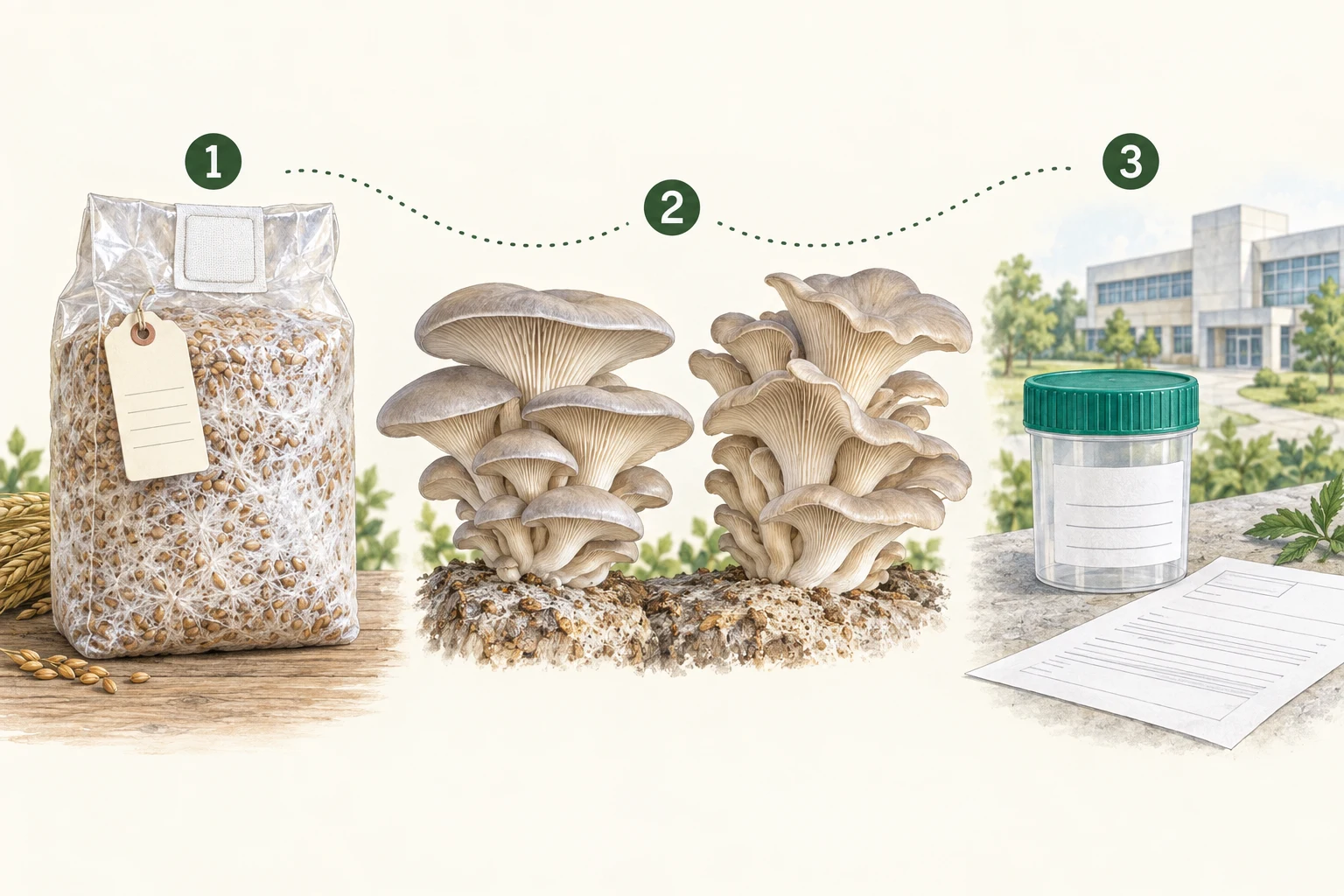
Keep the supplier, species, strain, spawn lot, receipt date and storage history.
Compare the same strain and stage under recorded conditions. Natural strain variation can resemble a disorder.
Contact a qualified laboratory about the diagnostic question, accepted material and shipping instructions.
Loss of expected fruiting or altered culture characteristics.
Wrong environmental trigger, unsuitable substrate or undetected contamination.
Compare a documented reference culture with the suspect line.
A visual match is only a starting point. Controlled comparisons and specialist analysis separate genetic/physiological change from production failure.
01 · Observe
No verified reusable diagnostic photograph is included for this entry. The illustration above explains observation context, not a confirmed disease specimen. Consult the original source figures where available.
02 · Compare
Degeneration is not necessarily contagious. Culture lineage, maintenance and propagation history need examination.
03 · Check
What confirmation needs: Controlled comparisons and specialist analysis separate genetic/physiological change from production failure.
Use the field record and sampling checklist →04 · Respond
These are investigation and containment steps, not a guaranteed cure. Do not eat, sell or distribute suspect material on the strength of a visual match. Do not culture unknown contaminants or experiment with pesticides in a growing room.
05 · Learn
After intervention, compare new affected units, crop condition and inspection results against the same recorded baseline. A lack of visible growth does not, by itself, verify decontamination or food safety.
Read the stage-by-stage prevention plan →Cordyceps mechanistic research; no medicinal-performance claims are made.
Scientific Reports · 2024
Used for: Non-fruiting and altered culture characteristics in compared strains.
Limit: Degeneration is not synonymous with contamination or a mycovirus; no medicinal efficacy claims adopted.
Cornell Small Farms · Undated guide
Used for: Indoor cultivation stages, ventilation, moisture and crop-specific conditions.
Limit: Environmental needs depend on species and strain; no single climate setpoint fits all crops.
Viruses & culture health
Separate three questions: was the spawn viable, was the substrate suitable, and was the inoculation/handling process sound?
Applies from grain spawn to compost, straw and supplemented wood substrates.
Signs, checks & response →Viruses & culture health
A mycovirus can alter crop performance in a susceptible strain, but contamination and growing conditions must also be investigated.
Experimental evidence in particular P. ostreatus and P. pulmonarius strains; not a universal explanation for poor oyster crops.
Signs, checks & response →Environmental disorders
Counting days is not the same as checking readiness. Poor fruiting can follow immature substrate, an unsuitable transition, culture quality or infection.
Species-specific induction and fruiting systems, including cased and uncased crops.
Signs, checks & response →