Describe the change
Slower mycelial growth or abnormal fruiting in documented infected strains.
 MushroomFarming.in
A joint educational initiative by

 ICAR–DMRSolan
Viruses & culture health
A mycovirus can alter crop performance in a susceptible strain, but contamination and growing conditions must also be investigated.
Organism / cause: Pleurotus mycoviruses, including oyster mushroom spherical virus (OMSV)
Where this evidence applies: Experimental evidence in particular P. ostreatus and P. pulmonarius strains; not a universal explanation for poor oyster crops.
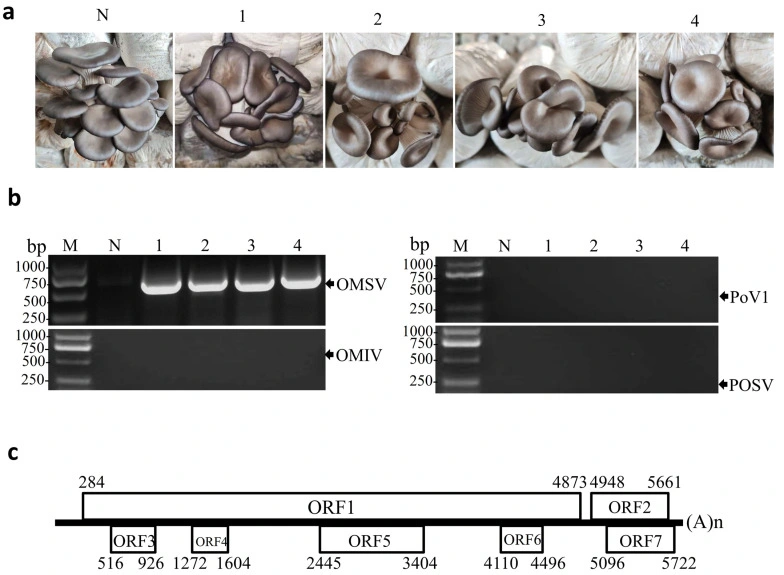
Reference image only. These are published study examples, not photographs of your crop or claims about an Indian outbreak.
Picture → observation → next check
Slower mycelial growth or abnormal fruiting in documented infected strains.
Old or damaged spawn, substrate failure and environmental stress.
Compare independent spawn lots under documented conditions.
A visual match is only a starting point. Virus-specific detection and a meaningful comparison are necessary; visible malformation is insufficient.
01 · Observe
02 · Compare
The virus is associated with fungal material; strain and culture history are central to investigation.
03 · Check
What confirmation needs: Virus-specific detection and a meaningful comparison are necessary; visible malformation is insufficient.
Use the field record and sampling checklist →04 · Respond
These are investigation and containment steps, not a guaranteed cure. Do not eat, sell or distribute suspect material on the strength of a visual match. Do not culture unknown contaminants or experiment with pesticides in a growing room.
05 · Learn
After intervention, compare new affected units, crop condition and inspection results against the same recorded baseline. A lack of visible growth does not, by itself, verify decontamination or food safety.
Read the stage-by-stage prevention plan →2022–2023 strain/host studies; results do not transfer automatically to every Pleurotus species.
Biology · 2022
Used for: OMSV-associated malformation and reduced growth in a tested P. ostreatus strain.
Limit: Preliminary, strain-specific work. Laboratory virus curing is not a DIY crop treatment.
Viruses · 2023
Used for: Experimental transmission to P. pulmonarius, not every tested Pleurotus species.
Limit: Do not generalise a positive study to all oyster strains.
Viruses & culture health
Separate three questions: was the spawn viable, was the substrate suitable, and was the inoculation/handling process sound?
Applies from grain spawn to compost, straw and supplemented wood substrates.
Signs, checks & response →Viruses & culture health
A clean-looking culture can lose desirable fruiting behaviour. Conversely, a failed crop does not prove that the strain has genetically degenerated.
Detailed research cited for Cordyceps militaris; other crop filters indicate a culture-quality investigation, not the same mechanism.
Signs, checks & response →Environmental disorders
Interpret shape against the intended crop. Air exchange, carbon dioxide, light and crowding interact; a single photograph cannot choose a ventilation setpoint.
Species and strain matter: a shape desired in enoki or king oyster may be undesirable in another crop.
Signs, checks & response →