Describe the change
Unexpected stem elongation or poor cap development.
 MushroomFarming.in
A joint educational initiative by

 ICAR–DMRSolan
Environmental disorders
Interpret shape against the intended crop. Air exchange, carbon dioxide, light and crowding interact; a single photograph cannot choose a ventilation setpoint.
Organism / cause: Crop environment, not automatically an infectious agent
Where this evidence applies: Species and strain matter: a shape desired in enoki or king oyster may be undesirable in another crop.
Picture → observation → next check
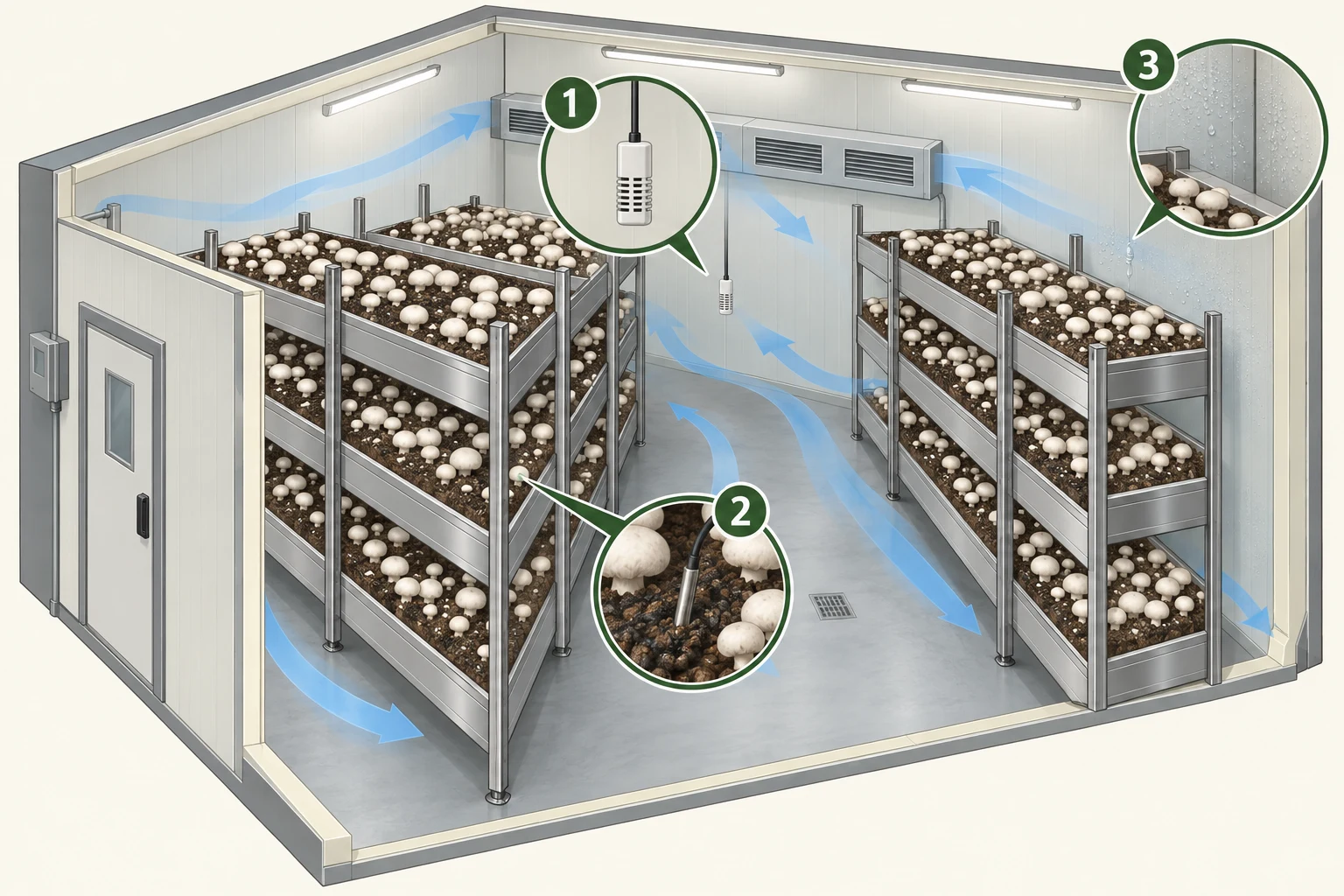
Use time-stamped readings at representative positions. One sensor can miss a rack-level or doorway difference.
Record substrate temperature separately from room air using the farm’s appropriate hygienic measurement procedure.
Map condensation, leaks and wet crop zones. Compare the pattern with watering and temperature changes.
Unexpected stem elongation or poor cap development.
Normal strain morphology, deliberate crop shaping and some disease-associated malformations.
Identify the species, strain and intended product form.
A visual match is only a starting point. A reproducible relationship to measured conditions supports an environmental explanation; persistent unexplained changes need further investigation.
01 · Observe
No verified reusable diagnostic photograph is included for this entry. The illustration above explains observation context, not a confirmed disease specimen. Consult the original source figures where available.
02 · Compare
A shared room condition can affect many units together without any infection passing between them.
03 · Check
What confirmation needs: A reproducible relationship to measured conditions supports an environmental explanation; persistent unexplained changes need further investigation.
Use the field record and sampling checklist →04 · Respond
These are investigation and containment steps, not a guaranteed cure. Do not eat, sell or distribute suspect material on the strength of a visual match. Do not culture unknown contaminants or experiment with pesticides in a growing room.
05 · Learn
After intervention, compare new affected units, crop condition and inspection results against the same recorded baseline. A lack of visible growth does not, by itself, verify decontamination or food safety.
Read the stage-by-stage prevention plan →Cultivation-stage guidance; no universal carbon-dioxide or light threshold is supplied.
Cornell Small Farms · Undated guide
Used for: Indoor cultivation stages, ventilation, moisture and crop-specific conditions.
Limit: Environmental needs depend on species and strain; no single climate setpoint fits all crops.
Environmental disorders
Counting days is not the same as checking readiness. Poor fruiting can follow immature substrate, an unsuitable transition, culture quality or infection.
Species-specific induction and fruiting systems, including cased and uncased crops.
Signs, checks & response →Viruses & culture health
A mycovirus can alter crop performance in a susceptible strain, but contamination and growing conditions must also be investigated.
Experimental evidence in particular P. ostreatus and P. pulmonarius strains; not a universal explanation for poor oyster crops.
Signs, checks & response →Environmental disorders
A room-air reading can miss a hot substrate core. Equally, a cold chain suitable for button mushrooms must not be assumed suitable for paddy straw.
Substrate, crop and storage temperatures must be interpreted separately for each species.
Signs, checks & response →