Describe the change
Weak or uneven growth, missing pin areas and abnormal fruit bodies.
 MushroomFarming.in
A joint educational initiative by

 ICAR–DMRSolan
Viruses & culture health
Poor cropping and malformed mushrooms can justify virus testing, but neither an image nor a low yield confirms a virus.
Organism / cause: La France-associated mycovirus complex in Agaricus
Where this evidence applies: Agaricus virus investigation; symptoms are not specific.
Picture → observation → next check
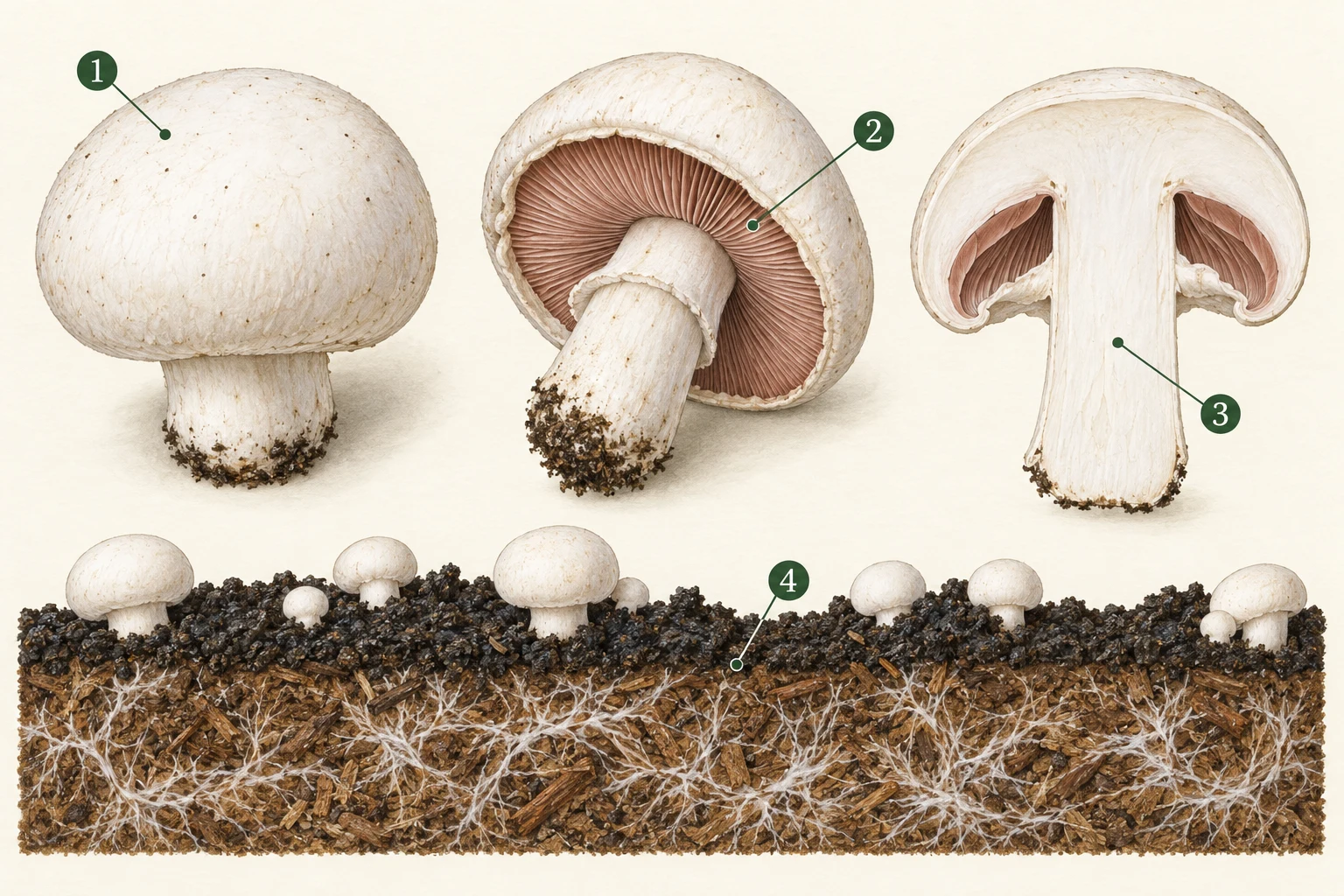
Record a local spot versus whole-cap colour, and whether it was present before picking.
Separate normal maturity-related pigmentation from unusual wetness, exudate or deterioration.
Internal changes can differ from the outside. Obtain sampling instructions before cutting suspect material.
Note whether the change starts in the fruit body, the casing surface or the substrate below.
Weak or uneven growth, missing pin areas and abnormal fruit bodies.
Environmental stress, compost failure and mummy syndrome.
Trace spawn lots and affected rooms over successive crops.
A visual match is only a starting point. A relevant molecular test and compatible crop history are needed; a negative limited panel does not exclude every virus.
01 · Observe
No verified reusable diagnostic photograph is included for this entry. The illustration above explains observation context, not a confirmed disease specimen. Consult the original source figures where available.
02 · Compare
Infected mycelium and spores can carry infection; crop residues and mixing old and new production are important exclusion concerns.
03 · Check
What confirmation needs: A relevant molecular test and compatible crop history are needed; a negative limited panel does not exclude every virus.
Use the field record and sampling checklist →04 · Respond
These are investigation and containment steps, not a guaranteed cure. Do not eat, sell or distribute suspect material on the strength of a visual match. Do not culture unknown contaminants or experiment with pesticides in a growing room.
05 · Learn
After intervention, compare new affected units, crop condition and inspection results against the same recorded baseline. A lack of visible growth does not, by itself, verify decontamination or food safety.
Read the stage-by-stage prevention plan →Established virus syndrome; diagnosis requires more than its visual checklist.
Penn State Extension · 8 July 2021
Used for: Mummy and La France recognition and exclusion.
Limit: Symptoms overlap with stress. Broad historical bacterial attribution does not establish a unique mummy pathogen.
mBio · 2021
Used for: Multiple viruses, cap colour and the difference between detection and disease.
Limit: Virus abundance and interactions require molecular evidence. A positive result alone is not a crop-loss forecast.
Viruses & culture health
Virus detection is not automatically proof that the detected virus caused the symptoms. Mixed infections complicate interpretation.
Unexpected browning in a normally white strain and associated crop disorders; normal brown strains are not this disease.
Signs, checks & response →Bacterial diseases
Mummy describes a recognisable crop syndrome, but the label should not hide uncertainty about cause.
Agaricus production syndrome.
Signs, checks & response →Viruses & culture health
Separate three questions: was the spawn viable, was the substrate suitable, and was the inoculation/handling process sound?
Applies from grain spawn to compost, straw and supplemented wood substrates.
Signs, checks & response →