Describe the change
Unusual spreading masses followed by crusts or tiny fruiting structures.
 MushroomFarming.in
A joint educational initiative by

 ICAR–DMRSolan
Competitor moulds
Slime moulds belong outside the true fungi. They can cover production surfaces or fruit bodies, but interpretation requires more than appearance.
Organism / cause: Myxomycetes / myxogastrids; not true fungi
Where this evidence applies: Reported on several cultivated mushrooms and substrates; presence does not automatically mean parasitic disease.
Picture → observation → next check
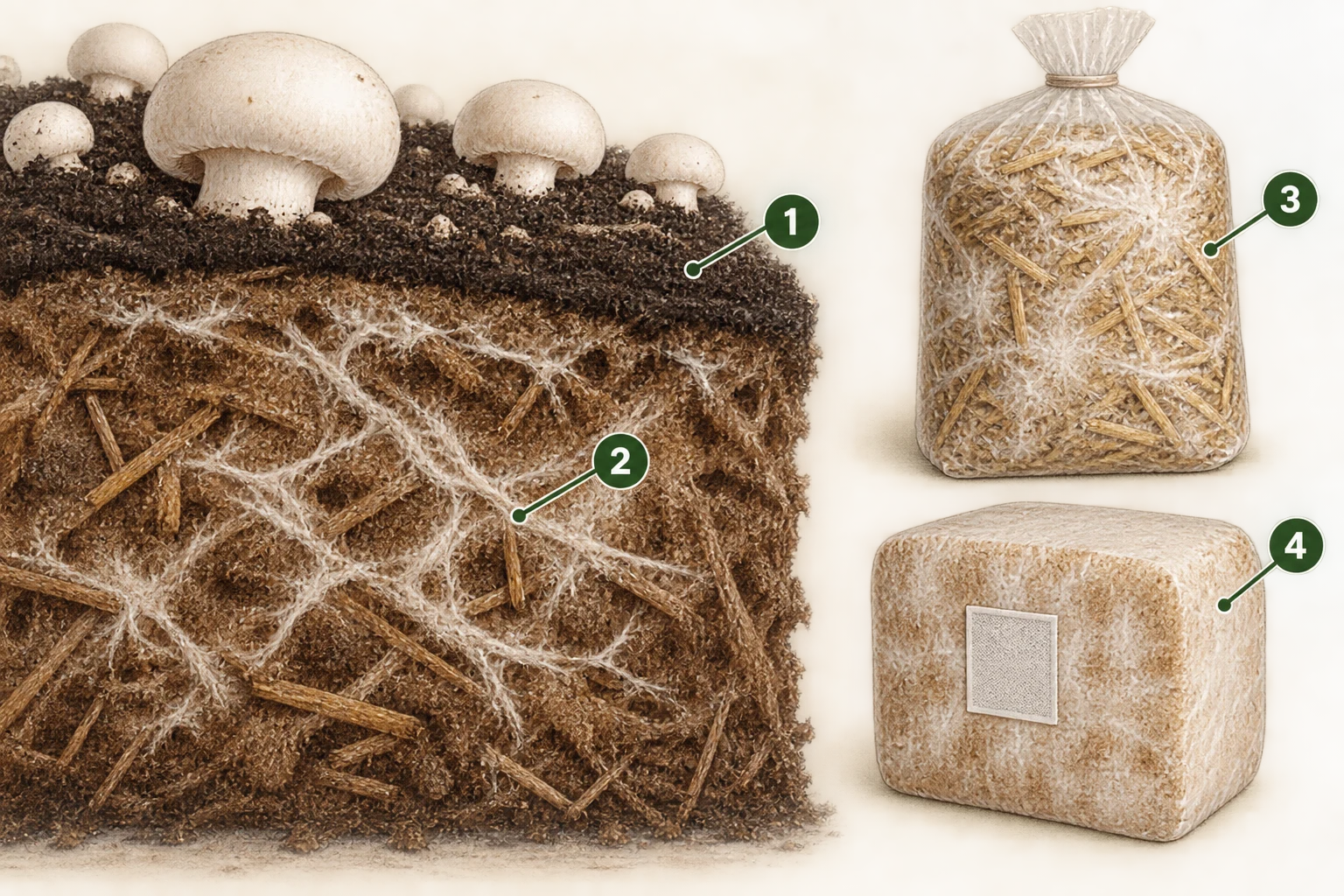
For crops that use casing, trace storage, handling and the casing lot separately from the compost.
Compare the compost lot and preparation history. White growth is not, by itself, proof of either purity or contamination.
Record treatment, cooling, spawning and the first affected position through the intact bag.
Check the filter, seal and batch history without opening suspect material. Normal block appearance depends on crop and stage.
Unusual spreading masses followed by crusts or tiny fruiting structures.
Fungal colonies, mineral residues and insect deposits.
Take dated photographs of the same undisturbed area.
A visual match is only a starting point. Specialist examination can separate slime mould from a true fungus and assess whether it caused the loss.
01 · Observe
No verified reusable diagnostic photograph is included for this entry. The illustration above explains observation context, not a confirmed disease specimen. Consult the original source figures where available.
02 · Compare
Moist organic environments can support these organisms; local ecology and substrate exposure matter.
03 · Check
What confirmation needs: Specialist examination can separate slime mould from a true fungus and assess whether it caused the loss.
Use the field record and sampling checklist →04 · Respond
These are investigation and containment steps, not a guaranteed cure. Do not eat, sell or distribute suspect material on the strength of a visual match. Do not culture unknown contaminants or experiment with pesticides in a growing room.
05 · Learn
After intervention, compare new affected units, crop condition and inspection results against the same recorded baseline. A lack of visible growth does not, by itself, verify decontamination or food safety.
Read the stage-by-stage prevention plan →2024 literature review; reports differ by organism, host and country.
Frontiers in Plant Science · 2024
Used for: Records across shiitake, Auricularia, Hericium, maitake and other crops.
Limit: Review. These organisms are not true fungi; their presence is not automatically proof of parasitism.
Competitor moulds
Upright fuzzy growth with tiny dark heads is an observation to record, not a reliable species identification.
Generic contamination differential, not a proven host disease on all crops.
Signs, checks & response →Fungal diseases
A reported Trichoderma-associated rot needs to be separated from natural wood-ear pigmentation, drying and general spoilage.
Confirmed in a particular A. cornea production study; not every brown Auricularia is diseased.
Signs, checks & response →