Describe the change
Abnormal browning accompanied by deterioration.
 MushroomFarming.in
A joint educational initiative by

 ICAR–DMRSolan
Fungal diseases
A reported Trichoderma-associated rot needs to be separated from natural wood-ear pigmentation, drying and general spoilage.
Organism / cause: Trichoderma pleuroticola in the cited Auricularia cornea study
Where this evidence applies: Confirmed in a particular A. cornea production study; not every brown Auricularia is diseased.
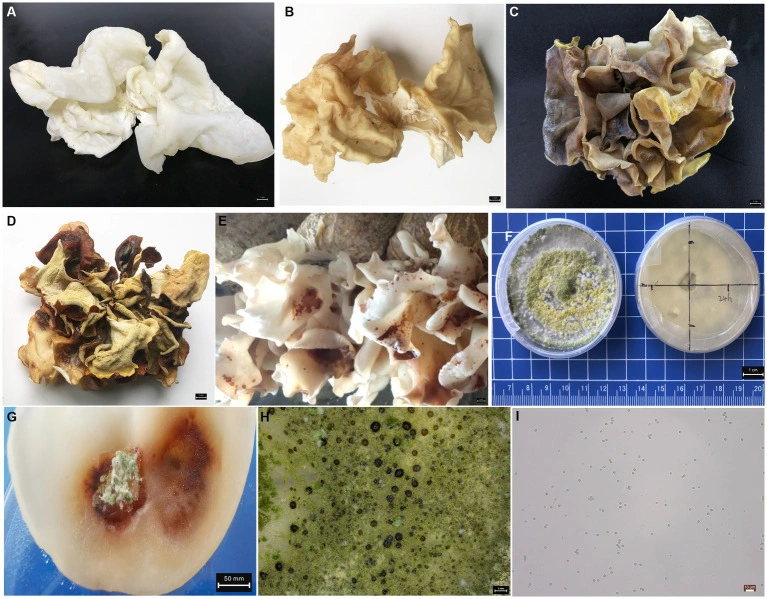
Reference image only. These are published study examples, not photographs of your crop or claims about an Indian outbreak.
Picture → observation → next check
Abnormal browning accompanied by deterioration.
Normal brown pigmentation.
Compare a healthy same-strain fruit body under the same light.
A visual match is only a starting point. Identification and evidence of pathogenicity established the organism in the study; a local case still needs examination.
01 · Observe
02 · Compare
The study concerns an invasive production contaminant; the introduction route on a different farm needs investigation.
03 · Check
What confirmation needs: Identification and evidence of pathogenicity established the organism in the study; a local case still needs examination.
Use the field record and sampling checklist →04 · Respond
These are investigation and containment steps, not a guaranteed cure. Do not eat, sell or distribute suspect material on the strength of a visual match. Do not culture unknown contaminants or experiment with pesticides in a growing room.
05 · Learn
After intervention, compare new affected units, crop condition and inspection results against the same recorded baseline. A lack of visible growth does not, by itself, verify decontamination or food safety.
Read the stage-by-stage prevention plan →2023 host-specific research, not a universal wood-ear diagnosis.
Frontiers in Microbiology · 2023
Used for: Auricularia cornea brown rot and confirmed pathogen in the study.
Limit: Do not extend one host’s diagnosis to all wood-ear species. CC BY; experimental and natural panels must be distinguished.
Fungal diseases
This is primarily a disease pattern in the growing substrate/mycelium, not simply a mark on a harvested wood-ear fruit body.
Published Auricularia research from China; check the actual species and strain being grown.
Signs, checks & response →Food & worker safety
Separate when damage started from when someone noticed it. That distinction prevents a storage problem being mislabelled as a growing-room disease.
Harvest, packing, transport and storage; a crop can deteriorate after leaving a healthy room.
Signs, checks & response →Competitor moulds
Slime moulds belong outside the true fungi. They can cover production surfaces or fruit bodies, but interpretation requires more than appearance.
Reported on several cultivated mushrooms and substrates; presence does not automatically mean parasitic disease.
Signs, checks & response →