Describe the change
White/brown plaster-like colonies, olive growth or pink/red patches.
 MushroomFarming.in
A joint educational initiative by

 ICAR–DMRSolan
Competitor moulds
Old farm manuals use colour and texture names. They are useful search terms, but a visible colony rarely supports a species-level diagnosis.
Organism / cause: Historical descriptive groups; see the identification register on the Sources & limits page
Where this evidence applies: A historical-name register, not proof that every organism occurs on every listed crop.
Picture → observation → next check
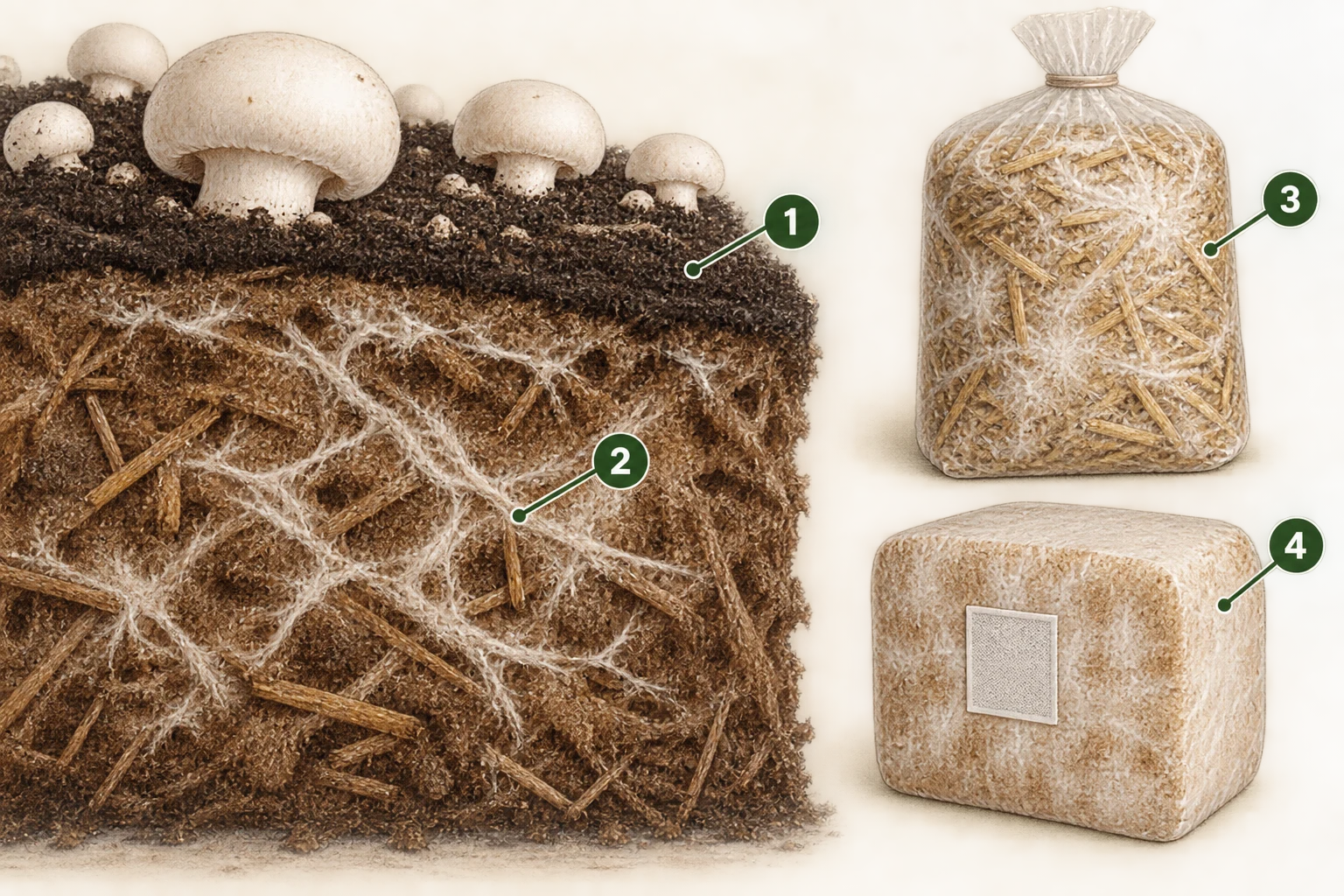
For crops that use casing, trace storage, handling and the casing lot separately from the compost.
Compare the compost lot and preparation history. White growth is not, by itself, proof of either purity or contamination.
Record treatment, cooling, spawning and the first affected position through the intact bag.
Check the filter, seal and batch history without opening suspect material. Normal block appearance depends on crop and stage.
White/brown plaster-like colonies, olive growth or pink/red patches.
Normal crop mycelium, pigmented metabolites and unrelated moulds.
Record colour under neutral light and where the colony starts.
A visual match is only a starting point. Macroscopic names are preliminary. A qualified laboratory may need microscopy or sequencing to identify the organism.
01 · Observe
No verified reusable diagnostic photograph is included for this entry. The illustration above explains observation context, not a confirmed disease specimen. Consult the original source figures where available.
02 · Compare
Competitors exploit available substrate; process failure and contamination after treatment must be examined separately.
03 · Check
What confirmation needs: Macroscopic names are preliminary. A qualified laboratory may need microscopy or sequencing to identify the organism.
Use the field record and sampling checklist →04 · Respond
These are investigation and containment steps, not a guaranteed cure. Do not eat, sell or distribute suspect material on the strength of a visual match. Do not culture unknown contaminants or experiment with pesticides in a growing room.
05 · Learn
After intervention, compare new affected units, crop condition and inspection results against the same recorded baseline. A lack of visible growth does not, by itself, verify decontamination or food safety.
Read the stage-by-stage prevention plan →Historic Indian manual used for names only; minor competitors have less current host-specific evidence.
ICAR–National Research Centre for Mushroom, Solan (now DMR) · 2007
Used for: Historical Indian register of competitor names and abiotic disorders; printed pages 2–43 and 65–69.
Limit: Older names and treatments. Used as a coverage checklist, not a current pesticide label or an image-reuse licence.
ICAR–DMR Solan · Historical technical bulletin
Used for: Volvariella cultivation, competitors and crop-specific handling.
Limit: Do not transfer button-mushroom climate, cold-storage or chemical recipes to this warm-growing species.
Competitor moulds
Rapidly spreading orange growth is an operational contamination problem. A history of food use for selected Neurospora strains does not make an unknown colony safe.
Generic substrate-contamination differential; not a confirmed disease report for every crop listed.
Signs, checks & response →Competitor moulds
Green, blue-green or dark growth is not automatically Trichoderma. Neither harmlessness nor toxin production can be established from its colour.
Raw-material, spawn, substrate and storage contamination differential across production systems.
Signs, checks & response →Environmental disorders
Poorly colonised substrate can be a process failure before a competitor arrives. Treating the visible late mould may miss the original cause.
Ammonia/conditioning is especially relevant to button compost. Bag substrates use different preparation systems.
Signs, checks & response →