Describe the change
Unexplained mycelial deterioration or wet, poorly productive patches.
 MushroomFarming.in
A joint educational initiative by

 ICAR–DMRSolan
Pests & vectors
Crop decline in wet substrate may justify examination for nematodes, but the presence of nematodes alone does not establish the cause.
Organism / cause: Mycelium-feeding, bacteria-feeding and insect-parasitic groups
Where this evidence applies: Nematode function depends on identity; not all are harmful to mushrooms.
Picture → observation → next check
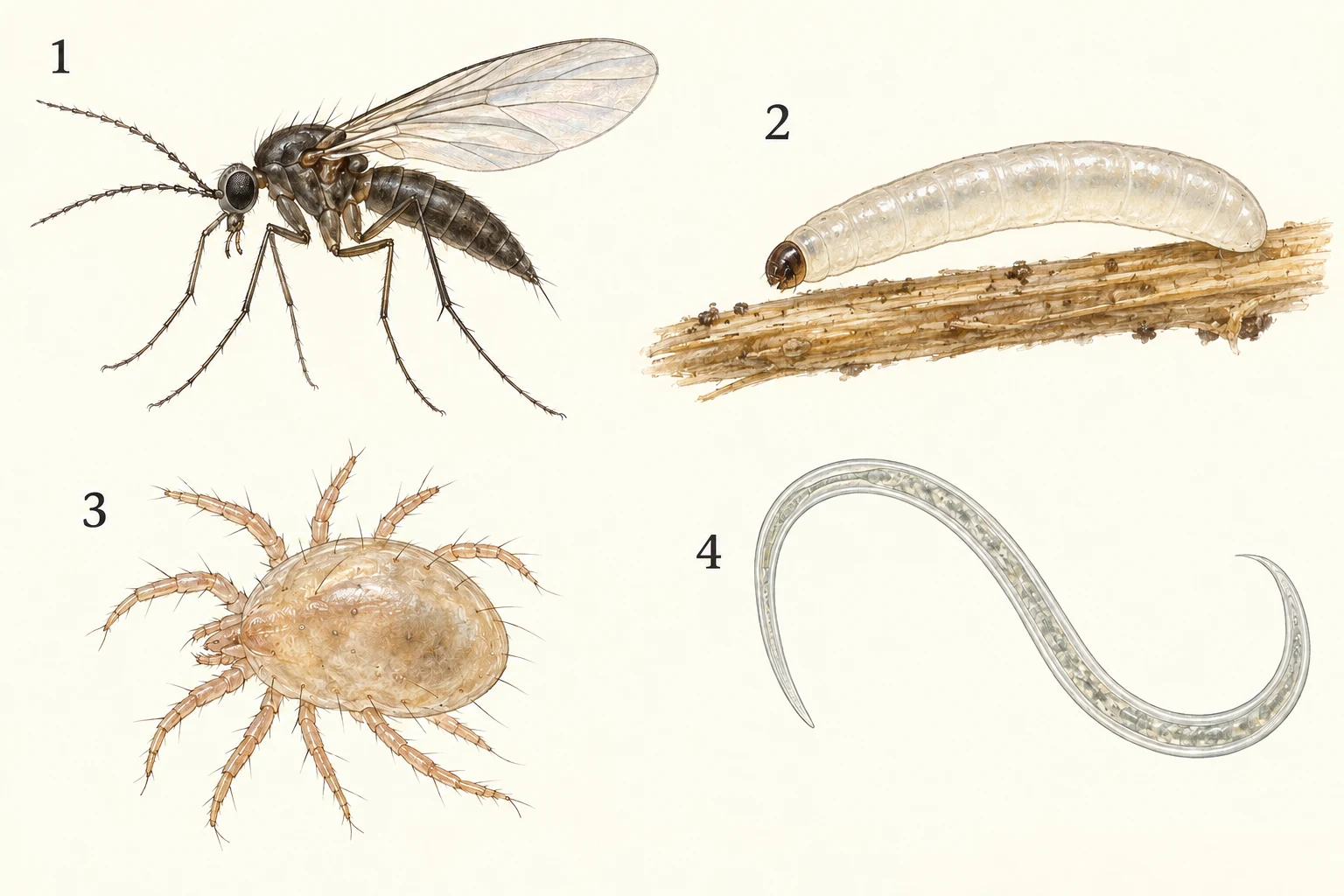
Record where it is seen and whether it walks, runs or flies. Adult identification and larval damage are separate observations.
A gnat-like legless larva is shown. Do not assume that every pale organism in substrate is the same pest.
Mites may feed on crop tissue, mould or other organisms. Presence alone is not proof of crop damage.
Nematode groups have different roles. Microscopic examination and specialist identification may be necessary.
Unexplained mycelial deterioration or wet, poorly productive patches.
Bacterial deterioration, waterlogging and poorly conditioned substrate.
Ask whether identified nematodes feed on mushroom mycelium, bacteria or insects.
A visual match is only a starting point. Microscopic identification and abundance must be interpreted alongside crop damage.
01 · Observe
No verified reusable diagnostic photograph is included for this entry. The illustration above explains observation context, not a confirmed disease specimen. Consult the original source figures where available.
02 · Compare
Contaminated water, substrate or equipment may introduce organisms; investigate the identified group’s route.
03 · Check
What confirmation needs: Microscopic identification and abundance must be interpreted alongside crop damage.
Use the field record and sampling checklist →04 · Respond
These are investigation and containment steps, not a guaranteed cure. Do not eat, sell or distribute suspect material on the strength of a visual match. Do not culture unknown contaminants or experiment with pesticides in a growing room.
05 · Learn
After intervention, compare new affected units, crop condition and inspection results against the same recorded baseline. A lack of visible growth does not, by itself, verify decontamination or food safety.
Read the stage-by-stage prevention plan →IPM sources explicitly separate harmful and beneficial functions.
Teagasc · Historical report, pre-2005 pesticide context
Used for: Functional distinctions among flies, pepper mites, predators and eelworms.
Limit: Old pesticide registrations are obsolete as operational guidance. Use for biology, not dosing.
Penn State Extension · 19 March 2026
Used for: New field research distinguishes S. carpocapsae against phorids from S. feltiae against sciarids.
Limit: US trials, not a validated Indian application protocol, product approval or guaranteed result.
ICAR–DMR Solan · Undated
Used for: Indian pest groups, farm hygiene and observation questions.
Limit: Historical chemical advice is not reproduced. Identification and management depend on the crop and organism.
Pests & vectors
Identification can prevent the removal of useful organisms. Biological control still needs the correct pest, product, conditions and local legal status.
A decision guide, not an instruction to release an unapproved organism.
Signs, checks & response →Environmental disorders
Poorly colonised substrate can be a process failure before a competitor arrives. Treating the visible late mould may miss the original cause.
Ammonia/conditioning is especially relevant to button compost. Bag substrates use different preparation systems.
Signs, checks & response →Environmental disorders
Room humidity does not tell the whole water story. A crop can have wet caps in one rack zone and drying injury in another.
All production systems, with different crop-specific tolerances.
Signs, checks & response →