Describe the change
Yellow growth or deposits associated with weak mushroom mycelium.
 MushroomFarming.in
A joint educational initiative by

 ICAR–DMRSolan
Competitor moulds
An Indian seasonal-production problem worth investigating when yellow colonies accompany poor compost colonisation.
Organism / cause: Myceliophthora lutea and Sepedonium species in Indian reports
Where this evidence applies: Agaricus compost; “yellow mould” is a group description, not one confirmed organism.
Picture → observation → next check
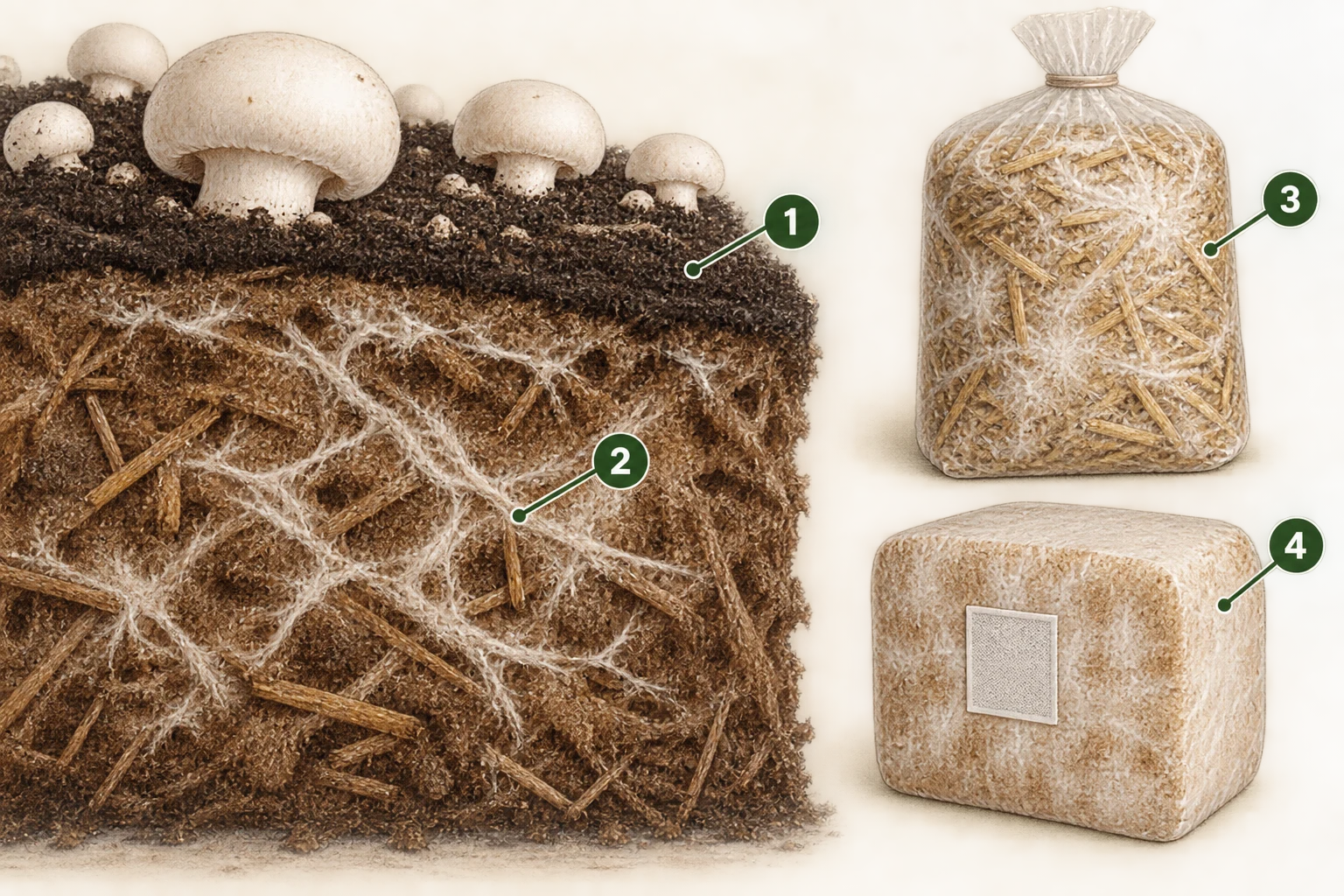
For crops that use casing, trace storage, handling and the casing lot separately from the compost.
Compare the compost lot and preparation history. White growth is not, by itself, proof of either purity or contamination.
Record treatment, cooling, spawning and the first affected position through the intact bag.
Check the filter, seal and batch history without opening suspect material. Normal block appearance depends on crop and stage.
Yellow growth or deposits associated with weak mushroom mycelium.
Normal compost colour, yellow metabolites and other moulds.
Compare affected and unaffected compost lots.
A visual match is only a starting point. Colour is insufficient to distinguish the organisms included under this historical label.
01 · Observe
No verified reusable diagnostic photograph is included for this entry. The illustration above explains observation context, not a confirmed disease specimen. Consult the original source figures where available.
02 · Compare
A compost-associated investigation should include preparation, conditioning, storage and filling records.
03 · Check
What confirmation needs: Colour is insufficient to distinguish the organisms included under this historical label.
Use the field record and sampling checklist →04 · Respond
These are investigation and containment steps, not a guaranteed cure. Do not eat, sell or distribute suspect material on the strength of a visual match. Do not culture unknown contaminants or experiment with pesticides in a growing room.
05 · Learn
After intervention, compare new affected units, crop condition and inspection results against the same recorded baseline. A lack of visible growth does not, by itself, verify decontamination or food safety.
Read the stage-by-stage prevention plan →Indian research abstract reviewed; not a current treatment protocol.
Journal of Mycology and Plant Pathology; ICAR–DMR authors · 2019
Used for: Research abstract identifies Myceliophthora and Sepedonium organisms in seasonal button production.
Limit: Abstract reviewed, not the full study. Experimental crop losses are not predictions for a reader’s farm; no chemistry adopted.
Fungal diseases
A competitive or pathogenic fungus can occupy compost that should be colonised by the mushroom. Green spores may appear after an initially white phase.
Composted Agaricus substrate. Not every green colony is the aggressive epidemic organism.
Signs, checks & response →Environmental disorders
Poorly colonised substrate can be a process failure before a competitor arrives. Treating the visible late mould may miss the original cause.
Ammonia/conditioning is especially relevant to button compost. Bag substrates use different preparation systems.
Signs, checks & response →