Describe the change
Pale brown patches becoming darker or depressed.
 MushroomFarming.in
A joint educational initiative by

 ICAR–DMRSolan
Bacterial diseases
Blotching in oyster needs its own host context. Different strains reacted differently to a controlled bacterial challenge.
Organism / cause: Pseudomonas tolaasii in the cited Pleurotus challenge study
Where this evidence applies: Detailed evidence here concerns tested P. ostreatus, P. pulmonarius and P. cf. floridanus strains. King oyster is a differential, not a claim that this trial tested it.
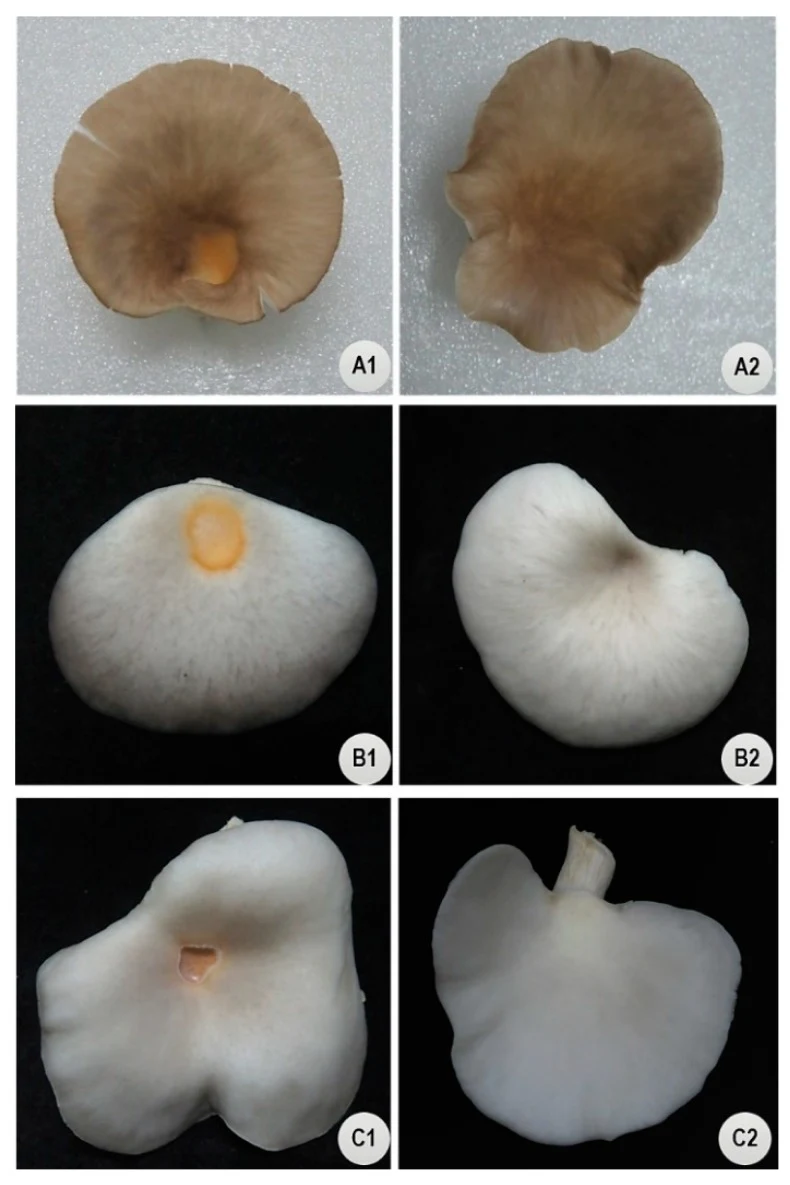
Reference image only. These are published study examples, not photographs of your crop or claims about an Indian outbreak.
Picture → observation → next check
Pale brown patches becoming darker or depressed.
Dry edges, bruising, age-related yellowing and other bacterial rots.
Identify the actual Pleurotus species and strain.
A visual match is only a starting point. Specialist examination is needed; photographed challenge symptoms do not prove infection in a reader’s farm.
01 · Observe
02 · Compare
Water films, contaminated handling and crop contact warrant investigation; experimental inoculation is not a normal farm exposure.
03 · Check
What confirmation needs: Specialist examination is needed; photographed challenge symptoms do not prove infection in a reader’s farm.
Use the field record and sampling checklist →04 · Respond
These are investigation and containment steps, not a guaranteed cure. Do not eat, sell or distribute suspect material on the strength of a visual match. Do not culture unknown contaminants or experiment with pesticides in a growing room.
05 · Learn
After intervention, compare new affected units, crop condition and inspection results against the same recorded baseline. A lack of visible growth does not, by itself, verify decontamination or food safety.
Read the stage-by-stage prevention plan →Controlled strain-screening study, not a claim of field immunity or a guaranteed resistant commercial strain.
Okorley et al., Pathogens 8:227 · 2019
Used for: Experimental inoculation and strain-dependent responses; Figure 1 infected and control fruit bodies.
Limit: Controlled challenge photographs are not natural farm incidence or proof of immunity. CC BY 4.0.
Bacterial diseases
Persistent surface wetness can favour bacterial blotch. Managing cap drying means balancing the crop environment, not simply drying the entire room.
Agaricus caps; a brown spot does not establish bacterial identity.
Signs, checks & response →Bacterial diseases
Wet, collapsing tissue is a reason to separate produce and investigate timing. It can be a primary infection or secondary decay after injury.
Symptom differential. The cited Burkholderia evidence includes Agaricus bitorquis; it is not the cause of every soft rot on this crop list.
Signs, checks & response →Environmental disorders
Room humidity does not tell the whole water story. A crop can have wet caps in one rack zone and drying injury in another.
All production systems, with different crop-specific tolerances.
Signs, checks & response →