Describe the change
Visible airborne dust or spores during work.
 MushroomFarming.in
A joint educational initiative by

 ICAR–DMRSolan
Food & worker safety
Removing a mouldy crop must not create a dust cloud. The work method and source control are central to protecting people.
Organism / cause: Bioaerosols and organic dust; this is not a personal medical diagnosis
Where this evidence applies: Substrate preparation, harvesting, waste handling and cleaning can create different exposures.
Picture → observation → next check
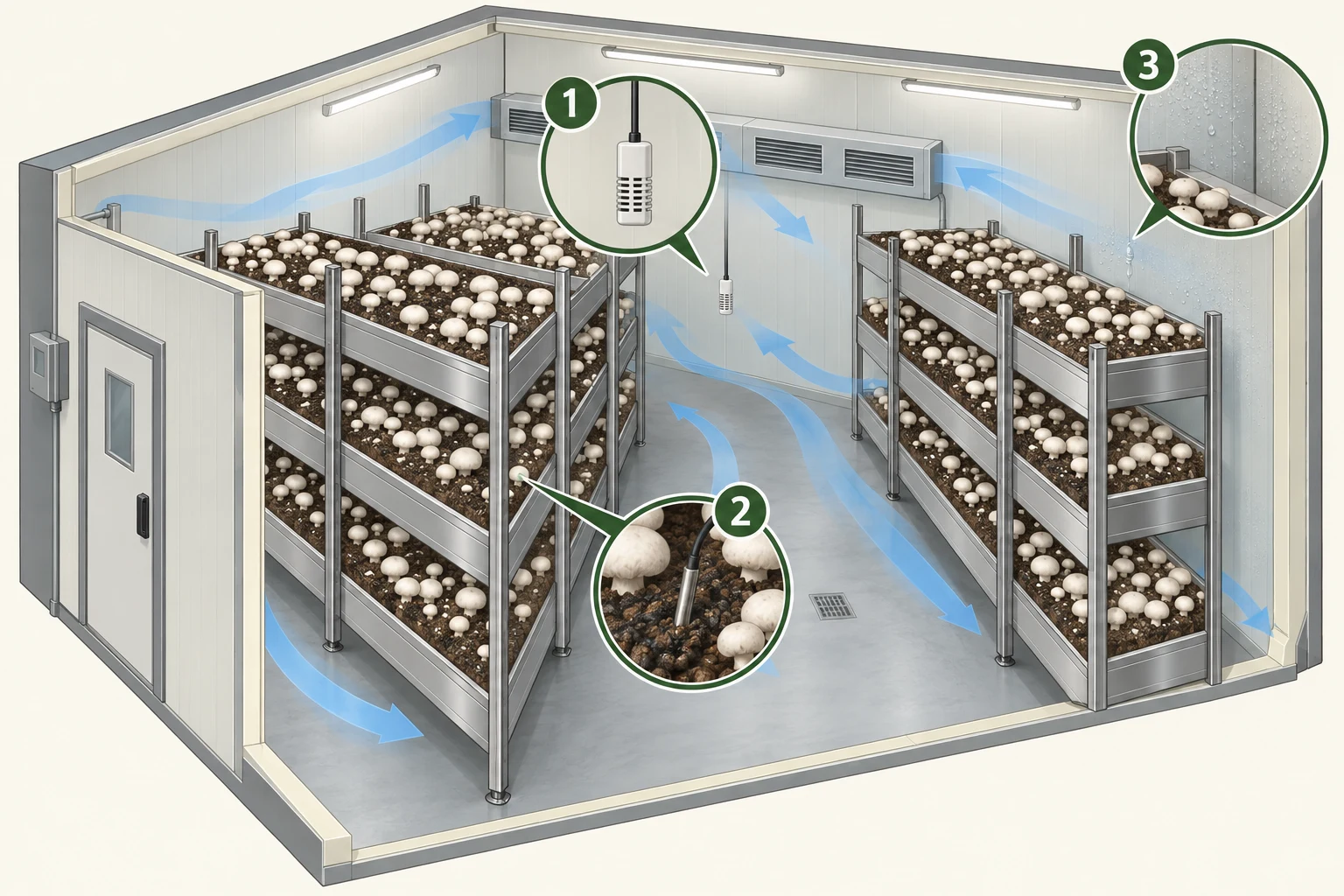
Use time-stamped readings at representative positions. One sensor can miss a rack-level or doorway difference.
Record substrate temperature separately from room air using the farm’s appropriate hygienic measurement procedure.
Map condensation, leaks and wet crop zones. Compare the pattern with watering and temperature changes.
Visible airborne dust or spores during work.
Many illnesses can produce similar symptoms; do not diagnose a person from workplace appearance.
Identify dust-generating tasks and who is exposed.
A visual match is only a starting point. Occupational-health assessment addresses people; microbial crop testing cannot diagnose their illness.
01 · Observe
No verified reusable diagnostic photograph is included for this entry. The illustration above explains observation context, not a confirmed disease specimen. Consult the original source figures where available.
02 · Compare
Disturbance and airflow can carry particles into breathing zones and neighbouring work areas.
03 · Check
What confirmation needs: Occupational-health assessment addresses people; microbial crop testing cannot diagnose their illness.
Use the field record and sampling checklist →04 · Respond
These are investigation and containment steps, not a guaranteed cure. Do not eat, sell or distribute suspect material on the strength of a visual match. Do not culture unknown contaminants or experiment with pesticides in a growing room.
05 · Learn
After intervention, compare new affected units, crop condition and inspection results against the same recorded baseline. A lack of visible growth does not, by itself, verify decontamination or food safety.
Read the stage-by-stage prevention plan →HSE/HDC occupational guidance; not a substitute for local safety requirements or clinical care.
UK Health and Safety Executive / HDC · 2011
Used for: Worker exposure controls and respiratory-risk assessment.
Limit: Agaricus-focused occupational guidance, not diagnosis or treatment of a person.
Competitor moulds
Rapidly spreading orange growth is an operational contamination problem. A history of food use for selected Neurospora strains does not make an unknown colony safe.
Generic substrate-contamination differential; not a confirmed disease report for every crop listed.
Signs, checks & response →Competitor moulds
Green, blue-green or dark growth is not automatically Trichoderma. Neither harmlessness nor toxin production can be established from its colour.
Raw-material, spawn, substrate and storage contamination differential across production systems.
Signs, checks & response →Food & worker safety
Separate when damage started from when someone noticed it. That distinction prevents a storage problem being mislabelled as a growing-room disease.
Harvest, packing, transport and storage; a crop can deteriorate after leaving a healthy room.
Signs, checks & response →